

 Jun 29, 2026


Published by Mottcell | Updated September 6, 2026
Choosing a 10kWh HESS supplier starts with a practical question: do you need a battery for an existing solar inverter, or a complete battery-and-inverter unit? For home energy storage system (HESS) projects, that decision changes the equipment list, integration work and information needed for an accurate quotation.
This guide helps distributors, installers and OEM buyers compare those two routes, estimate the energy their customers need, and prepare a clear purchasing specification. Mottcell lists both a 10kWh-class battery module and a 10kWh-class all-in-one system. The right choice depends on the site's loads, existing equipment and installation requirements.
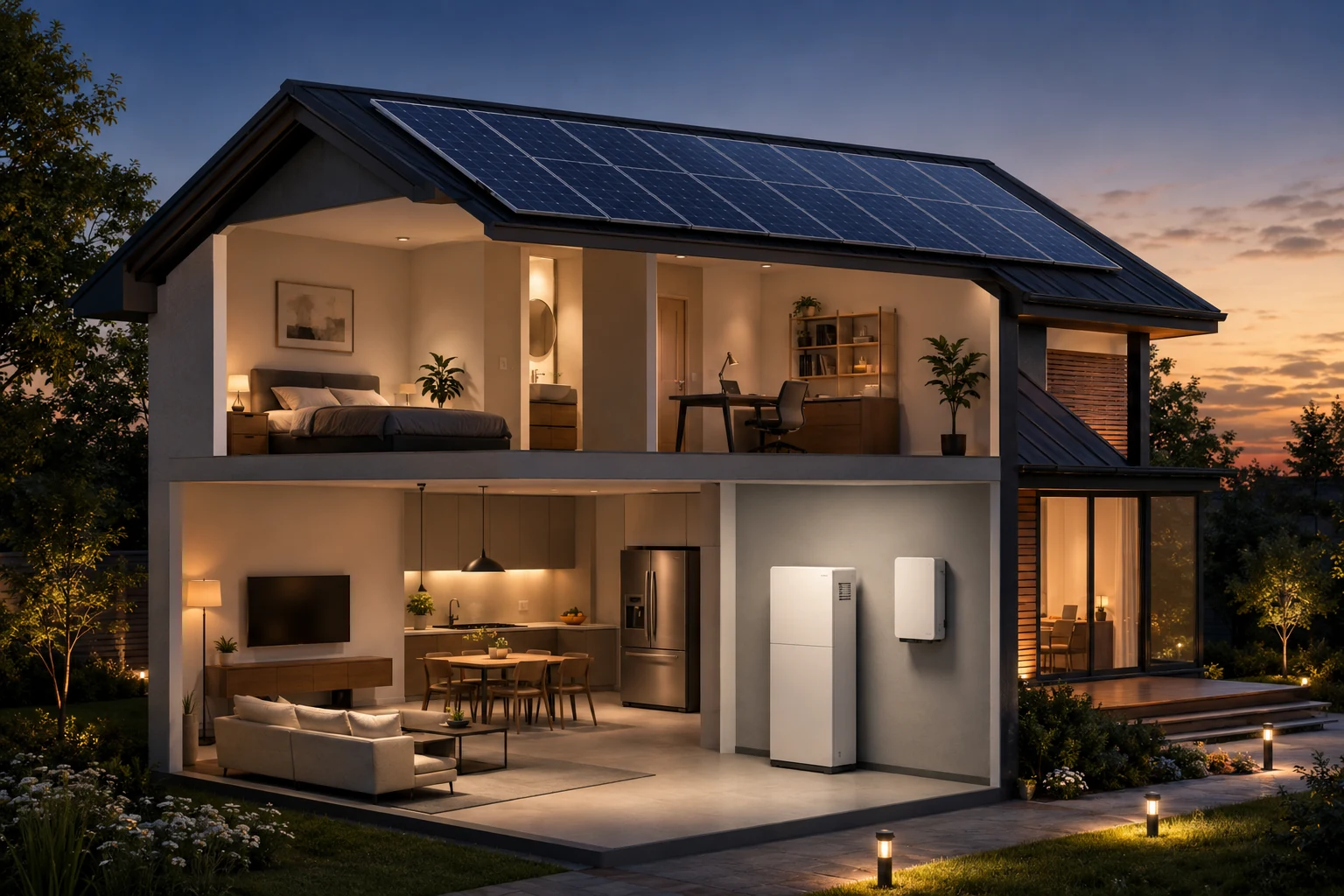
Quick buying rule: define the energy to be delivered, check the highest simultaneous power requirement, choose the equipment architecture, and then request a documented configuration. A useful supplier response should connect these requirements to a specific model and a clearly itemized supply scope.
This is a procurement guide based on Mottcell's published product information and transparent planning calculations. It is not a field-test report or a record of a customer installation. Calculations below use stated assumptions so buyers can replace them with the confirmed values for their own project. Final electrical design and commissioning belong with the qualified installer and the applicable equipment instructions.
In this guide: energy planning, system architecture, compatibility, site review, quotation comparison, sample acceptance, and project inquiry.
A 10kWh label describes an energy capacity class. It does not mean the system can continuously supply 10kW, and it does not guarantee a full day of backup. First decide whether the project is intended to shift daytime solar into evening use, support selected essential circuits during outages, or do both.
For solar self-consumption, review the home's evening consumption and the solar surplus available for charging. For backup, list the essential appliances, their expected operating hours and any loads that may start together. Keeping these two use cases separate makes it easier to avoid buying capacity that the home cannot regularly charge or power that the selected inverter cannot deliver.
Use this simple starting calculation:
Required AC energy (kWh) = average selected load (kW) × operating time (hours).
For example, a selected load averaging 0.8kW for eight hours requires 6.4kWh at the appliances. That is a planning example, not a Mottcell runtime claim. Battery sizing must also account for the permitted discharge window, conversion losses, reserve settings and operating conditions. Starting surge and simultaneous demand require a separate power check.
Separate essential circuits from optional loads. Refrigeration, communications and selected lighting may have a different priority from an electric oven, water heater or vehicle charger. The point is to make the customer's expectations explicit, not to assume that a particular appliance is always small enough to include. Record its measured or documented power and how often it runs.
For equipment that cycles, such as refrigeration, multiplying the maximum input power by the entire backup period can overestimate normal energy consumption. Conversely, using only the average consumption can hide a starting surge that matters to the inverter. Keep an energy column for daily consumption and a power column for the highest simultaneous demand. Obtain measurements or appliance documentation when those values determine the purchase.
Next, define the backup interval. An eight-hour overnight requirement is different from repeated outages with little opportunity to recharge. Check the minimum state of charge at the moment an outage could begin. A battery used aggressively for evening self-consumption may have less energy available for a late-night interruption unless the control strategy maintains a reserve.
For an illustrative 51.2V, 200Ah configuration, nominal energy is 10.24kWh. Assume, only for this example, that 90% of nominal energy is available within the planned discharge window and that 94% reaches the AC loads after conversion. These are chosen calculation inputs, not published performance guarantees for a Mottcell model.
Illustrative delivered AC energy = 10.24 × 0.90 × 0.94 = 8.66kWh.
With a constant 1kW load, that estimate corresponds to approximately 8.7 hours. At 2kW, it becomes approximately 4.3 hours. The same battery label can therefore describe very different backup experiences. Actual operation also depends on temperature, battery condition, settings, standby consumption and whether the equipment can sustain the selected load.
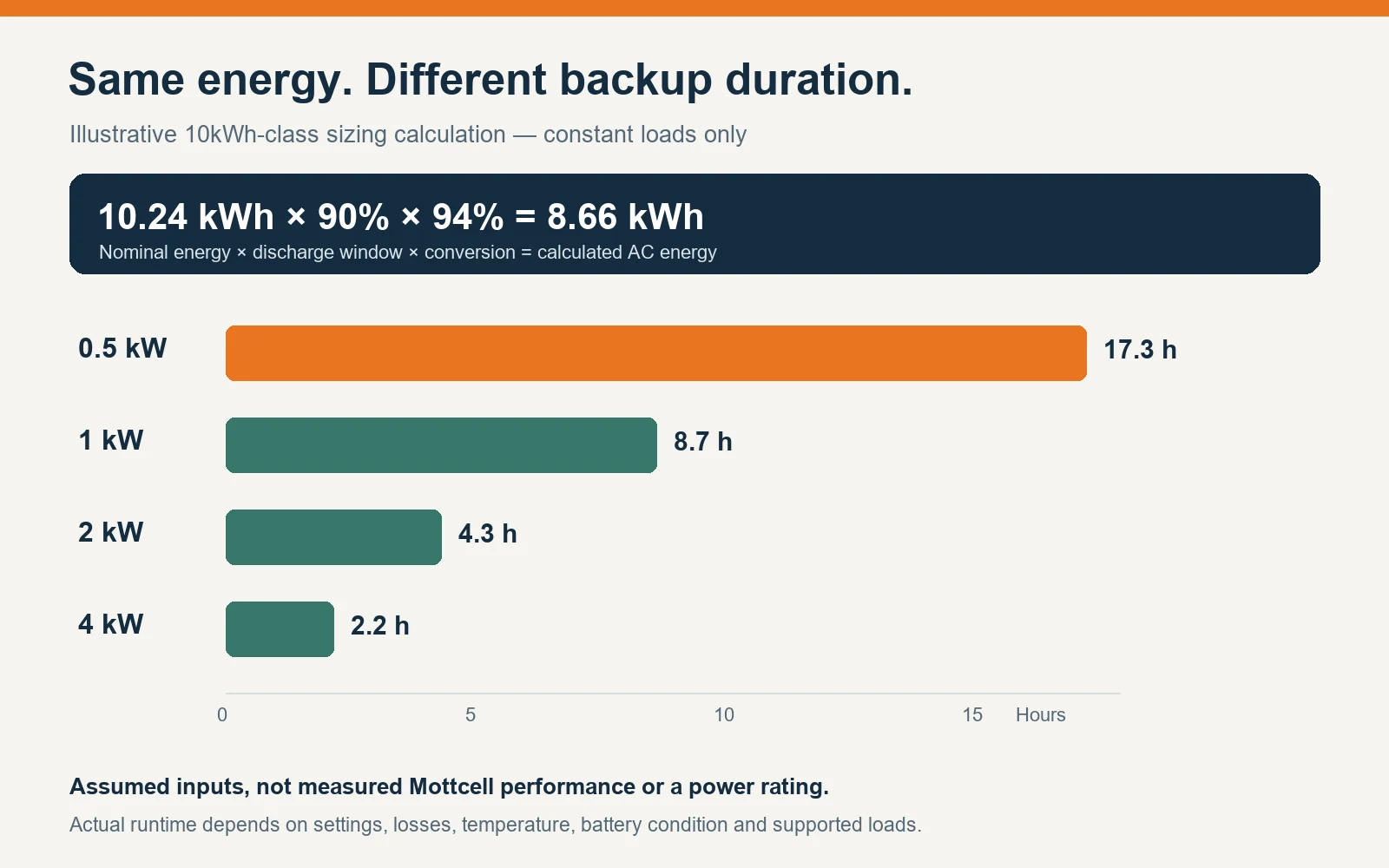
Returning to the earlier 6.4kWh load requirement, the minimum nominal capacity under these same assumptions would be 6.4 / (0.90 × 0.94), or about 7.57kWh. That is an arithmetic threshold before any additional allowance for the project's conditions. It should not be used to promise that a marketed capacity will meet every eight-hour requirement.
Finally, check replenishment. Determine whether the expected solar surplus or permitted grid-charging schedule can restore the planned energy before the next use period. Battery capacity and charging opportunity must work together. Buying a larger enclosure does not create extra solar generation, extend the permitted charging window or increase the inverter's charging limit.
The following comparison uses Mottcell's published product listings as a starting point. Confirm the current specification and supplied components in the quotation before ordering.
| Decision | Battery module | All-in-one system |
|---|---|---|
| Listed model | SMJ10KWh T01 | SMJ 10KWh&5KW T01 |
| Published cell capacity | 200Ah | 200Ah |
| Inverter arrangement | External inverter must be selected and checked | Integrated inverter; listed rated power is 5kW |
| Useful starting point | Projects retaining or separately specifying an inverter | Projects evaluating a combined battery-and-inverter package |
| Main purchasing check | Electrical limits, BMS communication and supported inverter configuration | AC output, PV input limits, backup operation and included installation components |
Review the home energy storage battery range and the all-in-one energy storage systems for the source product tables. An integrated enclosure still requires a site-specific installation assessment; it should not be treated as proof that every connection or operating mode is ready for a particular home.
For a retrofit, start with the installed inverter rather than the preferred cabinet appearance. Establish whether that inverter supports the proposed battery connection and operating mode. If it does not, compare the cost and scope of changing the inverter with other integration routes proposed by the system designer. A battery purchase should follow that assessment, not precede it.
For a new installation, a combined battery-and-inverter package can simplify the equipment comparison, but the quotation still needs a clear boundary. Confirm what is included inside the enclosure and what must be supplied externally. Mounting hardware, metering, protection, communication accessories and commissioning work should be explicit rather than assumed from a product photograph.
Also discuss future expansion before placing the first order. Ask for the documented expansion rules, supported module combinations and any restrictions on mixing production revisions or batteries of different ages. Do not infer that two units can be paralleled simply because their nominal voltage is the same. If expansion is important, include that requirement in the original configuration review.
Ask your supplier to distinguish the marketed capacity class, nominal battery energy and usable energy under the proposed operating settings. If a quotation specifies 51.2V and 200Ah, the arithmetic nominal energy is 51.2 × 200 / 1,000 = 10.24kWh. That calculation alone does not establish usable AC energy or backup duration.
For a battery-only project, provide the inverter's exact model and firmware version. Ask for confirmation of the battery voltage window, continuous and peak current limits, communication protocol, cable pinout and relevant operating settings. A shared connector type or a general description such as “48V inverter” is not sufficient evidence of compatibility. Our 48V-class 200Ah HESS guide covers the battery specification questions in more detail.
For an all-in-one project, check the required AC voltage, phase arrangement, PV string design and intended grid or backup operating mode with the installation team. Ask which loads can be supported during an outage and whether any transfer equipment is included. Do not infer these functions from the capacity label.
Make a compatibility record that names the battery model, inverter model, firmware versions, communication method and agreed operating mode. Ask whether the evidence is a manufacturer compatibility list, a documented integration test or a project-specific assessment. These are different levels of evidence; a general sales statement should not silently replace a test of the proposed combination.
The acceptance discussion should cover normal operation as well as relevant limits. For example, agree how the system reports state of charge, how charge and discharge limits are communicated, and how alarms are presented to the operator. Let the equipment supplier and installer define appropriate checks within the manuals. Do not improvise fault injection, bypass protection or deliberately operate outside electrical limits to test a claim.
Keep continuous power, short-duration surge and energy capacity in separate rows on the specification. A 5kW rating does not describe an unlimited motor-starting capability, and a surge figure without its duration does not establish a continuous rating. Likewise, a battery's allowable current cannot automatically be treated as AC output power without considering the inverter and the full operating voltage range.
Before the order, give the installer photographs or drawings of the proposed location and the dimensions of the access route. Confirm mounting requirements, service clearances and the environmental limits in the selected model's manual. Indoor and outdoor use, humidity, dust, temperature and exposure to water are separate questions; the word “home” does not establish an enclosure's suitability for every location.
Clarify who is responsible for utility coordination, any required project approvals, electrical installation, commissioning and customer handover. Requirements depend on the destination and project, so ask the responsible local professional which documents apply to the actual configuration. A certificate for a cell or another product family should not be presented as approval for the complete system being purchased.
Plan access to operating information as well. Agree who will receive manuals, alarm explanations and support contact details. If remote monitoring is part of the proposal, establish which functions are included, whether connectivity is required, and who administers access after installation. Confirm ongoing service arrangements and any associated charges in the quotation.
The lowest battery price may describe a different delivery scope. Ask each 10kWh HESS supplier to quote against the same equipment list and acceptance requirements so that the comparison remains useful.
| Quotation item | What to clarify |
|---|---|
| Equipment and accessories | Battery, inverter if required, communication cables, mounting parts and any separately supplied protection or transfer equipment |
| Performance basis | Nominal and usable energy, continuous power, allowed operating conditions and the settings used for any runtime estimate |
| Documentation | Model-specific datasheet, manuals, applicable compliance documents and transport documents for the destination and shipment |
| Commercial terms | Sample and order quantities, delivery scope, lead time, payment terms, warranty coverage and support responsibilities |
| Acceptance | Checks for the agreed configuration, inverter communication, supplied accessories, labelling and document completeness |
For repeat orders, keep the approved model revision and configuration with the purchase order. Agree how component or firmware changes will be communicated. This gives the purchasing and installation teams a shared reference when comparing a sample with later deliveries.
For a purchase decision, compare the complete delivered and installed scope rather than the battery headline price alone. Identify which quotation includes the inverter, accessories, shipping, destination charges, installation and commissioning. Then separate recurring costs, such as an optional monitoring service, from the initial equipment cost. A lower initial price may simply omit a necessary part of the project.
If the customer is interested in electricity savings, build the estimate from the actual tariff and intended charging strategy. For solar shifting, consider the value of electricity that could otherwise be exported as well as the retail electricity displaced later. For grid charging, use the charging tariff and conversion losses. Do not count the same stored energy as both solar-shifting savings and a separate full-value backup service.
Use a sensitivity comparison rather than one precise payback promise. Show how the result changes if the system cycles less often, electricity prices differ from the assumption, or usable capacity changes over time. Warranty terms, replacement responsibilities and any operating limits belong alongside the financial assumptions. A 10kWh HESS supplier can quote equipment; the customer's bill and usage pattern determine the project's economics.
Before a bulk purchase, agree what the sample is intended to demonstrate. A visual check can confirm dimensions, labels and supplied accessories, but it cannot establish a cycle-life claim. A short integration check can confirm selected functions under its test conditions, but it should not be generalized into approval for every inverter or operating environment.
Create an acceptance record with the unit identifier, model revision, firmware, approved configuration and document versions. Record the instruments, test conditions and results for any measurements. If the supplier provides a capacity or performance report, check that its conditions and product identification match the equipment being quoted. A graph without those details may be difficult to use when resolving a later discrepancy.
Ask the supplier and qualified installation team to agree a suitable sequence: receipt and accessory checks, document review, installation inspection, supported operating checks and customer handover. The detailed electrical procedure should come from the approved manuals and project professionals. Establish what counts as acceptance, what requires correction and who signs off each stage before shipment or commissioning.
For repeat supply, request an agreed process for notifying changes to cells, BMS hardware, firmware, enclosure design or accessories where those changes affect the approved configuration. Keep a record of which revisions were supplied to each project. Clear change control helps buyers avoid treating a later delivery as identical to the sample without checking.
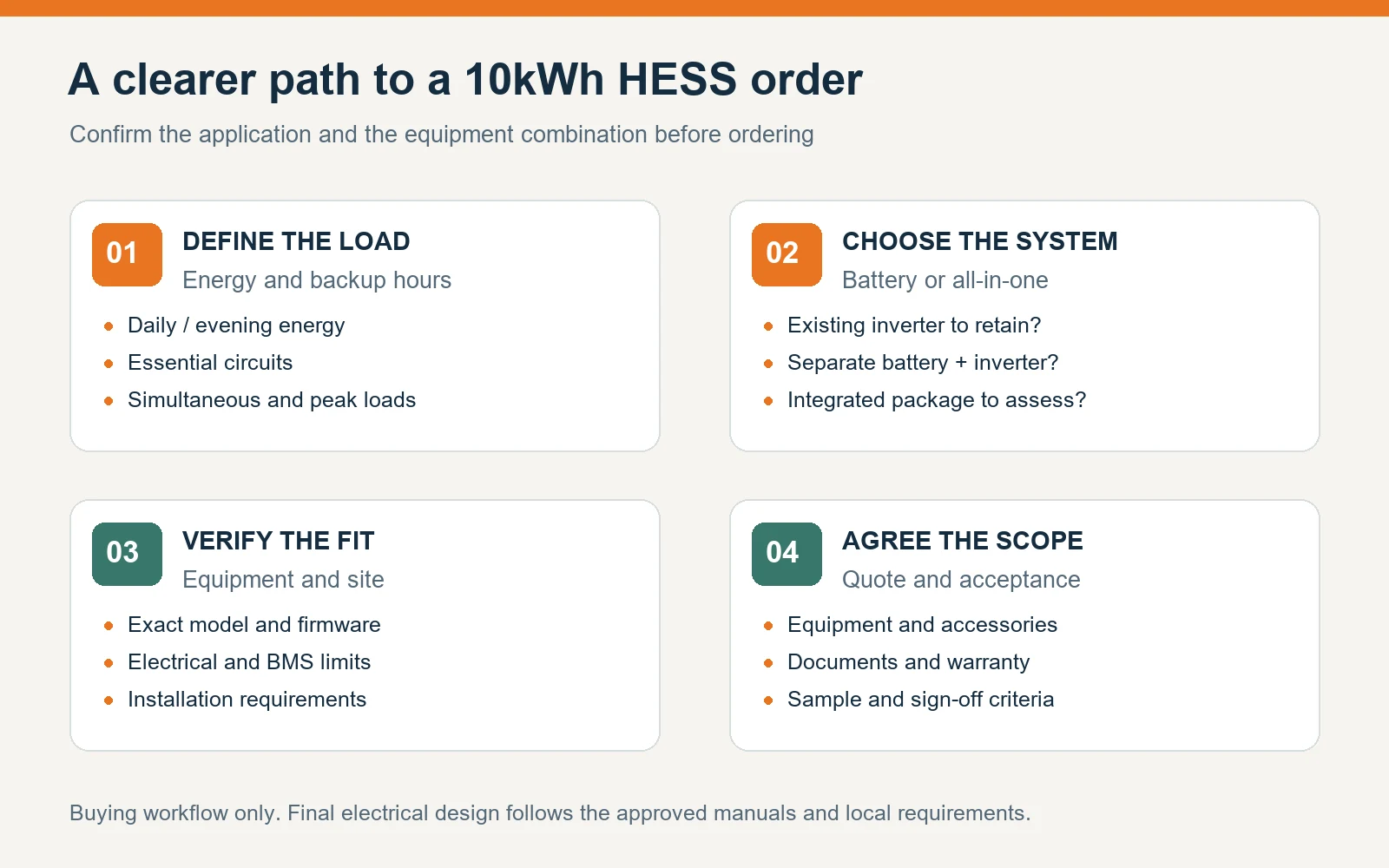
A useful inquiry describes the application before requesting a price. Send Mottcell the following information when discussing a customized 10kWh HESS:
Project and destination: installation country, customer type, solar self-consumption or backup objective, and any project documentation requirements.
Energy and loads: daily or evening consumption, essential loads, desired backup hours, peak demand and motor-starting loads.
Existing equipment: inverter make, model and firmware, PV system details, and the proposed AC supply arrangement.
Installation constraints: available space, indoor or outdoor location, expected temperature range and preferred mounting arrangement.
Order requirements: sample quantity, expected order volume, target delivery date and requested branding, packaging or configuration changes.
Ask which customization requests can be supported for the selected model and whether they affect testing, documentation or delivery. Confirm warranty conditions and model-specific approvals in writing instead of relying on general company claims.
A message such as “send your best price for a 10kWh battery” leaves several decisions unresolved. A stronger brief might say: “We are evaluating a residential solar storage project for the stated destination. Please quote a battery module compatible with the attached inverter details and, separately, an all-in-one alternative. Our selected loads require approximately 6.4kWh over eight hours under the attached usage assumptions.” This is an example inquiry, not a claim about an existing customer.
Follow that brief with the quantity, target schedule, delivery location, requested accessories and document requirements. Ask the supplier to list any assumptions or exclusions rather than filling gaps silently. Where the load information is incomplete, request a preliminary configuration for discussion and mark the unresolved items before treating it as an order specification.
For branding or other OEM requests, separate essential requirements from preferences. State the artwork, packaging, interface or enclosure changes being considered and ask which can be supported for the proposed model. The response should explain any effect on cost, lead time, documentation or acceptance. This makes customization a defined engineering and commercial discussion rather than a broad promise attached to the word “OEM.”
It depends on the selected loads, operating hours and usable energy. Calculate the energy requirement first, then check inverter power and starting surge separately. A capacity label alone cannot establish whole-home backup capability.
Only after checking the exact combination. Give the supplier the inverter model and firmware, and confirm voltage limits, current limits, BMS communication and supported settings before purchase.
Request the proposed model's datasheet, a detailed supply list, applicable documentation, warranty terms and a sample acceptance plan. Confirm any OEM changes and the approved configuration before moving to repeat orders.
Send your load requirements, inverter details, destination and order quantity to request a 10kWh HESS quotation. Specify whether you need a battery module or an all-in-one system so the discussion can begin with the appropriate configuration and documents.
Product references checked September 6, 2026: Mottcell's Energy Storage System product table for SMJ10KWh T01, and All-in-one Energy Storage System product table for SMJ 10KWh&5KW T01. Model references are based on these published listings; request the current approved datasheet and quotation for a purchase.
The energy and runtime examples in this guide are calculations using explicitly stated assumptions. No independent product test, verified installation case or engineering review is represented. Images are identified as a concept illustration or explanatory diagrams. For company background and contact details, see About Mottcell.
12.8V 200Ah Battery Pack Factory: OEM Sourcing Guide
Commercial HESS Supplier: Factory Microgrid Sizing Guide
51.2V HESS Battery Supplier: 100Ah to 314Ah Capacity Guide
12V LiFePO4 Battery Pack Manufacturer: 50Ah-314Ah OEM Guide
16kWh HESS Supplier: 51.2V 314Ah Buyer’s Guide
5kWh HESS Supplier: Indoor Modular Battery Buying Guide
48V 200Ah HESS Supplier: Voltage & Inverter Fit Guide
15kWh HESS Supplier: Capacity & Home Backup Runtime Guide
Established in 2005
In 2009, it was awarded the title of "National High tech Enterprise"
 zoe@mottcell.net
WhatsApp: 8617388790296
Fax: 86-0755-84042963
Skype: live:b0ebaecbb8782516
WeChat: +8613428749632

 VR show
 CN
CN Home >


