

 Aug 11, 2026


A commercial HESS supplier should help a factory convert operating data into a defensible energy storage specification. A useful proposal begins with the loads that must run, the power they draw, the required operating time, the site voltage, and the way the battery will interact with the grid, solar PV, generators, and plant controls. It should not begin with a capacity label chosen in isolation.
This guide is written for plant energy managers, EPC teams, electrical consultants, procurement teams, and equipment distributors comparing commercial and industrial energy storage systems. It explains how to separate power from energy, how to screen Mottcell’s currently published C&I ESS models, what information a supplier needs before quoting, and which assumptions still require project-level engineering review.
The product figures below come from Mottcell’s current micro-scale, small-scale, and mid-to-large-scale C&I ESS pages. Those pages list cabinet and container models from 50.68 kWh to 5,015.9 kWh. Published values are useful for preliminary screening, but the final bill of materials, usable energy, protection scheme, installation method, and compliance package must be confirmed for the target market and the exact configuration.
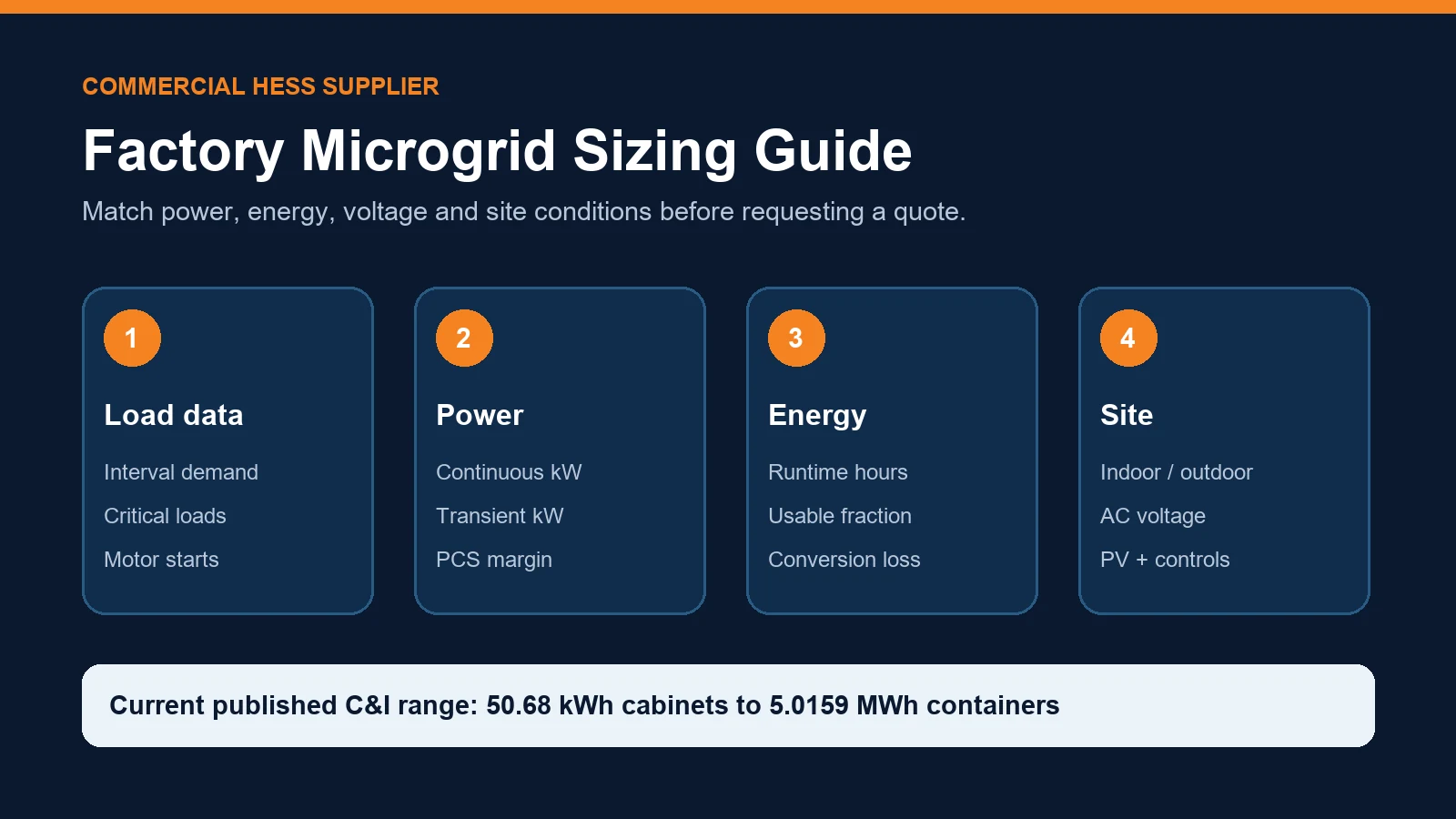
Factories buy energy storage for different reasons, and each reason creates a different sizing problem. A peak-shaving project may discharge for short, predictable tariff intervals. A backup project must carry selected loads through an outage. A solar self-consumption project must absorb midday generation and discharge it later. A power-quality project may focus on fast response and ride-through. A remote microgrid may combine several of these objectives and require coordination with a generator.
Before contacting a commercial HESS supplier, write the primary objective in one sentence. For example: “Keep the packaging line, controls, and emergency ventilation operating for two hours during a grid outage,” or “Limit imported power to 500 kW during the utility demand window.” This statement defines which measurements matter and prevents unrelated loads from inflating the project.
Then list secondary objectives separately. A system can support more than one operating mode, but the modes may compete for the same stored energy. If a battery discharges deeply for tariff savings just before an outage, it may not have the reserve required for backup. The energy management system therefore needs a clear priority order, reserve policy, and operating schedule.
| Project objective | Data needed first | Main screening question |
|---|---|---|
| Peak shaving | Interval demand, tariff window, monthly peak history | How many kW must be removed, and for how long? |
| Outage backup | Critical-load list, sequence, starting current, target runtime | Can the PCS start and sustain every selected load? |
| Solar self-consumption | PV profile, site load profile, export limits | How much surplus energy is available during charging hours? |
| Hybrid microgrid | Grid, PV, generator and load operating states | Who controls transitions, reserves and black-start logic? |
Power and energy answer different questions. Kilowatts describe the rate at which the system can supply or absorb electricity. Kilowatt-hours describe how much energy is stored. A factory can have a moderate daily energy requirement but a high momentary power requirement when compressors, pumps, conveyors, or machine tools start together.
For continuous power, identify the highest simultaneous load the HESS must support under the intended operating mode. Use measured interval data when possible, then reconcile it with the equipment list. If backup covers only a critical bus, do not size from the entire site’s utility bill. If the project targets demand reduction, identify the demand interval used by the tariff and model the period when discharge is required.
For transient power, record motor starting methods, inrush current, duty cycle, and the acceptable voltage dip. A nameplate motor rating alone does not define the transient requirement. Variable-frequency drives, soft starters, direct-on-line starts, transformer energization, and welding loads create different profiles. The supplier or PCS integrator must verify the overload curve and response against those measurements.
For energy, multiply each critical load by its expected operating time and add the results. The delivered-energy requirement then needs adjustment for the usable state-of-charge window, conversion losses, operating reserve, temperature, aging allowance, and any simultaneous charging or auxiliary consumption. These factors should be stated as assumptions rather than hidden inside a rounded capacity label.
Preliminary nominal energy = required delivered energy ÷ (allowed usable fraction × estimated conversion efficiency). This is a screening formula, not a substitute for the supplier’s approved design calculation.
A repeatable workflow makes supplier quotations easier to compare. It also shows where uncertainty remains. The following sequence works for peak shaving, backup, solar integration, and mixed-use factory microgrids.
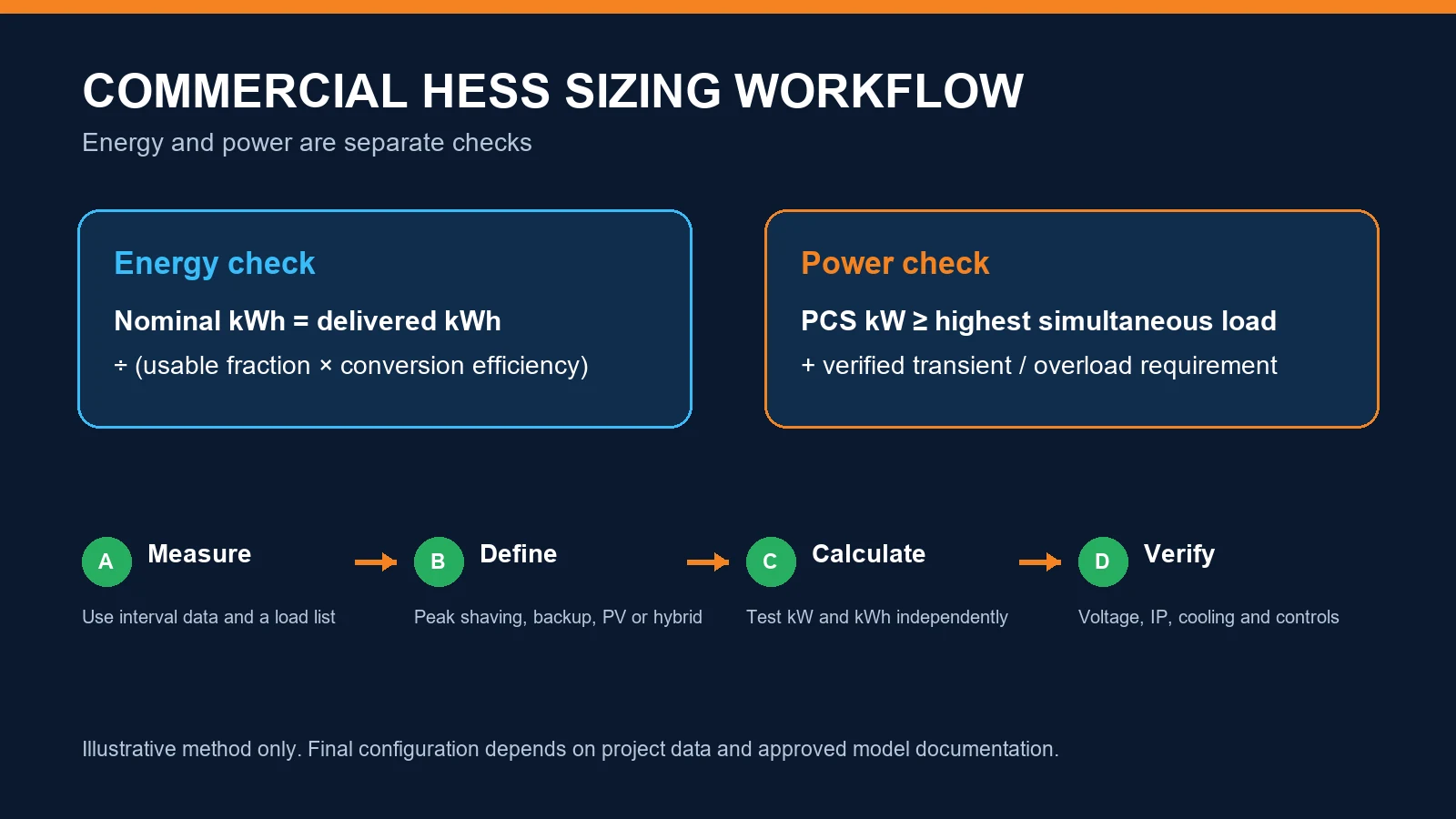
Collect interval data at the point where the system will connect. Fifteen-minute utility data may be sufficient for tariff screening, but short events and motor starts can require higher-resolution logging. Pair the measurements with a load schedule that identifies each item, rated power, measured running power, starting method, operating hours, criticality, and whether it may be shed during an outage.
Check seasonality and production changes. A week with reduced output may understate the design peak. A new production line may make historical bills obsolete. Record the date range, shift pattern, and any unusual shutdowns so the commercial HESS supplier understands the quality of the source data.
Describe normal grid-connected operation, peak-shaving periods, charging windows, islanded operation, generator support, and the transition back to grid power. State whether the site needs seamless transfer or can tolerate an interruption. The answer affects switchgear, controls, PCS selection, and commissioning scope.
Decide which loads remain energized in each state. Emergency lighting and controls may need long runtime but little power. A compressor may need high starting power for a short time. A furnace or thermal process may require a controlled shutdown instead of continuous operation. Treating every load the same usually produces a larger and less economical system.
Suppose a critical bus averages 60 kW and must operate for two hours. The delivered energy is 120 kWh. If the preliminary study assumes an 80% usable fraction and 92% conversion efficiency, the screening result is 120 ÷ (0.80 × 0.92) = 163.0 kWh of nominal energy. These two percentages are project assumptions for the example. They are not published specifications for every Mottcell model.
The same project must pass a separate power check. If normal operation is 60 kW but simultaneous starts create a 120 kW event, a 100 kW PCS may or may not be suitable depending on the verified overload duration and load sequence. The engineering team could reduce the transient through controlled starting, select a higher-power configuration, or divide loads into staged groups. Capacity alone does not answer this question.
Confirm AC voltage and frequency, transformer capacity, short-circuit level, grounding arrangement, available space, floor loading, access path, altitude, temperature, humidity, dust, corrosive exposure, and indoor or outdoor location. The published micro-scale and small-scale Mottcell cabinets list IP20 and air cooling, which points to a protected indoor installation. Do not treat an IP20 cabinet as an outdoor enclosure without a separate approved solution.
The operating plan also affects lifetime and economics. Record expected cycles per day, typical depth of discharge, standby time, charging source, maintenance access, and the required service period. Ask for the cycle-life conditions, warranty terms, auxiliary consumption, and replacement strategy for the offered configuration. Avoid comparing suppliers using a cycle number with no temperature, rate, depth-of-discharge, or end-of-life definition.
Mottcell groups its C&I products into micro-scale, small-scale, and mid-to-large-scale categories. The model tables below reproduce the current nominal energy and rated power values published on those product pages. They provide a starting point for shortlisting; they do not replace a project-specific technical proposal.
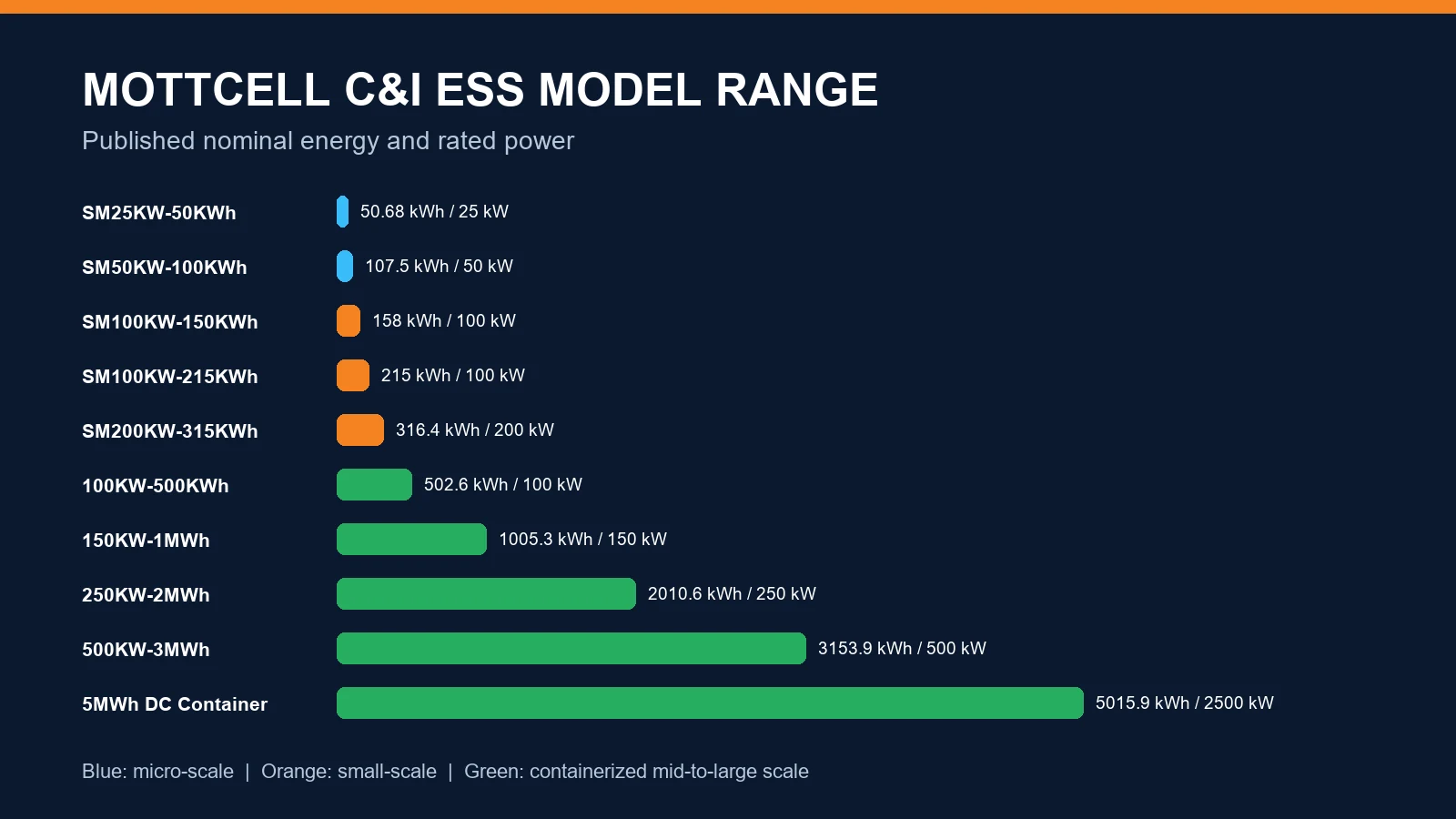
The micro-scale C&I ESS page lists two indoor, air-cooled cabinet models. SM25KW-50KWh is published with 50.68 kWh nominal energy and 25 kW rated power. SM50KW-100KWh is published with 107.5 kWh nominal energy and 50 kW rated power. Both list 400 V three-phase AC input and output, 50/60 Hz, RS485/CAN communication, maximum PV input voltage of 850 V, IP20, altitude up to 2,000 m, a 0°C to 50°C charging range, and a -20°C to 55°C discharging range.
These models can be screened for shops, offices, distributed sites, and smaller factory loads when the power and runtime match. The 25 kW/50.68 kWh model has an energy-to-power ratio of about two hours at nameplate values; the 50 kW/107.5 kWh model is also slightly above two hours. Actual delivered runtime depends on the usable state-of-charge window, conversion efficiency, auxiliary loads, operating conditions, and system controls.
The small-scale C&I ESS page lists three indoor, air-cooled models for factories, buildings, and retail chains. SM100KW-150KWh is published at 158 kWh and 100 kW. SM100KW-215KWh is published at 215 kWh and 100 kW. SM200KW-315KWh is published at 316.4 kWh and 200 kW. The page lists 768 V DC nominal battery voltage, 400 V three-phase AC input and output, 50/60 Hz, RS485/CAN communication, IP20, altitude up to 2,000 m, and maximum PV input voltage of 850 V.
The 100 kW models illustrate why power and energy must be checked separately. The 158 kWh cabinet has less nameplate energy per kW than the 215 kWh cabinet, even though both list the same rated power. A project that requires a longer discharge period may favor more energy, while a project dominated by short peak events may place greater weight on power, control response, and tariff timing.
The mid-to-large-scale ESS page lists containerized configurations for plants, commercial parks, data centers, and grid applications. Published models include 100KW-500KWh at 502.6 kWh, 150KW-1MWh at 1,005.3 kWh, 250KW-2MWh at 2,010.6 kWh, 500KW-3MWh at 3,153.9 kWh, and a 5MWh DC container at 5,015.9 kWh with 2,500 kW DC output.
The first four container models list AC output of 320–460 V and air cooling. The 5 MWh DC container lists liquid cooling and DC output, so it should not be compared as if it were the same turnkey AC product. Balance-of-system scope, PCS, transformer, switchgear, controls, fire protection, civil work, and grid interconnection must be identified in the quotation.
| Published model | Nominal energy | Rated power | Published cooling / form |
|---|---|---|---|
| SM25KW-50KWh | 50.68 kWh | 25 kW | Air-cooled indoor cabinet, IP20 |
| SM50KW-100KWh | 107.5 kWh | 50 kW | Air-cooled indoor cabinet, IP20 |
| SM100KW-150KWh | 158 kWh | 100 kW | Air-cooled indoor cabinet, IP20 |
| SM100KW-215KWh | 215 kWh | 100 kW | Air-cooled indoor cabinet, IP20 |
| SM200KW-315KWh | 316.4 kWh | 200 kW | Air-cooled indoor cabinet, IP20 |
| 100KW-500KWh | 502.6 kWh | 100 kW | Air-cooled container |
| 150KW-1MWh | 1,005.3 kWh | 150 kW | Air-cooled container |
| 250KW-2MWh | 2,010.6 kWh | 250 kW | Air-cooled container |
| 500KW-3MWh | 3,153.9 kWh | 500 kW | Air-cooled container |
| 5MWh DC Container | 5,015.9 kWh | 2,500 kW DC output | Liquid-cooled DC container |
The same energy target can be delivered through different architectures. An indoor cabinet may suit a protected electrical room with controlled access, acceptable ventilation, and a short cable route. A containerized solution may suit a large project with dedicated outdoor space, civil works, and centralized balance-of-system equipment. A custom low-voltage solution can serve specialized applications, but it should not be treated as interchangeable with a high-voltage C&I cabinet.
Voltage affects current, conductor size, conversion equipment, and protection design. It also affects service procedures and the required competence of installers. Do not describe 48 V or 51.2 V equipment as automatically safe to touch, and do not assume a high-voltage cabinet is compatible with a particular PCS solely because the nominal voltage appears similar. The operating voltage range, current limits, communication protocol, pre-charge sequence, contactor logic, and approved compatibility must all be checked.
For PV-coupled projects, compare the PV input range and power on the exact model. Mottcell’s micro-scale and small-scale pages list model-specific maximum PV power and MPPT voltage ranges. The array voltage at the coldest expected temperature, inverter loading, clipping strategy, and local interconnection rules should be reviewed by the system designer.
For on-grid and off-grid operation, define the point of common coupling, anti-islanding requirements, transfer equipment, grid-forming or grid-following behavior, generator coordination, and the loads permitted during islanded operation. These functions involve the PCS, EMS, switchgear, and site protection as a system. A battery cabinet data sheet alone cannot prove that the entire microgrid will perform the required transition.
A credible supplier response should connect each proposed value to a document. Ask for a model-specific data sheet, single-line concept, system boundary, bill of materials, communication list, protection description, operating limits, and applicable test or certification records. If a certification is required, verify that the exact model or relevant component appears in the scope and that the document is valid for the destination market.
Mottcell states that it was established in 2005 and manufactures battery cells, packs, and energy storage systems. Its product pages publish electrical, mechanical, environmental, communication, and certification fields for the listed C&I models. Buyers can use these public values to prepare questions, then request the current controlled documents for the exact configuration through Mottcell’s project inquiry form.
Experience is most useful when it is traceable. Ask the supplier to explain the proposed design against your load profile, identify any unverified assumptions, and define the factory acceptance test. A FAT plan can include visual inspection, communication checks, alarms, charge and discharge operation, emergency-stop behavior, and document review. Site acceptance should then verify installation, protection settings, controls, and operating modes under the actual site conditions.
A vague request such as “Please quote a 200 kWh battery” invites proposals with different boundaries and assumptions. A better RFQ states the project objective, measurement period, required power, required delivered energy or runtime, and the equipment that must be included. It also identifies which items the buyer, EPC, and supplier will provide.
Site and market: country, project address or climate zone, applicable grid code, target commissioning date, and required language.
Electrical system: AC voltage, frequency, phase arrangement, transformer rating, point of connection, available fault data, and grounding arrangement.
Load evidence: interval demand file, critical-load schedule, motor-start details, existing generator data, and planned expansion.
Operating modes: peak shaving, backup, PV charging, export limits, islanding, generator coordination, reserve policy, and control priority.
Performance requirement: continuous kW, transient kW and duration, delivered kWh, target runtime, response requirement, and expected cycles.
Environment: indoor or outdoor, IP requirement, temperature, humidity, altitude, dust or corrosion exposure, floor loading, and access limits.
Integration: PV size and voltage, PCS scope, EMS functions, communication protocols, SCADA points, metering, and remote access rules.
Commercial boundary: Incoterm, delivery destination, installation scope, commissioning, spares, training, warranty, and after-sales response.
Documentation: data sheets, drawings, manuals, certificates, test reports, FAT and SAT plans, packing list, and shipment documents.
Send the same RFQ package to every supplier and require a deviation list. This makes differences visible. One proposal may include PCS and EMS while another covers only the battery. One may quote nominal energy while another emphasizes usable energy. One may include transformer and switchgear while another excludes them. Normalize scope before comparing price per kWh.
A battery can have enough stored energy but insufficient PCS power for the load. It can also have enough continuous power but an unsuitable transient response. Keep the kW and kWh checks separate until both pass.
A low-voltage residential battery module and a three-phase commercial cabinet serve different system architectures. Mottcell’s household energy storage range is useful for residential and smaller low-voltage projects, while the C&I pages list high-voltage cabinets and containers for commercial sites. Classify the project before comparing model names.
The published micro-scale and small-scale cabinets list IP20. If the project is outdoors or exposed to dust, water, salt, chemicals, or extreme temperature, request an approved enclosure and environmental design for those conditions. Do not create an outdoor claim by inference.
A product page may list standards or certifications, but procurement should verify the exact report, certificate holder, product scope, revision, and destination-market requirement. Include this check in technical due diligence.
Price per nominal kWh can hide large differences in PCS, transformer, controls, cooling, fire protection, switchgear, installation, commissioning, documentation, warranty, and shipping. Compare a normalized bill of materials and stated exclusions.
Start by matching the required continuous power and delivered energy to one or more published model families. Then check voltage, indoor or outdoor location, cooling, PV interface, communications, access, and project scope. Mark every missing value as an open item. The shortlist is complete only when it records both the reasons a model fits and the assumptions that still need verification.
For specialized low-voltage or non-standard requirements, review Mottcell’s customized energy storage page and send the same load and site data. A custom request should still define electrical limits, enclosure, controls, protection, testing, and documentation. “Custom” is a design process, not a substitute for specifications.
When you contact Mottcell, attach the interval load file, critical-load list, single-line diagram if available, PV and generator data, site conditions, required operating modes, and target schedule. Ask the response to separate confirmed values, assumptions, options, and exclusions. That structure gives procurement and engineering teams a shared basis for review.
Provide interval demand data, a critical-load schedule, required runtime, continuous and transient power requirements, AC voltage and frequency, PV or generator details, indoor or outdoor conditions, operating modes, communication needs, destination market, and scope of supply. More complete inputs reduce hidden assumptions.
No. A 100 kWh label does not show usable delivered energy, PCS power, transient capability, reserve policy, site voltage, or required runtime. The load profile and operating objective determine whether a model near that capacity is suitable.
Mottcell’s current C&I product pages list indoor cabinet models at 50.68, 107.5, 158, 215, and 316.4 kWh, plus containerized models at 502.6, 1,005.3, 2,010.6, 3,153.9, and 5,015.9 kWh. Confirm current documents and project suitability before procurement.
A useful first review should identify the target operating mode, required kW and kWh, installation environment, integration boundary, and open engineering questions. Submit your project data through the Mottcell contact form and request a model-specific proposal with confirmed specifications, options, and exclusions.
Editorial and technical scope note: This guide uses values currently published on Mottcell product pages and provides a preliminary selection method. Final design, safety, code compliance, performance, and system compatibility require review of the exact model documentation and project conditions.
Commercial HESS Supplier: Factory Microgrid Sizing Guide
51.2V HESS Battery Supplier: 100Ah to 314Ah Capacity Guide
12V LiFePO4 Battery Pack Manufacturer: 50Ah-314Ah OEM Guide
16kWh HESS Supplier: 51.2V 314Ah Buyer’s Guide
5kWh HESS Supplier: Indoor Modular Battery Buying Guide
48V 200Ah HESS Supplier: Voltage & Inverter Fit Guide
15kWh HESS Supplier: Capacity & Home Backup Runtime Guide
10kWh HESS Supplier: Home Solar Storage Buying Guide
Established in 2005
In 2009, it was awarded the title of "National High tech Enterprise"
 zoe@mottcell.net
WhatsApp: 8617388790296
Fax: 86-0755-84042963
Skype: live:b0ebaecbb8782516
WeChat: +8613428749632

 VR show
 CN
CN Home >


