

 Oct 31, 2026


A 12V 300Ah battery pack can be the starting point for a larger energy store, but buying several identical batteries does not automatically create an approved battery bank. Series and parallel arrangements change different electrical properties. They also create different questions for the BMS, charger, protection devices and maintenance team.
For an OEM buyer, the useful question is not simply how to connect the terminals. It is which architecture the exact battery model supports, what happens when one unit disconnects, and which evidence must exist before the design enters production. This guide explains those decisions using transparent calculations and a practical approval checklist.
By Mottcell | October 31, 2026. Calculations below are illustrative design comparisons, not measured performance or approval to interconnect a particular model. Installation and protective-device selection require the approved equipment instructions and a qualified system designer.
Start with the electrical interface of the equipment you are supplying. A 12V auxiliary system may need more operating time while retaining its existing DC loads. A new inverter-based system may benefit from a higher DC voltage. Those are different requirements, even if both projects start with a request for two 300Ah batteries.
Write the required operating-voltage range beside the continuous load, starting load and duty duration. Include chargers, converters and auxiliary equipment. A nominal voltage label is only one point in that range; the equipment must remain suitable throughout the approved charge and discharge cycle. Changing the battery-bank voltage can require changes to the rest of the system.
For model dimensions, published specifications and single-pack runtime estimates, use our 12V 300Ah battery pack buying guide. Here the focus is the additional engineering review needed when a project proposes multiple packs. Keep that review separate from the commercial comparison of individual batteries.
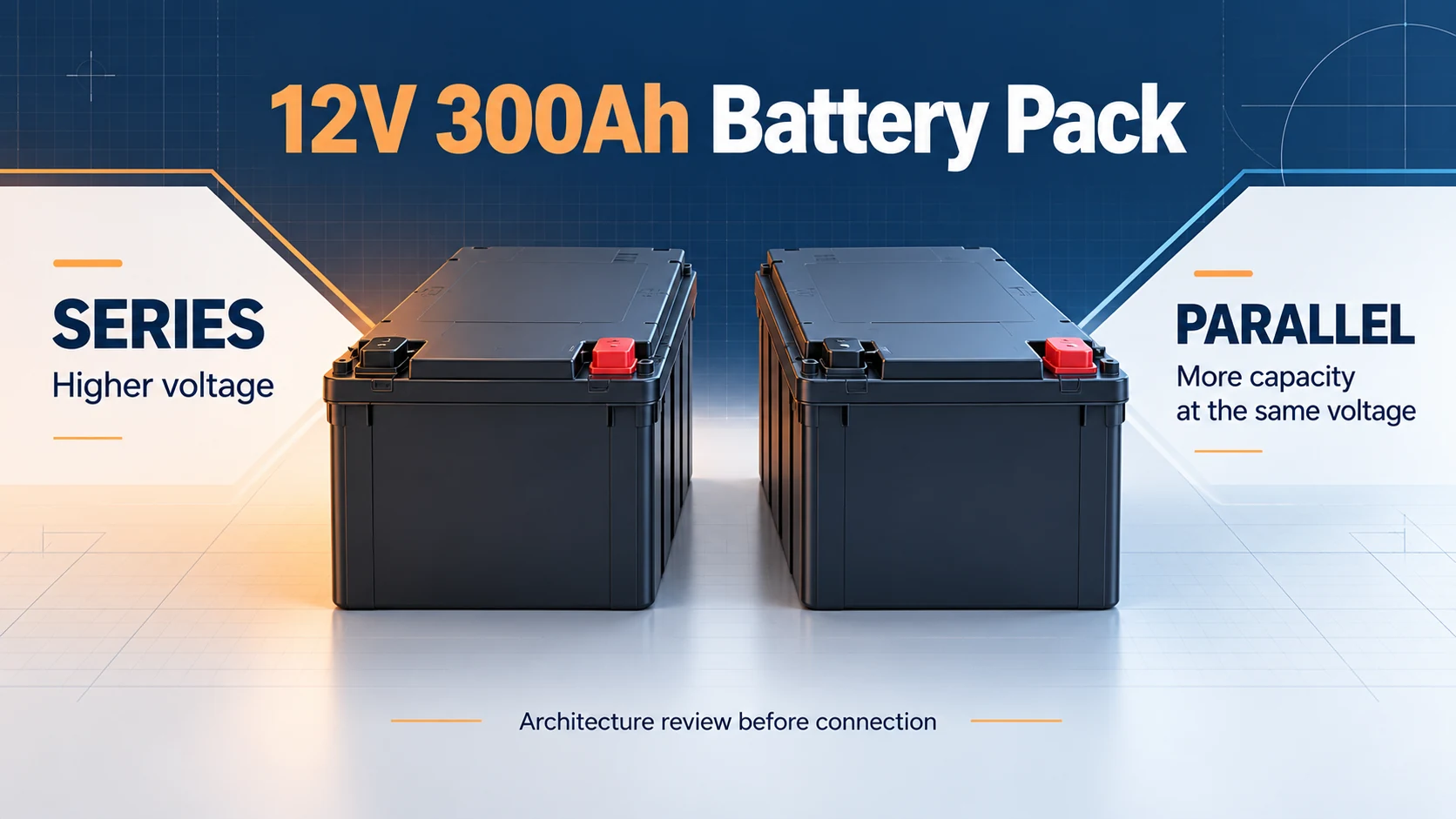
For identical batteries, a series arrangement adds nominal voltages while the nominal ampere-hour capacity remains that of one battery. A parallel arrangement retains nominal voltage while adding ampere-hour capacity. Either arrangement adds the energy of the batteries used. Victron Energy's battery-bank wiring reference explains these general principles; its product-specific installation rules do not establish approval for Mottcell equipment.
Assume each example battery is rated at 12.8V and 300Ah. Its nominal energy is 12.8 × 300 = 3,840Wh, or 3.84kWh. The following arithmetic describes possible architectures only. Every multi-pack row is conditional on written approval for the exact battery configuration.
| Illustrative arrangement | Nominal voltage | Nominal capacity | Calculated nominal energy |
|---|---|---|---|
| One 12.8V, 300Ah pack | 12.8V | 300Ah | 3.84kWh |
| Two identical packs in series | 25.6V | 300Ah | 7.68kWh |
| Two identical packs in parallel | 12.8V | 600Ah | 7.68kWh |
| Two series pairs connected in parallel | 25.6V | 600Ah | 15.36kWh |
Two batteries therefore do not gain more nominal energy merely because the connection changes from parallel to series. What changes is the voltage and current relationship at the load interface. Delivered energy can differ because of equipment efficiency, operating limits and protection behavior, so equal nominal watt-hours do not guarantee equal runtime.
The notation also needs care. A catalog reference to a 4S BMS normally describes the cell groups inside one pack. It is not permission to connect four complete packs in series. An OEM drawing should distinguish internal cell configuration from the number of finished batteries in the bank.
Each finished lithium battery contains a protection architecture with a defined operating envelope. The manufacturer's approval needs to cover the proposed bank voltage, number of units, current duty and recovery behavior. A BMS that operates correctly in a standalone pack is not automatically suitable for every series or parallel arrangement.
In a series string, the same string current passes through each battery. One unit reaching its protection threshold can interrupt the string even when the other units retain energy. Ask what happens to charging and load operation in that event, how the system reports the fault, and what conditions permit a controlled restart.
In a parallel bank, current sharing and the consequences of losing one branch matter. If two branches normally support a load and one disconnects, the remaining branch may face substantially more current. The system specification should state whether operation continues at a reduced load or stops. Extra installed capacity should not be described as redundancy without this review.
Request an approval that identifies the battery model, BMS version, firmware where relevant, permitted configuration and applicable restrictions. A sales statement such as “supports expansion” leaves too much unresolved. It should be possible for an engineer, purchasing colleague and service technician to identify the same approved combination from the document.
An ideal pair of identical parallel batteries sharing a 200A load equally would carry 100A each. Actual sharing depends on more than the printed capacity. Battery condition, state of charge and resistance in each branch affect the result. Connection quality and layout therefore belong in the system review, not just in the installation team's final checklist.
Use a simple planning stress case: if one branch opens while the load remains at 200A, the other branch may be asked to carry approximately the full 200A. That is a scenario to evaluate, not a prediction that the remaining battery will accept it. Its protection may disconnect, or the load controller may reduce demand first.
Define acceptable branch-current imbalance and measurement conditions with the designer before testing. A total bank-current reading can conceal a heavily loaded branch. Record the individual currents during representative charging and discharge duties, particularly near the operating conditions most likely to reveal unequal sharing. Compare results with agreed limits rather than inventing a universal percentage.
The same caution applies to charging. Two approved parallel batteries do not automatically justify doubling every charger's current setting. The permitted total must account for each branch, other simultaneous charging sources and the behavior after a branch is lost. A useful specification covers normal operation and the intended response to a single-unit interruption.
For an illustrative 2,000W AC load and an assumed 90% inverter efficiency, approximate battery current is AC power divided by efficiency and DC voltage. At 12.8V the result is about 174A. At 25.6V it is about 87A. These are nominal-voltage calculations with an assumed efficiency, not approved operating currents for a battery or inverter.
Lower current can ease some aspects of distribution design, but series connection is not a shortcut around equipment compatibility. The inverter input, charger output, DC protection, isolation devices and any converters must all suit the revised voltage range. A 12V appliance cannot simply be treated as a 24V appliance because the larger bank has enough energy.
Compare a purpose-designed higher-voltage pack with an approved bank of smaller packs before fixing the architecture. The first may simplify some interfaces; the second may suit a defined service or mechanical requirement. The decision should include fault behavior, replaceable parts and support responsibilities, rather than battery purchase price alone.
For either option, evaluate the lower-voltage end of the permitted discharge range. Constant-power loads can demand more current as voltage falls. Ask the equipment supplier to provide the relevant continuous and transient requirements so that the designer can check the full operating envelope instead of using only the nominal example above.
The Mottcell Energy Storage Battery catalog lists SMG12300BE and SMG12300PLUS as 300Ah, 3,840Wh models. It shows hardware and optional software BMS entries and different enclosure dimensions. These published fields help identify candidate packs, but the table does not establish approved series or parallel counts for either model.
Accordingly, an inquiry for a 12.8V 300Ah battery pack manufacturer should include the intended bank arrangement explicitly. Ask Mottcell to confirm whether the requested configuration is supported and to supply its current operating limits and drawings. Do not treat a catalog continuous-current figure as a guaranteed rating for a combined battery bank.
If the proposed arrangement is unsupported, revise the architecture or request a suitable engineered pack. Preserve the selected model and configuration in the quotation, sample record and purchase order. This keeps the discussion connected to a deliverable specification instead of an assumption made from photographs or a general product-family description.
A series bank needs a charger appropriate to the approved bank voltage and control scheme. A parallel bank retains its nominal voltage, but total charging capacity and branch behavior still require review. Document the actual charging profile and permitted temperature conditions rather than relying on a charger menu item called “lithium.”
List every source that can charge the bank: solar controller, inverter charger, dedicated AC charger or an appropriately designed vehicle interface. State whether they can operate together and what coordinates their limits. A project can satisfy the limit of each individual charger while still creating an unacceptable combined condition at a battery branch.
Monitoring also needs a defined purpose. A total-voltage display alone does not explain the condition of individual units in a series bank. A total-current display alone does not show current sharing in parallel. Specify which measurements or alarms the operator receives, what action each alarm requires and how service staff retrieve the relevant record.
The Lithium Smart Battery installation manual provides an example of manufacturer-specific requirements for battery preparation, BMS connections, charger settings and commissioning. Use it as context for the questions to ask. Its numerical settings, supported battery counts and component choices must not be transferred to a different manufacturer's pack.
The most useful purchasing document connects each open question to evidence and an owner. The buyer does not need to design the protection circuit, but should know which party approves it and which version of the answer applies. The following checklist can accompany a request for quotation or a sample-order review.
| Approval item | Evidence to request | Decision before production |
|---|---|---|
| Exact pack configuration | Model, BMS and relevant firmware identification | Freeze the approved version |
| Permitted interconnection | Manufacturer's written series/parallel limits | Accept the architecture or redesign |
| Load duty | Continuous demand and transient profile | Agree the operating envelope |
| Branch or string interruption | Documented system response and restart conditions | Define stop or reduced-load behavior |
| Charging sources | Equipment models, profiles and simultaneous-source limits | Confirm coordinated charging |
| Protection and installation | Designer-approved drawings and device specifications | Approve installation scope |
| Monitoring and service | Required measurements, alarms and replacement process | Assign support responsibility |
| Sample verification | Test conditions, acceptance criteria and report format | Authorize the production reference |
Keep unresolved items visible in the quotation. “To be confirmed” is useful when it has an owner and deadline; it becomes a problem when it disappears between sampling and purchase. Separate the battery supply scope from installation engineering so that neither party assumes the other has checked a critical interface.
Also define the change-control process. A later substitute BMS, connector or firmware revision may require another interface review. The order should state which changes need approval and how an approved sample relates to future deliveries. This is particularly important when the same product name covers multiple customization options.
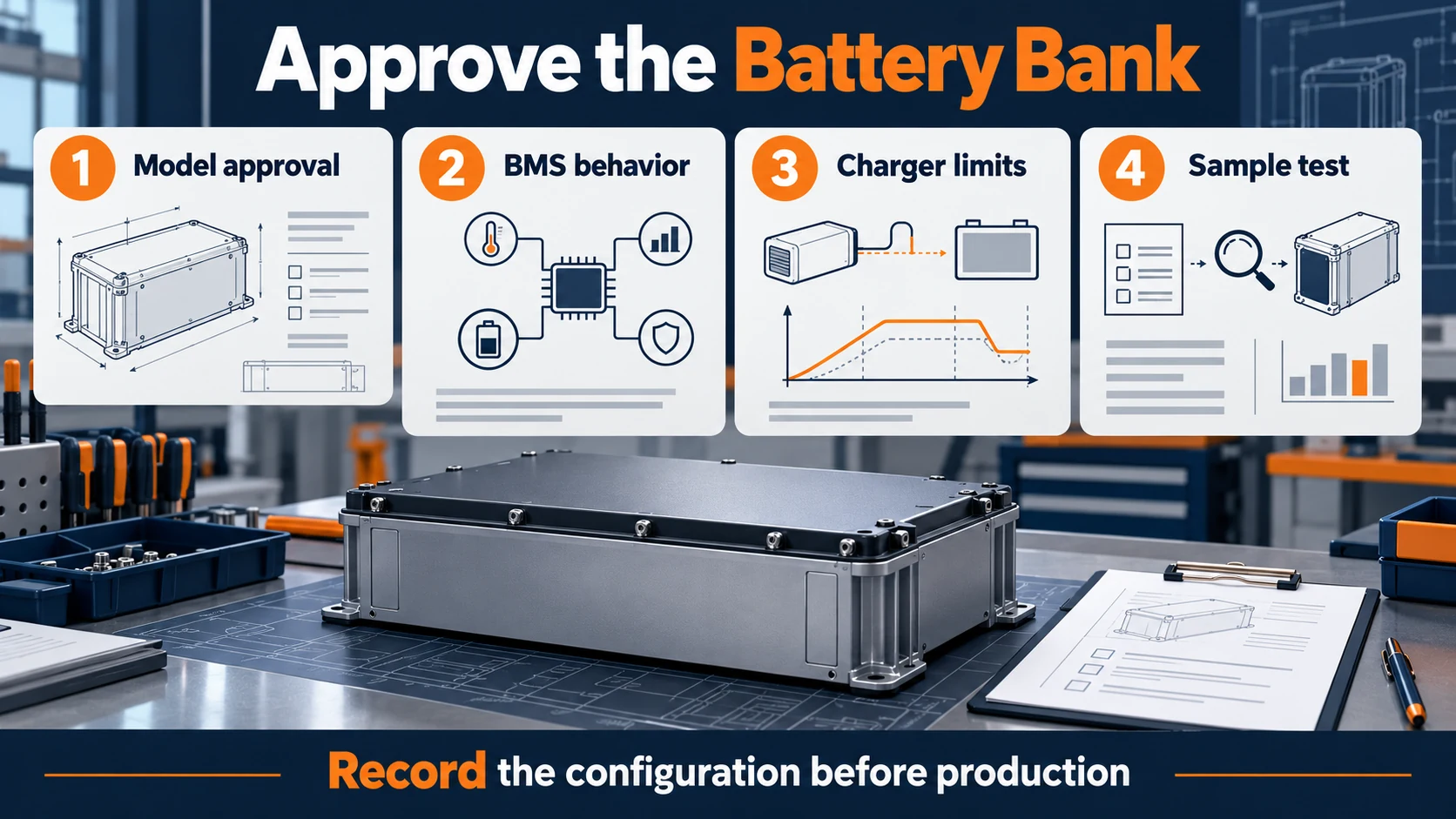
Begin with document review and identification checks before energizing the pilot assembly. Confirm that the delivered models, drawings and configuration match the agreed scope. Have the responsible engineer approve the test method, protective arrangements and measurement equipment. A successful standalone capacity check cannot establish that the complete bank handles the intended load correctly.
Run representative normal-duty tests at the agreed conditions and record the measurements that matter to the architecture. For parallel operation, that includes branch currents. For series operation, it includes the individual-unit observations required by the approved design. Record temperature and starting state because an unexplained starting condition makes a later comparison difficult.
Protection and restart behavior require a controlled, manufacturer-approved verification method. Do not improvise a fault by shorting terminals, bypassing protection or disconnecting a live battery under load. Ask the supplier and system designer to define a suitable simulation or test procedure, including who may perform it and what constitutes a pass.
Make the report useful for repeat orders. Record model identifiers, revisions, equipment settings, test conditions, results and unresolved deviations. Include the agreed response to an interrupted branch or string. A report that states only “battery bank works” does not tell the production team which configuration and duty have actually been accepted.
Future expansion is a separate design requirement, not an automatic benefit of using several packs. Tell the supplier whether the customer expects to add capacity later and under what conditions. Ask for the permitted matching criteria, preparation procedure and inspection requirements. Differences in age, condition or configuration can make an apparently identical replacement unsuitable.
Avoid mixing 280Ah, 300Ah and 314Ah models merely because they belong to the same voltage class. Their appearance and nominal voltage do not establish an approved combined system. If capacity selection itself is still open, compare the 12V 314Ah battery option as a separate candidate before approving a bank configuration.
Agree how replacement units are identified and obtained. Specify whether the service team needs configuration records, a matching revision or supplier review before replacement. Include access, isolation and return-to-service requirements in the handover package. These details help an OEM deliver a maintainable system rather than leaving the end customer to interpret a generic battery label.
Only when the exact batteries and BMS configuration are approved for that arrangement. Two identical 12.8V, 300Ah units would mathematically form a 25.6V, 300Ah bank with 7.68kWh nominal energy. That arithmetic does not establish compatibility. Obtain the manufacturer's written limits and confirm that the connected equipment, charging and protection design suit the bank.
It adds nominal capacity to 600Ah for two identical, approved batteries at the same voltage. Permitted output current is a separate system limit. Current sharing, branch protection, temperature and behavior after one battery disconnects must be evaluated. Use the approved bank rating rather than automatically adding the headline BMS current figures.
Send the application, required voltage range, load duty, runtime target, proposed battery count, charger and inverter models, installation constraints and monitoring needs. Include the intended response to a battery interruption and any future expansion requirement. Ask for a model-specific configuration review, drawings and sample acceptance plan before approving the production order.
The correct series or parallel choice follows the system requirement and the manufacturer's approval. Use voltage, ampere-hours and watt-hours to compare architectures, then verify BMS behavior, charging, monitoring and serviceability for the exact combination. Those decisions are more useful than treating a larger nominal capacity as proof of a stronger system.
Mottcell's 12V battery pack manufacturing overview provides context for discussing an OEM supply requirement. To move a defined project forward, send your load profile and proposed configuration to Mottcell. Request confirmation of a supported design and its documentation before ordering a multi-pack sample.
12V 300Ah Battery Pack: Series vs Parallel OEM Guide
12V 50Ah LiFePO4 Battery Pack: Size, Runtime & OEM Guide
22650 LiFePO4 Battery Manufacturer: OEM Buying Guide
36V Battery Pack for E-Bikes and AGVs: OEM Buying Guide
12V 100Ah Battery Pack: Compare 3 Models for OEM Buyers
12V 280Ah Battery Pack: Solar Runtime & OEM Buying Guide
18650 Battery Manufacturer: Cell Specs & OEM Checklist
12V 300Ah Battery Pack: Runtime, BMS and OEM Buying Guide
Established in 2005
In 2009, it was awarded the title of "National High tech Enterprise"
 zoe@mottcell.net
WhatsApp: 8617388790296
Fax: 86-0755-84042963
Skype: live:b0ebaecbb8782516
WeChat: +8613428749632

 VR show

 CN
 Home >


