

 Jun 10, 2026


A 12V 300Ah battery pack gives an OEM buyer two separate questions to answer: how much energy can the system use, and how much current must the battery deliver? A LiFePO4 pack specified at 12.8V and 300Ah has 3.84kWh of nominal energy. Its continuous output, charging limits and usable runtime still depend on the selected pack, connected equipment and operating conditions. Capacity alone does not establish inverter compatibility.
For buyers comparing a 12.8V 300Ah battery pack manufacturer or factory, this guide connects those questions to a practical purchasing decision. It compares two published Mottcell enclosure options, shows transparent runtime calculations, and explains what to confirm before approving an OEM sample. The goal is a quotation tied to a defined application, followed by a repeatable acceptance process.
By Mottcell. Updated October 15, 2026. Model information below comes from the linked public product table checked on that date. Calculations are planning examples with stated assumptions, rather than measured performance or a completed customer project.
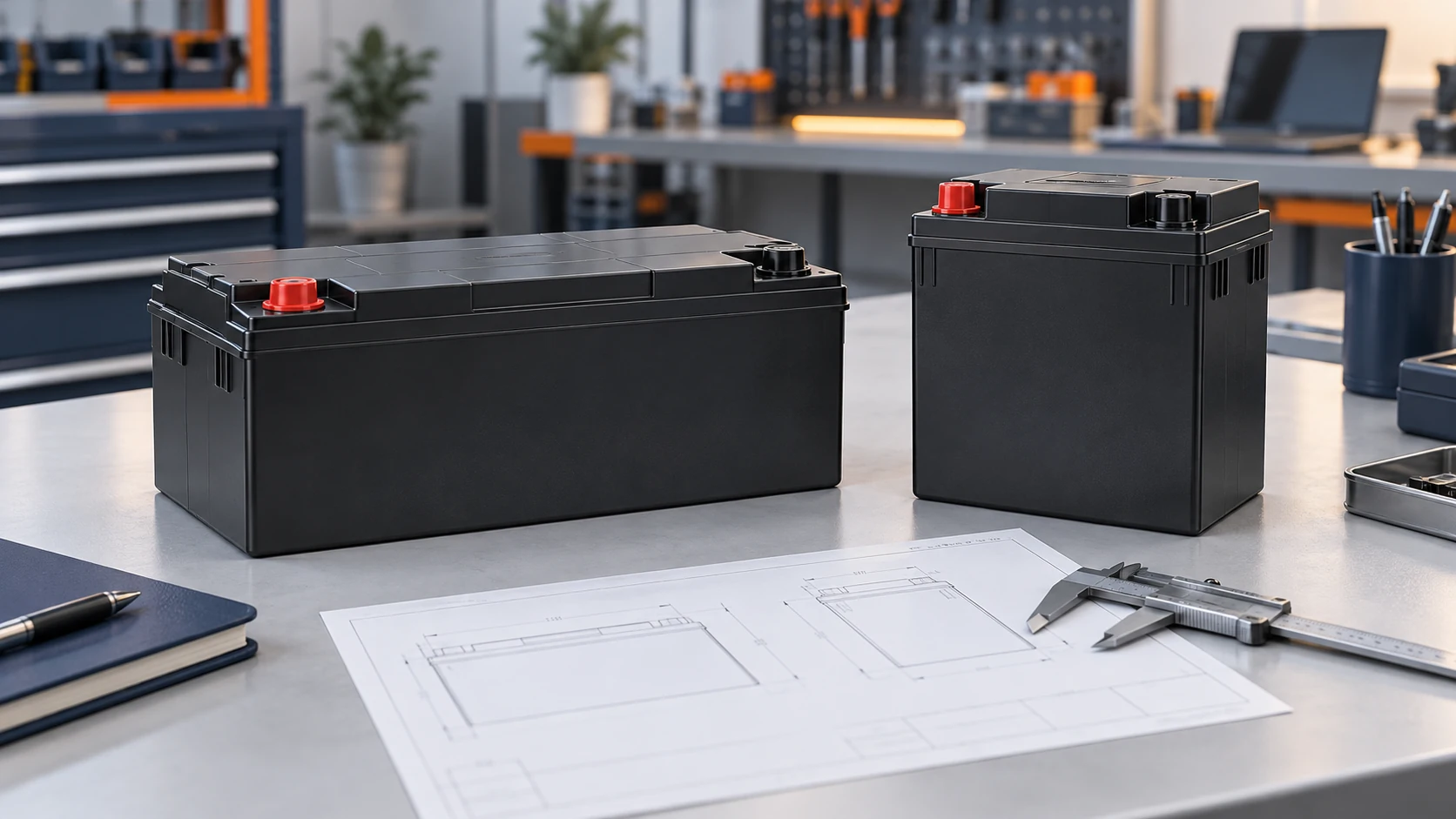
Write down the application before choosing the battery. A small solar backup unit, a mobile service station and an auxiliary power compartment can all use a 12V-class battery, but their load patterns and installation constraints differ. Record which loads operate together, their average demand, their starting demand and the time they must run without charging. Include standby electronics that remain powered between work periods.
For an existing system, identify the inverter, charger, solar controller and any DC equipment by model number. Their acceptable input ranges matter throughout charging and discharge. A battery label that says 12V is insufficient evidence that every connected device will work correctly. The equipment manual and agreed battery voltage limits must overlap under the expected operating conditions.
Decide whether the project actually needs a 12V architecture. Keeping an existing 12V distribution system may simplify a replacement project. A new design with sustained high power may deserve a comparison with a higher-voltage platform because the same power requires less current as voltage rises. That comparison belongs at system design stage, before cable routes, protective devices and battery compartments become fixed.
If the required capacity is still uncertain, use the 12V LiFePO4 battery capacity guide to frame the alternatives. Choose 300Ah because it fits the energy and mechanical requirements, and then check its power capability separately.
The nominal energy calculation is straightforward: 12.8V multiplied by 300Ah equals 3,840Wh, or 3.84kWh. Using the shorthand 12V instead produces 3,600Wh. Neither calculation should silently replace the nominal voltage printed in the selected model specification. Ask the supplier to state voltage, capacity and energy together so competing quotations use the same basis.
Nominal energy describes the battery rating. Usable energy describes what the application can draw within its approved operating limits. Discharge settings, reserve requirements, temperature, aging and conversion losses can change the useful result. A 3.84kWh label does not promise 3.84kWh at an AC socket, and it does not guarantee that a particular load will remain powered until that amount has been delivered.
Ampere-hours also need measurement conditions. Ask how rated capacity is checked, including starting state, discharge current, temperature, cutoff and the measurement method. Two suppliers can quote the same capacity while using different test conditions. An acceptance document makes that difference visible and gives the purchasing team a repeatable way to compare samples and later deliveries.
Keep energy, power and current as separate lines in the project brief. Energy is expressed in Wh or kWh, power in W or kW, and current in A. A 300Ah battery is not automatically a 300A battery. Any current claim needs a model-specific limit, a duration where relevant, and the conditions under which it applies.
The Mottcell Energy Storage Battery product table lists SMG12300BE and SMG12300PLUS as 300Ah, 3,840Wh options with different enclosure dimensions. The following is a limited comparison of published catalog fields. Request the current drawing and controlled specification for the exact configuration before using either option in a production design.
| Published field | SMG12300BE | SMG12300PLUS |
|---|---|---|
| Capacity | 300Ah | 300Ah |
| Nominal energy | 3,840Wh | 3,840Wh |
| BMS options shown | 4S hardware / 4S software | 4S hardware / 4S software |
| Maximum continuous operating current | 300A | 300A |
| Housing material | ABS | ABS |
| Dimensions, L × W × H | 522 × 238 × 221mm | 382 × 193 × 250mm |
Source: the public product table checked October 15, 2026. These entries establish a starting point for discussion. They do not establish an ingress rating, low-temperature heating function, communications protocol, terminal arrangement or approval for series and parallel operation. Those items require confirmation for the quoted version.
The mechanical difference can decide which model is practical even when nominal capacity is identical. The PLUS entry is shorter in length and taller in height. The BE entry has a longer footprint and lower listed height. Neither description tells you whether a terminal cover, lifting space or cable bend will fit. An installation envelope must include those additional clearances.
Do not assume that selecting the software BMS option also selects Bluetooth, CAN or a particular inverter protocol. Ask for the actual functions, interfaces and settings in the quotation. Record the complete model identifier and relevant revisions, so a sample approved with one configuration does not become an ambiguous reference for a later order.
For a simple AC planning example, assume 3,840Wh nominal battery energy, an 80% usable-energy allowance and 90% inverter efficiency. The illustrative energy available to a steady AC load is 3,840 × 0.80 × 0.90 = 2,764.8Wh. Divide that result by average load power to estimate runtime. Both percentages are assumptions for this example, rather than Mottcell specifications.
| Constant AC load used in the example | Calculated runtime | How to interpret it |
|---|---|---|
| 100W | 27.65 hours | Low-load inverter overhead can materially change the result |
| 300W | 9.22 hours | Check whether all loads really average 300W over the period |
| 600W | 4.61 hours | Verify continuous current and operating temperature |
| 1,000W | 2.76 hours | Check cable losses and low-voltage operation |
| 2,000W | 1.38 hours | Starting demand and the full DC circuit need separate review |
These values are energy estimates, not approval to connect those loads. The simplified calculation omits changing efficiency, standby demand, wiring losses and any additional derating. A low-power inverter may use a meaningful share of the available energy itself. A system operating near a protection threshold may stop earlier even while some stored energy remains.
For cycling equipment, measure or estimate energy across a representative duty period. A refrigerator or pump does not necessarily draw its label power continuously. A heater may operate for long intervals at full demand. Combining those behaviors into one unexamined average can produce a runtime estimate that looks precise but is unsuitable for planning.
For a direct DC load, use the equipment input requirements and a suitable energy budget rather than applying an arbitrary inverter efficiency. If a DC converter is present, include its losses. Define the required remaining reserve at the end of the test, so a successful demonstration means the system can still meet the intended operating policy.
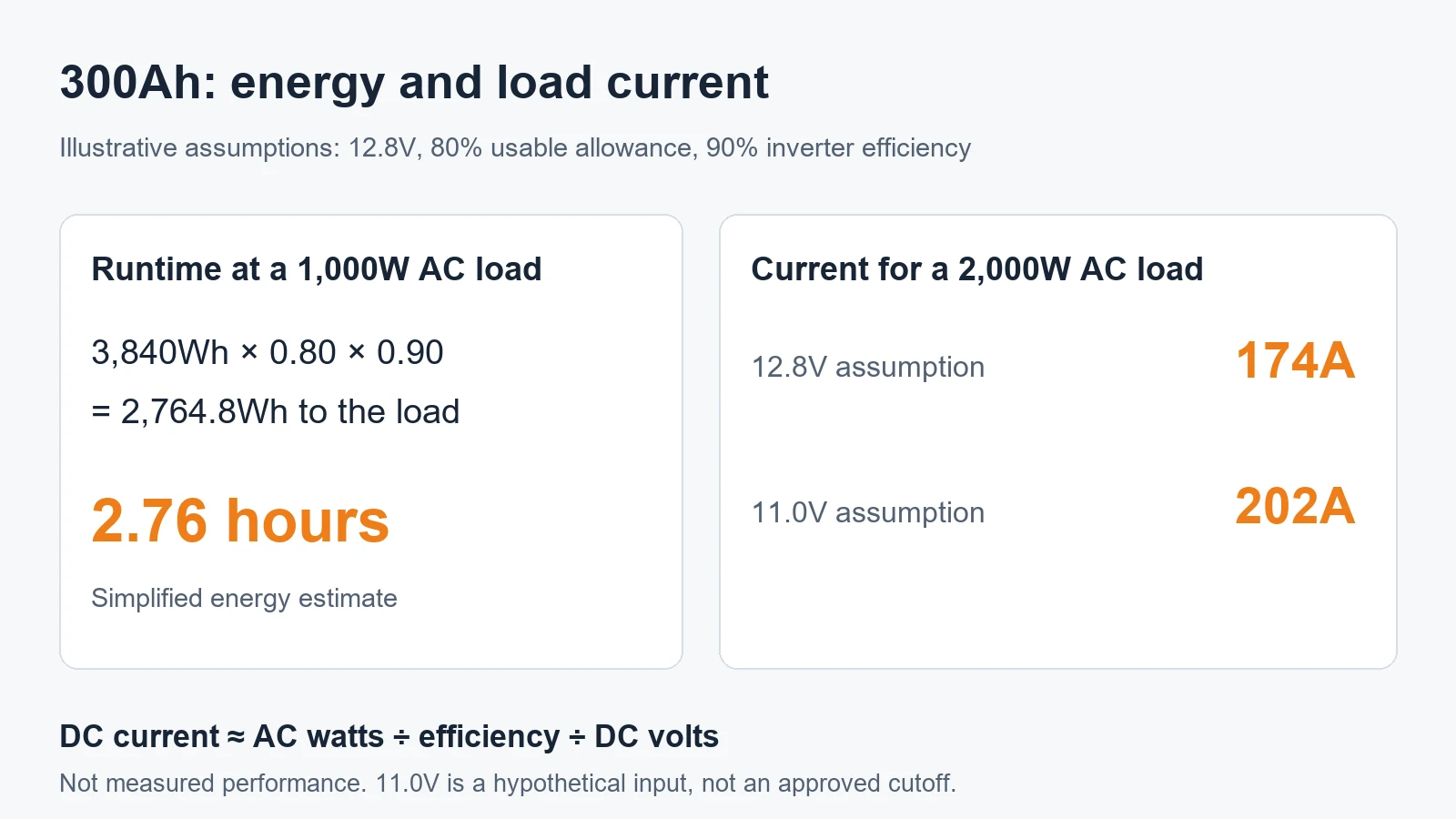
An approximate inverter input calculation is DC current = AC power divided by inverter efficiency and battery voltage. At an assumed 90% efficiency, a 2,000W AC load requires about 174A at 12.8V. At a hypothetical 11.0V battery input it requires about 202A. The 11.0V example is a calculation input, not a recommended cutoff or an approved operating limit for either catalog model.
This illustrates why checking current only at nominal voltage can miss a difficult part of the duty cycle. Constant-power equipment can demand more current as battery voltage falls. Starting loads may add a separate short-duration requirement. Provide the inverter continuous rating, surge profile and expected simultaneous loads so the pack and equipment limits can be assessed together.
A catalog continuous-current figure describes one component of that assessment. The complete circuit also includes terminals, connectors, cables, isolation devices and protective devices. Their ratings and installation conditions must support the approved duty. Operating temperature, cable routing and enclosure conditions can affect the result. The lowest applicable limit controls the system operating envelope.
For general background, Victron Energy's Wiring Unlimited DC wiring guidance explains cable selection, voltage drop and fuse ratings. It is an external engineering reference, not evidence that a Mottcell model is approved for a Victron inverter. Final protective-device and wiring choices should follow the equipment instructions and applicable installation requirements.
Ask the supplier for the approved charge voltage, charge-current range, temperature conditions and any required control behavior for the exact battery version. Then compare those requirements with every charging source. An inverter charger, an AC charger, a solar controller and an alternator interface can all feed the same system, making their combined operation relevant.
A charger setting named lithium does not identify a complete matching profile. Record the actual voltage settings, charge stages, restart behavior and relevant firmware. Confirm whether any equalization or other lead-acid routines must be disabled. Use the battery and charger documentation together, rather than transferring settings from another brand or a different capacity.
For planning, replacing 240Ah with a constant 60A input takes an ideal four hours. That arithmetic excludes tapering, losses, concurrent loads and control interruptions. Actual charging can take longer, and the selected battery may have a different approved current. In a solar system, available sunlight and controller output vary, so use a daily energy budget as well as a peak charger rating.
Low-temperature charging needs explicit review when the project will operate in cold conditions. Ask for the permitted charging window, how protection is implemented, and whether a heating option is actually included. Do not assume an outdoor enclosure, a software BMS or an application name implies a heating function. Capture the agreed behavior in the sample test plan.
Create a compartment drawing that includes battery support, retention, terminal orientation, connection clearances and access for inspection. Compare it with the current model drawing rather than a web photograph. A change in case height can move the terminal into a restricted space. A shorter enclosure can still be unsuitable if its connector or cable exit conflicts with the installation.
Request the model weight and handling instructions rather than estimating them from capacity. Define how the pack will be secured and the conditions it will encounter in service. If the application involves movement, vibration or exposure, ask which corresponding validation applies to the delivered configuration. A general factory photograph cannot demonstrate that a particular battery has passed those tests.
Record any required ingress protection, corrosion resistance and temperature limits as project requirements. Ask for supporting evidence where those properties are essential. An ABS housing entry describes material, rather than a waterproof rating. Likewise, a sealed-looking case does not establish the suitability of terminals and connectors for the intended environment.
If the project requires multiple batteries, obtain written confirmation of the permitted arrangement and supporting instructions. Series connection changes system voltage. Parallel connection changes current sharing and protection requirements. Approval for one model or BMS version should not be generalized to another. Where a new design needs a higher-voltage solar platform, compare a dedicated 48V-class HESS selection approach before assuming several 12V packs are the preferred architecture.
At the same 12.8V nominal voltage, 200Ah corresponds to 2.56kWh, 300Ah to 3.84kWh, and 314Ah to 4.0192kWh. These are nominal-energy calculations. The increase from 300Ah to 314Ah is approximately 4.7%, so a small capacity change should not replace a review of fit, current capability and operating conditions.
The 12.8V 200Ah OEM sourcing guide is useful when the energy budget supports a smaller pack. The 12V 314Ah battery pack buying guide covers the adjacent capacity request. Keep each option tied to an actual quoted specification, since enclosure size and BMS configuration do not necessarily scale in proportion to ampere-hours.
A sensible purchasing comparison uses the same required duty and reserve for every option. Include mounting changes, charging changes, freight, inspection and service access in the scope. A lower unit price may require a different installation, while a larger capacity may add little value if the system cannot charge it within the available period.
For a custom project outside those catalog choices, use the 12V LiFePO4 battery pack manufacturing guide to prepare the design inputs. Treat custom dimensions, labels, interfaces and protective settings as items to review, rather than assuming that every requested combination is already qualified.
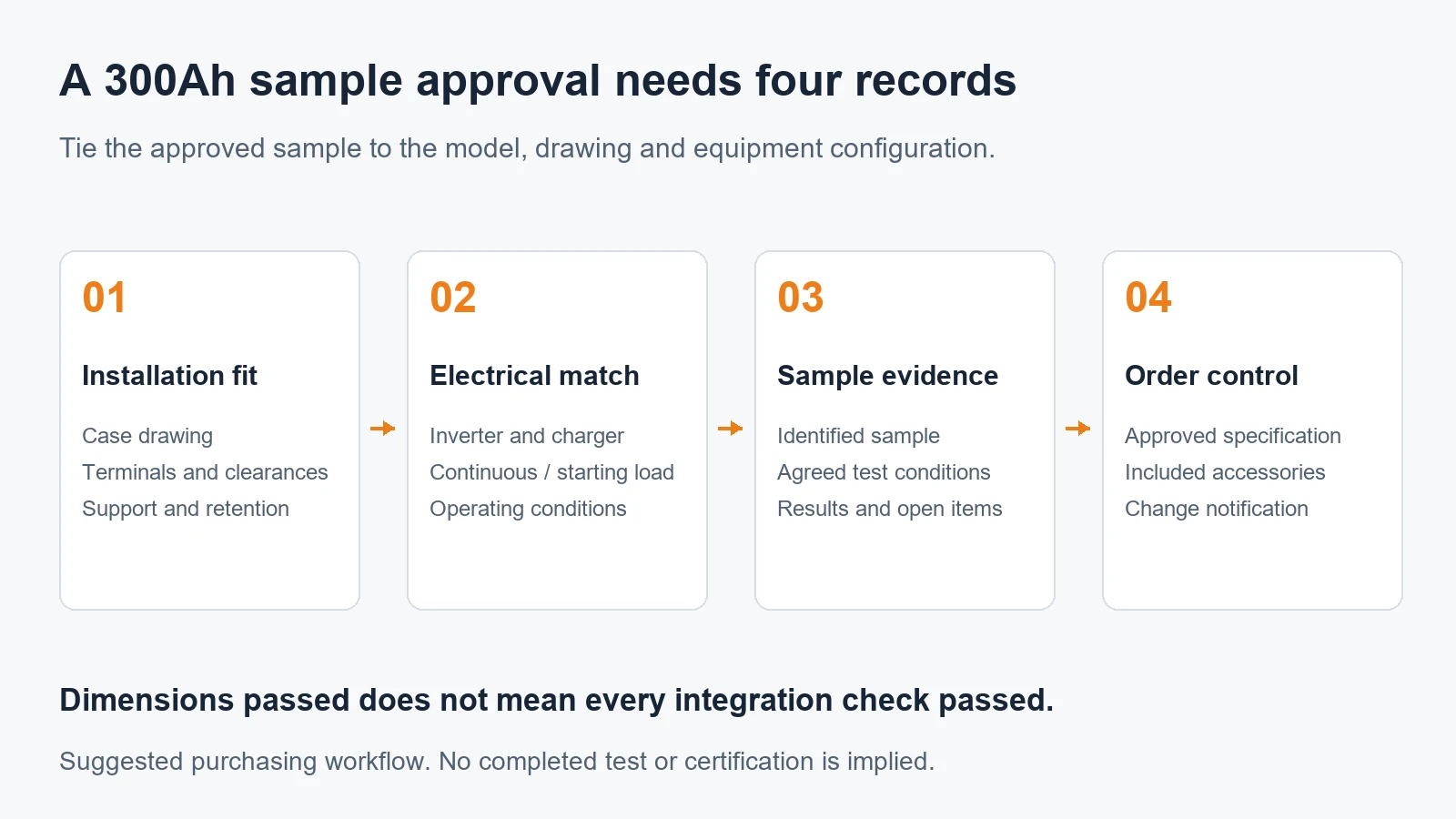
The sample order should identify the battery model, agreed specification revision, relevant BMS configuration and associated equipment. Record the physical sample identifier when it arrives. Keep photographs and measurements with that record so the purchasing and engineering teams are discussing the same unit.
Define the checks before testing. Useful categories include received condition, dimensions, terminal arrangement, documented capacity test, operation with the nominated charger and inverter, and behavior during the intended load profile. Use agreed limits and suitable test equipment. Deliberately creating a short circuit or forcing a battery outside its approved operating range is not a substitute for a controlled qualification procedure.
For runtime evaluation, record starting conditions, ambient temperature, load measurement, discharge settings and the reason the test ended. For integration checks, record equipment models and settings. A result without that context is hard to reproduce and can be misread as a universal performance claim.
Separate passed checks from open questions. A sample may fit the compartment while charger behavior remains unresolved. Another may deliver the expected energy while a communication feature is still under review. List each unresolved item, the evidence needed and the decision owner. Production approval should reflect the requirements that have actually been met.
Agree how later changes will be handled. Changes to cells, BMS hardware, software, terminals or enclosure can affect a previous assessment. The purchase specification should identify which changes require notice or renewed review. That control is especially useful for OEM programs where the battery is incorporated into a product with its own service documentation.
Ask for documentation linked to the exact model and intended market. Where transport documentation or market compliance evidence is required, check the model coverage, issuer, scope and revision. A company certificate, a material safety document and a product test report serve different purposes. Keep the distinction visible in the purchasing file.
Specify quantities for the evaluation stage and expected repeat orders separately. Request a quotation that identifies the included configuration, accessories, packaging, labeling and agreed inspection scope. Confirm lead time and commercial terms directly, since they depend on the actual order. This guide does not assign a current price or delivery promise to either model.
Clarify support and warranty terms in writing. Identify the operating conditions, evidence required for a claim and the process for handling an issue. Do not infer a guaranteed cycle life or a maintenance-free installation from a chemistry name. The battery remains part of a system whose connections and protective equipment need appropriate inspection.
For company background, review the Mottcell company profile alongside the model-specific documents. Company information helps a buyer understand the supplier, while technical approval still depends on the selected battery and its intended application.
A 12.8V 300Ah pack has 3,840Wh nominal energy. With the illustrative 80% usable-energy allowance and 90% inverter efficiency used above, the result is about 2.76 hours. Actual runtime needs verification with the selected model, load profile, temperature, reserve and system settings.
No. Ah is a capacity unit, while A describes current. The Mottcell catalog lists 300A maximum continuous operating current for the two models compared here, but the quoted configuration and complete electrical circuit must be checked for the intended load and conditions.
Only use a series or parallel arrangement approved for the exact model and BMS configuration. Ask for connection limits, protection and charging instructions. A 12V-class label or an example from another supplier does not establish approval for the proposed battery bank.
Prepare a short project brief with the application, required runtime, average and starting loads, inverter and charger models, installation envelope, operating environment and target market. Add the required quantity, desired interfaces and any essential compliance requirements. State which items are confirmed and which need engineering review.
Mottcell can use those inputs to discuss a 12V 300Ah battery pack request against the published product range and the configuration you need. Send your load profile and OEM requirements to Mottcell and ask for the current model specification, drawing and quotation. A documented configuration and an agreed sample evaluation provide a clearer basis for an order than capacity and price alone.
12V 100Ah Battery Pack: Compare 3 Models for OEM Buyers
12V 280Ah Battery Pack: Solar Runtime & OEM Buying Guide
18650 Battery Manufacturer: Cell Specs & OEM Checklist
12V 300Ah Battery Pack: Runtime, BMS and OEM Buying Guide
48V HESS Supplier: Inverter Matching & OEM Checklist
4860 Battery Supplier Guide: Cell Specs & OEM Checks
36V 314Ah Battery Pack Manufacturer: OEM Buying Guide
26700 LiFePO4 Battery Manufacturer: 4000-5000mAh Cells
Established in 2005
In 2009, it was awarded the title of "National High tech Enterprise"
 zoe@mottcell.net
WhatsApp: 8617388790296
Fax: 86-0755-84042963
Skype: live:b0ebaecbb8782516
WeChat: +8613428749632

 VR show
 CN
CN Home >


