

 Jun 12, 2026


A 12V 314Ah battery pack is a sourcing specification, not a complete system design. For a proposed LiFePO4 pack with a confirmed 12.8V nominal voltage and 314Ah rated capacity, the nominal energy calculation is 4,019.2Wh, or about 4.02kWh. The energy you can deliver to a load depends on the approved operating window, discharge conditions and conversion losses. Capacity alone does not establish continuous power, charger compatibility or runtime.
For OEM buyers, solar equipment distributors and industrial integrators, the practical question is whether a particular configuration meets the application requirements and can be supplied consistently. This guide explains how to evaluate a 12.8V 314Ah battery pack manufacturer, compare quotations and establish sample acceptance criteria before committing to a production order.
Product availability note: Mottcell publishes several 12V-class energy storage battery configurations, including 300Ah models. The published product table does not identify a separate 12.8V 314Ah standard model. Treat an exact 314Ah request as a configuration to discuss and confirm in writing, rather than assuming that a catalog specification or another voltage platform proves availability.
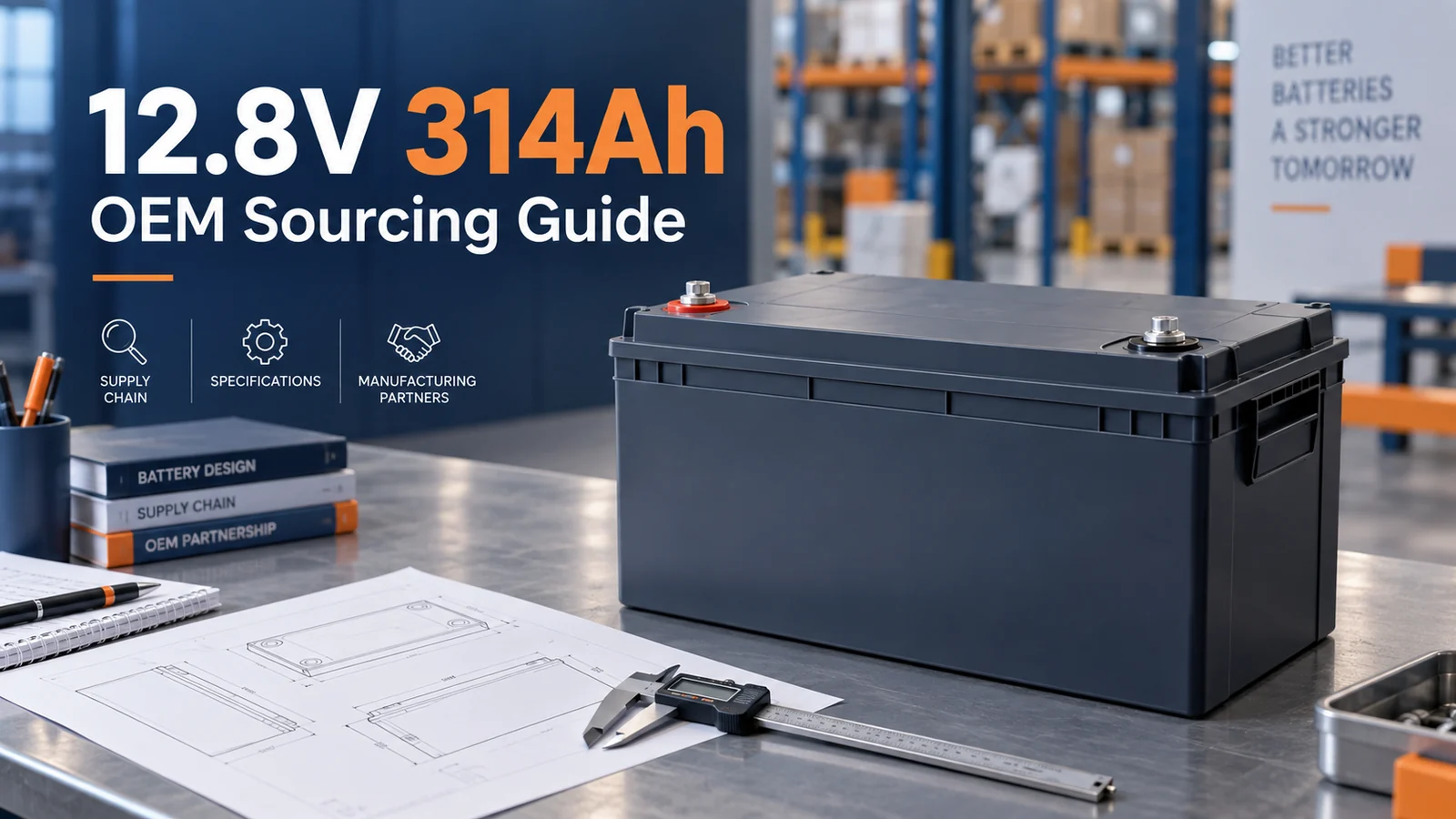
Concept illustration for this sourcing guide. This is an AI-generated image, not a photograph of a verified Mottcell 314Ah model or a completed test.
Start with the electrical system that the battery must support. A solar backup installation, a mobile auxiliary power unit and a low-voltage industrial control cabinet may all use a 12V-class supply, but their operating patterns can differ substantially. A battery that stores enough energy for one application may still fail the current, mechanical or control requirements of another.
Write down the operating voltage range of the connected equipment, average and maximum load, startup events, required backup duration, charging sources and expected daily use. Include the ambient conditions and the space available around the enclosure. A supplier cannot assess a meaningful configuration if the requirement is simply “314Ah, best quality, lowest price.”
Separate energy loads from power events. A communications device drawing a steady modest load presents a different duty cycle from a motor that starts repeatedly. For equipment with an inverter, obtain the inverter input requirements and its startup behavior. For a direct DC load, check the acceptable input voltage across the battery operating range, not just the nominal label.
Also specify the business boundary. Are you sourcing a battery only, a battery plus charger, or a complete integrated assembly? Identify who provides the cables, protective devices, mounting parts and commissioning instructions. This prevents a quotation for a bare battery from being compared with an apparently more expensive package that includes essential integration work.
If the platform itself is still undecided, use the 12V LiFePO4 capacity selection guide to frame the capacity comparison. Select 314Ah because the documented project requirement supports it, not because a larger number automatically represents a better system.
“12V battery” is commonly used as a platform description. A proposed four-series LiFePO4 configuration using a 3.2V nominal cell value gives 12.8V nominal pack voltage. Confirm the actual chemistry and approved configuration with the supplier. Do not assume that every product described as 12V uses the same cells, operating limits or charging settings.
The nominal energy relationship is straightforward: voltage multiplied by ampere-hour capacity gives watt-hours. For the proposed configuration, 12.8V × 314Ah = 4,019.2Wh. Using 12.0V in the calculation instead produces 3,768Wh. That difference is a labeling and calculation issue; it is not evidence that a particular supplier has increased the usable energy of its product.
Ampere-hours do not describe the maximum load current. A 314Ah capacity statement says nothing by itself about whether the pack can sustain 100A, 200A or another current. The permitted current depends on the cells, BMS, internal interconnections, terminals, enclosure and thermal design. Obtain the continuous rating and the separate peak rating with duration and recovery conditions.
The following comparison uses the same assumed 12.8V nominal voltage for every row. It is arithmetic for evaluating a requirement, not a list of confirmed Mottcell models or usable energy test results.
| Proposed capacity | Calculated nominal energy | Difference from 314Ah | Procurement interpretation |
|---|---|---|---|
| 200Ah | 2.560kWh | 1.4592kWh less | Consider if the required runtime and operating reserve are met |
| 280Ah | 3.584kWh | 0.4352kWh less | Evaluate whether the additional energy is necessary |
| 300Ah | 3.840kWh | 0.1792kWh less | Compare the exact offered specification and tested capacity |
| 314Ah | 4.0192kWh | Reference requirement | Confirm exact configuration, ratings and availability |
The energy increase from 300Ah to 314Ah is approximately 4.67% at the same nominal voltage. It does not guarantee the same percentage increase in field runtime. A different operating reserve, cutoff behavior or converter efficiency can change the result. It also does not prove identical dimensions or weight, so request the actual enclosure drawing rather than inferring mechanical interchangeability.
For an early AC-load estimate, use nominal energy multiplied by an assumed usable fraction and an assumed inverter efficiency. Both assumptions must later be replaced with values supported by the selected configuration and system testing. For a direct DC load, the relevant conversion losses may be different; do not apply an inverter factor when no inverter is present.
For illustration only, assume 80% of nominal battery energy is available within the intended operating window and an inverter efficiency of 90%. The calculation is 4.0192kWh × 0.80 × 0.90 = approximately 2.894kWh at the AC-load boundary. A constant 500W load would then have a simplified runtime estimate of 2.894kWh ÷ 0.500kW = about 5.79 hours.
This is not a promised runtime, a measured Mottcell result or an efficiency specification. It excludes inverter standby consumption, wiring losses beyond the assumed factor, temperature effects, aging and changing loads. A reserve needed for emergency operation also reduces energy available for ordinary use. State the boundary clearly whenever a runtime estimate is shared with a customer.
For variable loads, calculate the energy of each operating period and add them. A machine that runs briefly and then idles should not be modeled as a continuous maximum load. Conversely, an average load estimate must not hide a short event that trips the BMS or inverter. Energy and current checks must both pass, even if the spreadsheet runtime looks adequate.
Commissioning should compare the estimate with a repeatable duty cycle. Record initial charge condition, ambient temperature, load profile, termination condition and delivered energy at the agreed measurement point. A single demonstration that “the equipment turned on” is insufficient evidence for a runtime requirement. Retain the sample result and repeat the procedure when a relevant configuration changes.
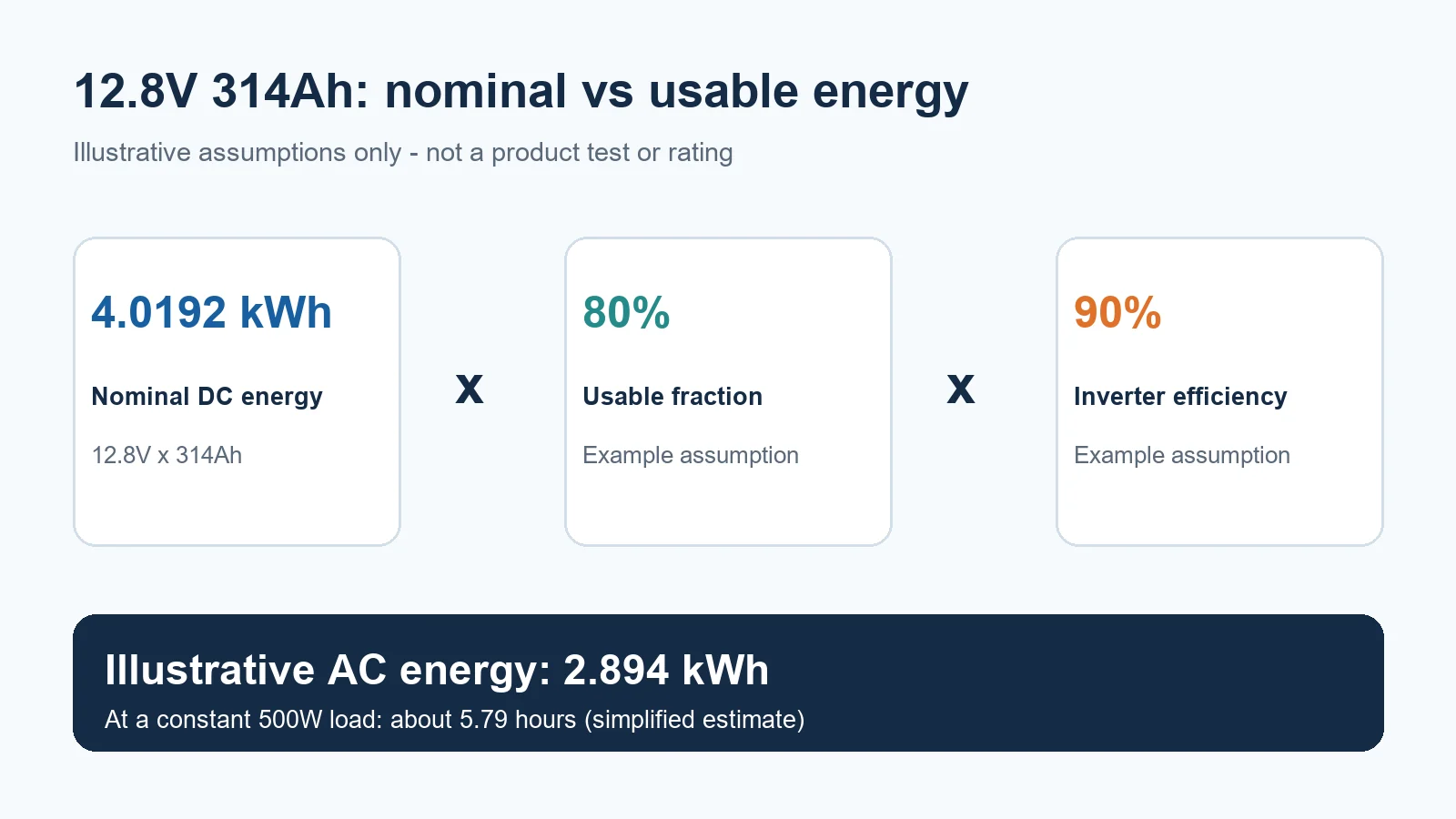
Worked example only: 4.0192kWh nominal × 80% assumed usable fraction × 90% assumed inverter efficiency ≈ 2.894kWh. These assumptions are not product ratings.
Low system voltage can create demanding current requirements. For a simplified AC-load calculation, battery-side current is AC power divided by battery voltage and inverter efficiency. At 12.8V and an assumed 90% efficiency, a 1,000W load implies about 86.8A. A 2,000W load implies about 173.6A. These are approximate operating points, not recommended pack ratings or cable sizes.
Current can rise as battery voltage falls for a constant-power load. Startup demand may also be higher than the steady load. Therefore, evaluate the whole intended operating range and the relevant surge duration. A large capacity does not remove these constraints, and a short peak-current claim cannot substitute for a continuous-discharge specification.
Ask the supplier to distinguish cell capability, BMS current limits and the rating of the completed pack. The weakest approved component or thermal limit can determine the allowable current. Request any temperature derating and the conditions for protective shutdown and restart. Avoid combining the most attractive numbers from different models into one assumed configuration.
An application with sustained high power may justify reviewing another system voltage with the integrator. That is a system-level decision involving the loads, inverter, charging equipment and protective devices. Do not create a higher-voltage battery by connecting independent packs in series unless the manufacturer explicitly approves that configuration and provides an appropriate design and operating procedure.
Qualified integration personnel should select protective devices, conductor sizes, connectors and installation arrangements using the actual specifications and applicable requirements. This buying guide does not provide an installation wiring design. Its purpose is to identify the questions that need engineering answers before procurement.
Document every source that can charge the battery. A solar charge controller, an AC charger and a vehicle charging system can have different control behavior. Confirm permitted charge voltage, charge current, temperature limits and any prohibited modes for the exact configuration. A charger marked “12V” should not be treated as compatible without this review.
Ask whether charging and discharging have separate temperature limits and what happens when a limit is reached. Determine whether the BMS prevents charging under unsuitable conditions and whether any heating option is actually included. A temperature range stated for another product or for discharge does not establish permission to charge at the same temperatures.
Define recovery behavior after a protection event. Does the pack restart automatically, require removal of the load, need a charger connection or require a manual action? This matters in unattended equipment. An unexpected recovery sequence can cause an operational problem even when the protection system is behaving exactly as designed.
Communication requires more than an interface name. If the application needs CAN or RS485, request the connector pinout, protocol details, data map and supported controller pairing. Confirm firmware versions and the meaning of reported state of charge and alarm values. A physical port does not prove communication compatibility with every inverter or programmable controller.
Discuss alarms, service access and diagnostic records in the same review. Specify which information the operator needs and which changes are controlled by the supplier. Avoid assuming that every optional software BMS feature is included in the quotation. The Mottcell battery pack portfolio can provide an initial overview, but exact interfaces and settings belong in the agreed model documents.
An enclosure proposal should show external dimensions, mounting points, terminal orientation, cable clearances and service access. Confirm the supplied weight and the permitted installation orientation. If the battery is replacing an existing unit, check the surrounding structure and connections rather than comparing only nominal enclosure length, width and height.
Environmental requirements need a defined use case. An indoor cabinet, a vehicle compartment and an exposed location present different conditions. Identify condensation, dust, water exposure, vibration, storage temperature and handling demands. Request the relevant evidence for any ingress-protection or mechanical-resistance claim. Do not infer an IP rating from a sealed-looking image or a metal housing.
Clarify how internal cells are restrained and how the completed pack is inspected. Mechanical support and connection design must suit the selected cells and intended operating conditions. A claim that one connection process is always superior is too broad; ask for the proposed construction and the validation appropriate to that construction.
The cover illustration in this article deliberately shows a generic evaluation concept. It is not a drawing of the quoted enclosure, proof of a mounting method or evidence of a test. Use approved drawings and sample inspection for purchasing decisions. Photography and marketing images can help explain a product, but they should not replace controlled technical documents.
Mottcell's energy storage battery product table lists SMG12300BE and SMG12300PLUS as 300Ah configurations with 3,840Wh stated energy and different dimensions. These entries can be starting points for a discussion. They do not confirm an independent 314Ah variant or establish that its current ratings, dimensions and other specifications would be identical.
For an exact 314Ah requirement, request a written configuration proposal identifying nominal voltage, rated capacity, test method, pack current limits, enclosure and included options. Ask whether the proposal involves a distinct cell selection or an adaptation of an existing platform. Do not change the capacity label on a 300Ah offer and treat the rest of its specification as automatically transferable.
If the application can accept either capacity, compare validated performance, fit, integration effort and commercial scope. The smaller nominal energy difference may be less consequential than a charger mismatch or an unsuitable continuous-current limit. Likewise, a larger pack may not be the right choice if it introduces unnecessary integration changes without improving the required duty cycle.
Keep a documented preferred configuration and a separately approved alternative. Avoid ordering “300Ah or 314Ah equivalent” without defining what equivalent means. For lower-energy projects, the 12.8V 200Ah sourcing guide provides a related procurement framework. The choice should follow the load and runtime requirement rather than an assumption that all low-voltage battery capacities are interchangeable.
A useful RFQ makes the offered scope visible. Include annual volume expectations, initial sample quantity, shipment destination, required delivery schedule, labeling and packaging needs. Separate mandatory requirements from preferences. This helps the supplier identify a feasible proposal and avoids late changes after a sample has already been approved.
Use a comparison sheet that captures the exact offered configuration, not just the supplier name and unit price. Mark unanswered items as open. A quotation with an attractive price but missing pack-current data is incomplete for a current-sensitive application. Do not treat silence as agreement or copy a specification from an unrelated product page into the supplier's offer.
| RFQ item | What the buyer should provide | What to request from the manufacturer |
|---|---|---|
| Electrical duty | Load profile, surge duration, operating range and runtime target | Exact voltage, capacity test conditions and continuous/peak limits |
| Charging and controls | Charger/controller models and required communication | Approved settings, protection behavior, protocol and pairing evidence |
| Mechanical environment | Space, mounting, exposure and ambient conditions | Drawing, weight, installation limits and relevant validation |
| Quality acceptance | Defined sample duty cycle and pass criteria | Test records, traceability approach and configuration identification |
| Compliance documents | Destination and intended application | Applicable model-specific documents and scope confirmation |
| Commercial scope | Quantity, packaging, branding and timing | Included items, lead time, warranty terms and change-control process |
Identify the contractual party and the party responsible for engineering and after-sales support. Factory capability, a website company introduction and a product-specific approval are different forms of evidence. The Mottcell company profile provides background; the proposed pack still needs its own documents and acceptance process.
Use the customized service information to organize the discussion around electrical, structural and project requirements. Ask for written confirmation of requested options and the commercial impact of those options. A generic OEM service statement should not be interpreted as confirmation that every requested design, protocol or delivery schedule has already been accepted.
Agree on acceptance criteria before the sample arrives. Define what will be measured, how the test will be performed and what constitutes a pass. Record capacity and delivered energy using a stated procedure, verify the intended duty cycle, inspect mechanical fit and test the actual charger and controller combination. Match the sample identity to the quoted specification revision.
Protection and abnormal-condition validation should follow a controlled plan performed by qualified personnel. Do not attempt unsafe fault demonstrations to prove a marketing claim. Request the appropriate supplier records and application-level validation, and separate destructive testing from ordinary acceptance work. A sample should answer the project's specific questions rather than become a general demonstration of undefined “reliability.”
Document any discrepancy and the resolution before moving forward. If a connector, firmware setting or enclosure feature changes, determine whether another integration check is required. Approval of the first sample does not mean that an altered production configuration is approved. Keep the final drawing, bill-of-material identification where agreed, firmware information and test procedure with the purchase record.
For repeat orders, agree how configuration changes will be communicated and accepted. Establish traceability expectations and the evidence that accompanies each shipment. The 12V battery pack manufacturing guide discusses the broader supplier-evaluation framework; the practical objective is consistent delivery of the approved configuration, not simply a successful one-off sample.
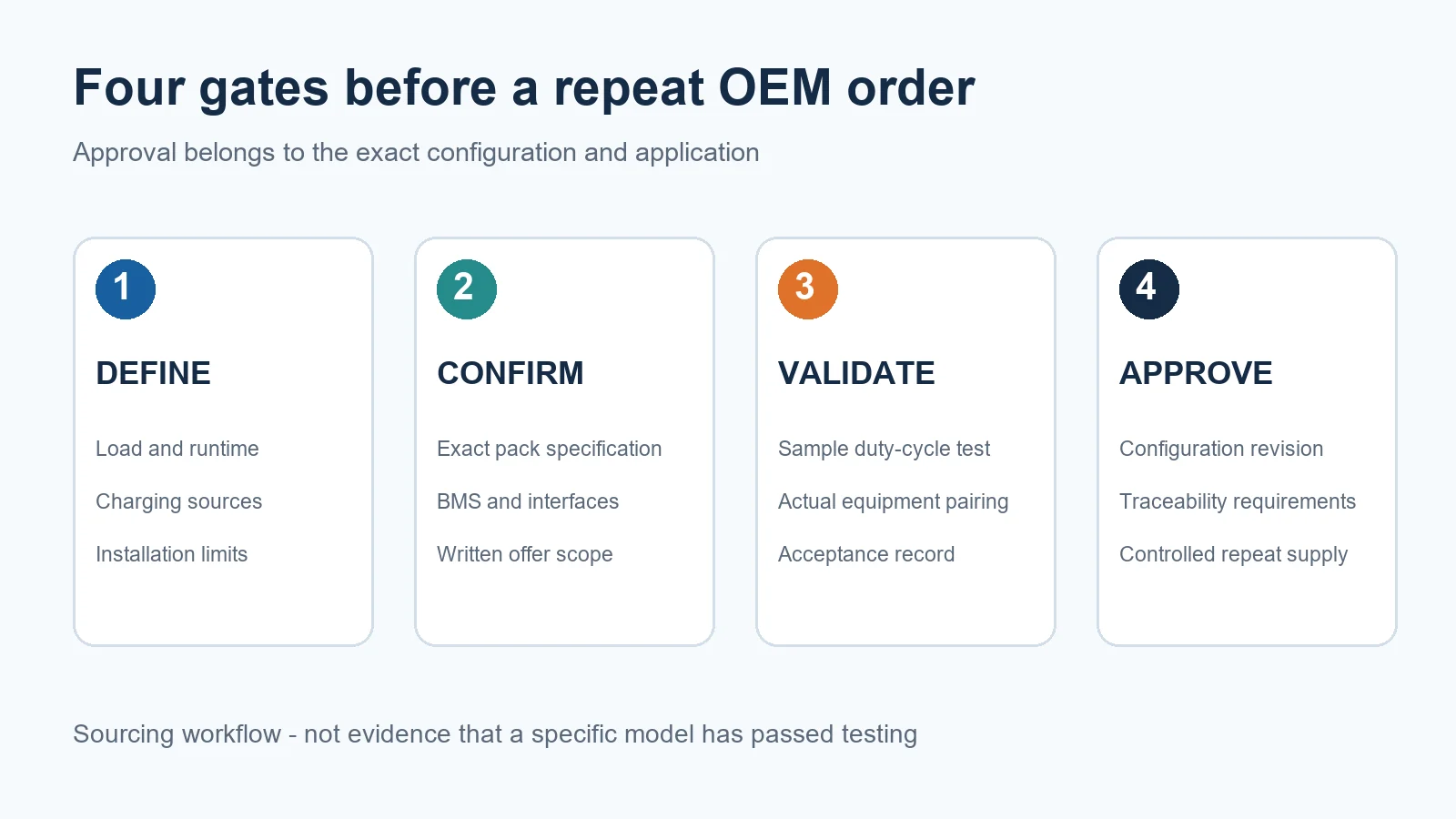
Procurement sequence: define the requirement, confirm the configuration, validate the sample and approve repeat supply. This is a buying workflow, not a claim that a particular pack has passed these steps.
Request documents appropriate to the destination, transport arrangement and intended application. Check the model designation, report scope, issuer and current relevance. A logo on a web page is not a substitute for the required documentation. Reports for a cell, another pack capacity or another voltage platform may not cover the assembly being purchased.
Cycle-life and warranty statements also need conditions. Ask for the relevant test method, temperature, charge/discharge rates, operating window and end-of-life criterion. Separate a laboratory cycle result from a field-life estimate and from the commercial warranty. This guide does not assign a cycle-life promise or certification to an unconfirmed 314Ah configuration.
Compare project cost using the actual offered scope: battery, charging equipment, integration work, freight, documentation, commissioning and expected service arrangements. If estimating lifetime cost, state the assumptions and use sensitivity ranges for uncertain inputs. Without project records, a fixed payback period or claimed percentage saving would be misleading.
Warranty review should address the covered product, operating conditions, claim procedure, responsibility for diagnosis and any transport or replacement costs. Confirm how the supplier supports an integrator when a problem spans the battery, charger and controller. Clear responsibilities make a procurement decision more useful than broad statements about maintenance-free operation.
The calculation is approximately 4.02kWh when the confirmed nominal voltage is 12.8V and rated capacity is 314Ah: 12.8 × 314 = 4,019.2Wh. Verify those inputs and the capacity test conditions. Nominal energy is not the same as usable energy or energy delivered through an inverter. The operating window, load, conversion losses and actual configuration determine what the application can use.
No. Confirm the inverter's input range and current demand, including startup events, and obtain approved charging settings for the exact pack. Check BMS protection and recovery behavior and any required communication pairing. A shared “12V” description, a connector that fits or a CAN/RS485 port does not establish complete compatibility. The intended combination should be evaluated with the sample before deployment.
The energy storage battery table reviewed for this guide lists 300Ah configurations but does not identify a separate 12.8V 314Ah standard model. Send the exact 314Ah requirement for a written configuration review. Do not inherit dimensions, current ratings, certification, warranty or delivery availability from a 300Ah pack or from a 314Ah model at another system voltage.
For a useful first discussion, provide the intended application, operating voltage range, load profile, runtime target, charger/inverter model, enclosure limits, destination and quantity. Identify which requirements are mandatory and which can be discussed. Request a configuration proposal and a sample-validation plan before finalizing a production order.
Contact Mottcell about your 12.8V 314Ah OEM requirement. The next step is to establish the exact model and evidence needed for your application, then compare a confirmed offer against the same acceptance criteria used for every supplier.
Published by Mottcell. This guide combines the linked company/product information with transparent illustrative calculations and procurement questions. It does not report a field case study, independent certification review or completed test of an unconfirmed 314Ah configuration. Product availability and project-specific ratings require written confirmation.
36V Battery Pack for E-Bikes and AGVs: OEM Buying Guide
12V 100Ah Battery Pack: Compare 3 Models for OEM Buyers
12V 280Ah Battery Pack: Solar Runtime & OEM Buying Guide
18650 Battery Manufacturer: Cell Specs & OEM Checklist
12V 300Ah Battery Pack: Runtime, BMS and OEM Buying Guide
48V HESS Supplier: Inverter Matching & OEM Checklist
4860 Battery Supplier Guide: Cell Specs & OEM Checks
36V 314Ah Battery Pack Manufacturer: OEM Buying Guide
Established in 2005
In 2009, it was awarded the title of "National High tech Enterprise"
 zoe@mottcell.net
WhatsApp: 8617388790296
Fax: 86-0755-84042963
Skype: live:b0ebaecbb8782516
WeChat: +8613428749632

 VR show
 CN
CN Home >


