

 Jun 02, 2026


In the commercial marine sector of 2026, operational efficiency, powertrain reliability, and onboard safety represent the foundational pillars of maritime enterprise. Whether engineering a fleet of autonomous research vessels, upgrading commercial fishing trawlers, or managing high-capacity passenger ferries, procurement directors and marine engineers face severe environmental challenges. Maritime hardware operates under extreme conditions: constant high-amplitude vibration, corrosive saltwater environments, wide thermal fluctuations, and the relentless demand for sustained deep-cycle power delivery.
Historically, commercial vessel builders relied on heavy, high-maintenance lead-acid or glass mat (AGM) battery arrays to power secondary house loads, thrusters, and emergency backup systems. However, these legacy architectures present severe operational liabilities, including rapid capacity drop-offs under continuous load, a lack of deep-discharge resilience, heavy structural weight penalties, and toxic environmental hazards.
To overcome these design constraints, modern naval engineering frameworks have shifted rapidly toward advanced Lithium Iron Phosphate (LiFePO4) chemistries. At the core of this clean energy transition is the specialized deep cycle 12v battery pack, re-engineered from the ground up to supply continuous, high-performance power across the most demanding marine deployment footprints.
Evaluating a premium deep cycle 12v battery pack for marine integration requires a thorough analysis of the internal electrochemical configuration. Unlike light-duty consumer batteries, commercial-grade marine lithium banks leverage high-capacity prismatic cells arranged in a robust 4S (4 Series) matrix. Because an individual Grade A LiFePO4 cell maintains a nominal voltage of 3.2V, coupling four units in series yields a highly stable nominal operating baseline of 12.8V (4 x 3.2V = 12.8V).
The primary technical asset of this chemical composition is its linear discharge curve. While legacy lead-acid options suffer from steep voltage drops as capacity diminishes—starving sensitive ship navigation systems and electric thrusters of required operating currents—a premium lithium pack maintains stable voltage output across more than 90% of its entire discharge cycle. This ensures that multi-kilowatt maritime hardware performs identically from the first hour of operation to the very end of a crew shift.
To accommodate a wide array of onboard ship hulls, auxiliary power units, and remote marine sensor grids, authoritative manufacturers design these packs across a highly scalable capacity spectrum. Naval procurement groups can evaluate precise cell weights, structural footprints, and sustained electrical profiles via our direct industry reference by the
| Product Model Capacity Block | Nominal Energy Capacity (Wh) | Continuous Current Output Threshold | Primary Marine Deployment Target Environments |
| 12v 100ah battery pack | 1,280 Wh (1.28 kWh) | 100A Continuous / 200A Surge | Autonomous Oceanographic Buoys, Small Commercial Sonar Arrays, Dedicated Engine Crank Backup |
| 12v 200ah battery pack | 2,560 Wh (2.56 kWh) | 150A Continuous / 300A Surge | Mid-Tier Commercial Vessel House Banks, Electric Trolling Motors, Remote Coastal Radar Nodes |
| 12v 280ah battery pack | 3,584 Wh (3.58 kWh) | 200A Continuous / 400A Surge | Heavy Auxiliary Winch Systems, Hybrid Tugboat Backup, Long-Duration Commercial Fishing Refrigeration |
| 12v 300ah battery pack | 3,840 Wh (3.84 kWh) | 200A Continuous / 500A Surge | Multi-Day Commercial Vessel House Power, Electric Bow Thruster Matrices, Onboard Desalination Pumps |
| 12v 314ah battery pack | 4,019 Wh (4.01 kWh) | 250A Continuous / 600A Surge | Next-Gen Ultra-High-Density Marine Fleets, Large Scale Yacht Electrification, Compact High-Yield Ship ESS Blocks |
The emergence of the high-density 314Ah cell module represents a significant breakthrough for commercial boat builders. This configuration packs more than 4.0 kWh of raw energy into a physical footprint historically occupied by legacy 280Ah cell blocks, enabling shipyards to expand a vessel's total cruising runtime by 12% without redesigning internal engine rooms or adding structural dead weight to the ship's keel.
The physical environment of a deep-sea vessel is intensely hostile to electrical components. Sourcing an energy asset for long-term commercial deployment requires structural engineering that mitigates three main hazards: electrochemical corrosion, extreme mechanical shock, and localized thermal runaway.
Saltwater and high ambient humidity accelerate galvanic corrosion if internal components are exposed to the atmosphere. To isolate the core cell matrix, a certified marine 12v battery pack features high-grade, CNC-machined aluminum or reinforced powder-coated steel enclosures.
Advanced production lines apply automated polyurethane or silicone gasket-pouring protocols to guarantee verified IP65 or IP67 ingress protection ratings. These sealed housings completely stop the entry of moisture, dust, and low-pressure water sprays.
Furthermore, external connection terminals are constructed from heavy-duty, tin-plated pure copper blocks or marine-grade stainless steel studs. This material selection minimizes contact resistance and stops salt-spray oxidation from degrading electrical performance over multi-year deployments.
Vessels pushing through rough ocean swells subject internal battery configurations to continuous, high-amplitude mechanical stress and sharp g-force shocks. If individual cells are left free-floating inside an outer shell, this physical movement will quickly strain internal terminal tabs, damage voltage sensing wires, and crack structural welds.
To ensure long-term field survivability, premium modules are built using high-pressure internal structural compression plates that hold the prismatic cells in a rigid, vibration-absorbing matrix.
Enterprise procurement buyers looking for verified manufacturing quality can review the comprehensive guide covering our factory's
Marine battery compartments are frequently confined, unventilated spaces subject to intense engine room heat or sub-zero northern water temperatures. Because charging lithium cells below freezing causes lithium plating on the cell anodes—creating permanent capacity loss and internal short-circuit risks—the internal architecture must integrate smart thermal regulation.
Advanced marine configurations incorporate integrated, automated internal heating blankets surrounding the cell core. When the system detects sub-freezing conditions during an incoming charge sequence, it redirects the initial power to warm the internal heating plates first, safely bringing the cell core up to optimal processing temperatures before accepting charge currents.
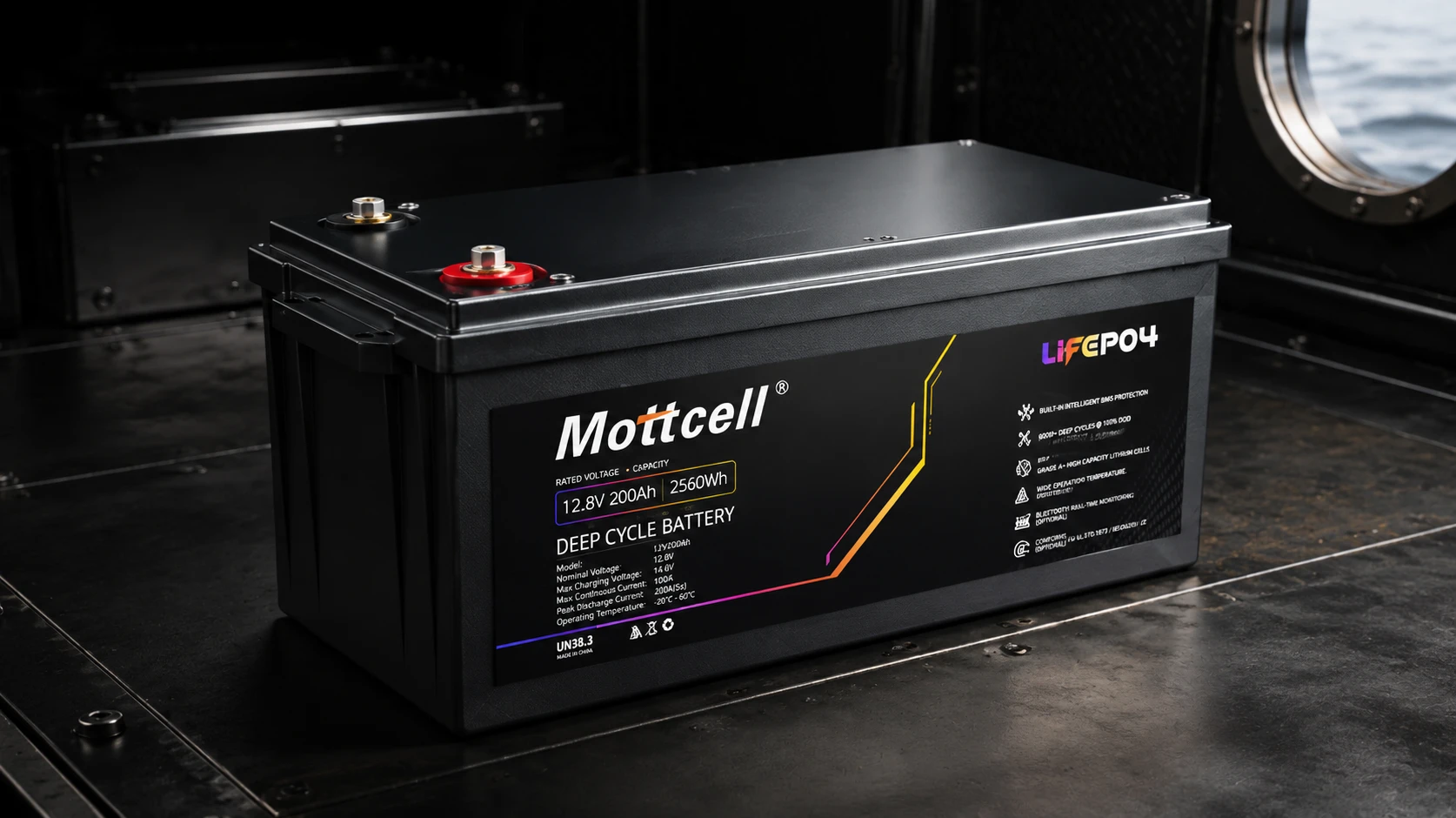
Modern commercial vessels operate as highly integrated digital ecosystems. Navigational computers, sonar arrays, satellite communication links, and electric propulsion systems communicate across standardized onboard data networks. Consequently, a standalone battery can no longer operate as an isolated analog component; it must function as a smart node capable of streaming real-time diagnostic telemetry to the ship's bridge.
This critical communication capability is managed by a customized, built-in Battery Management System (BMS). The smart BMS governs the entire internal cell matrix, acting as a real-time safety system and an intelligent data hub.
| System Control Domain | Precise Protective Intervention Point | Automated Remediation Action | Onboard System Security Impact |
| Over-Voltage Shield | Any individual cell string crossing 3.65V boundary. | Instantly opens incoming solid-state charge relays. | Prevents cell over-charging and long-term chemical degradation. |
| Under-Voltage Guard | Any individual cell dropping beneath 2.50V threshold. | Isolates discharge terminal to drop parasitic load. | Stops permanent capacity loss from deep-discharge cycles. |
| Short-Circuit Cut-off | Microsecond detection of external electrical surge faults. | Opens primary safety switches to isolate the entire cell block. | Shields the ship's wiring grids and engine chassis from fire hazards. |
| Active Balancing Node | Micro-volt cell variance detected during charging phase. | Transfers energy from high-voltage cells to lower-voltage cells. | Maximizes usable capacity and extends lifecycle past 6,000 iterations. |
To support modern maritime integration, the smart BMS integrates specialized industrial and marine communication protocols, including CANbus, RS485, Modbus, and marine-specific digital network platforms. This communication capability allows the ship's central power distribution system or an external IoT monitoring console to track vital performance metrics, such as real-time State of Charge (SOC), individual cell voltage strings, localized internal temperatures, and overall State of Health (SOH).
This granular transparency allows fleet managers to implement predictive maintenance schedules, eliminating unexpected power failures while at sea. To see how these intelligent modules scale into comprehensive multi-kilowatt arrays, explore our specialized
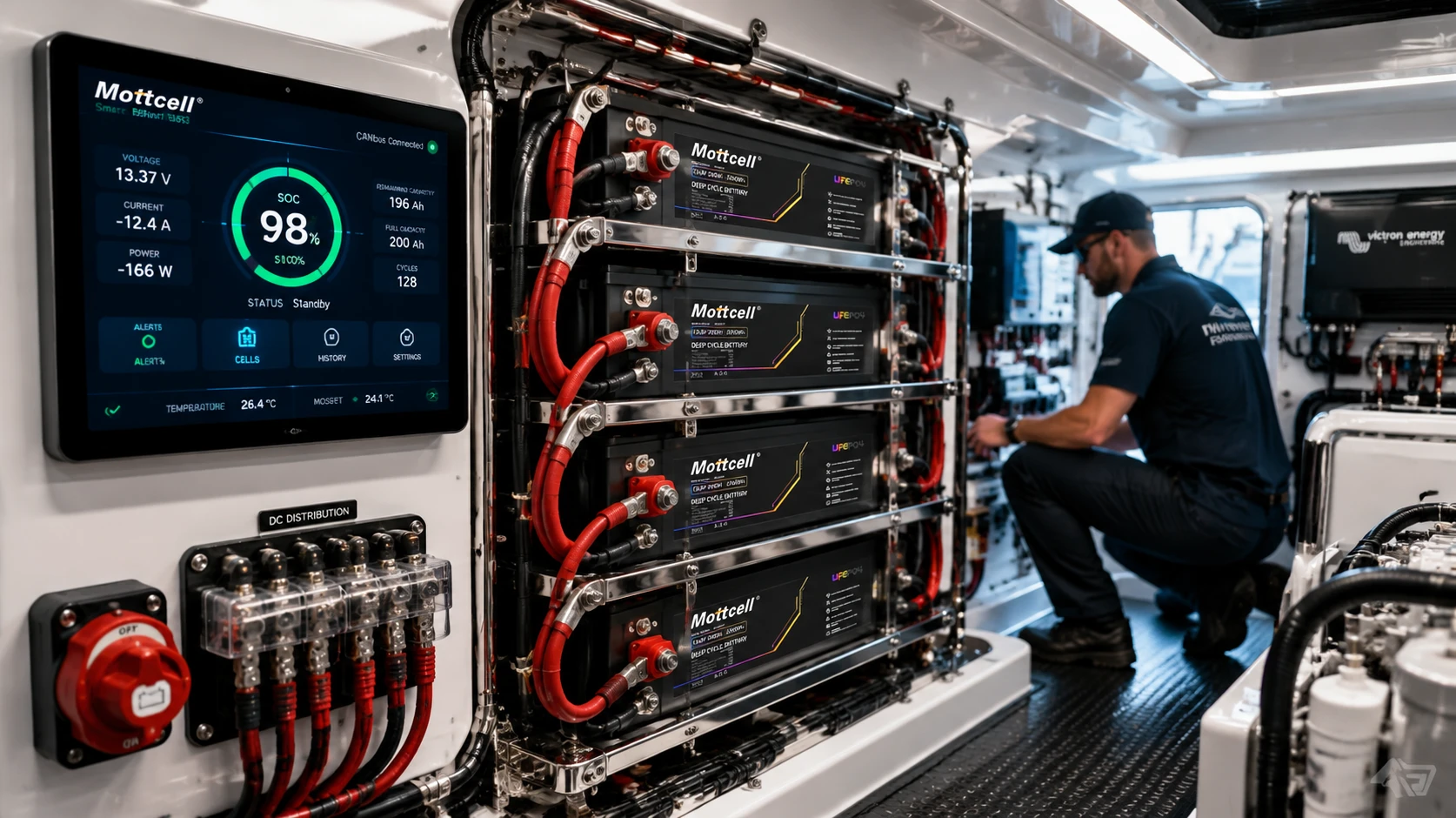
For maritime corporate executives, fleet operators, and commercial shipyards, the procurement of energy assets requires an analytical focus on long-term lifecycle economics rather than looking solely at initial acquisition capital expenditure (CapEx). While cheap, uncertified import options present an appealingly low upfront price tag, they inevitably generate heavy long-term operational expenditures (OpEx) through frequent field failures, premature replacements, and expensive vessel downtime.
Quantifying the true return on investment (ROI) of upgrading to a premium 12v battery pack requires analyzing the complete financial lifecycle across five core parameters:
Extended Cycle Longevity: A premium Mottcell marine lithium system utilizing Grade A prismatic cells delivers more than 6,000 full deep-discharge cycles before its capacity degrades to 80% of its initial rating. In comparison, high-grade marine AGM or Gel alternatives rarely survive past 1,200 to 1,500 cycles under identical real-world deep discharge duty cycles. This means a single lithium deployment outlasts multiple lead-acid change-out rounds, eliminating repeat procurement and maintenance cycles.
Zero Routine Maintenance Overhead: Lead-acid installations require ongoing operational maintenance, including distilled water top-offs, equalizing charges, and continuous terminal cleaning to remove toxic acid corrosion. Premium marine lithium packs are completely sealed, zero-maintenance systems, allowing fleet operators to reallocate engineering labor to core mechanical tasks.
Fuel Efficiency through Mass Reduction: Mass optimization is a critical engineering focus for high-speed hull designs and commercial shipping logistics. Upgrading a large multi-pack vessel configuration from lead-acid to lithium reduces total battery weight by up to 70%, immediately lowering fuel consumption, improving hull speed, and freeing up structural capacity for commercial cargo or fishing yields.
Volumetric Space Optimization: Space inside ship cabins and engine compartments is highly restricted. The high energy density of the 12V lithium platform enables shipwrights to deliver more kilowatt-hours of usable power within a fraction of the space required by legacy battery banks, maximizing usable cabin or storage layouts.
Predictive Fleet Diagnostics: By leveraging live telemetry streams from the integrated Smart BMS, shore-side fleet supervisors can monitor battery health across multiple vessels in real time, preventing unexpected operational downtime and protecting your operational bottom line.
To explore purchasing tiers, volume pricing breaks, and international maritime logistics compliance guidelines for large-scale corporate fleet rollouts, read our specialized commercial brief covering

Answer: Marine environments subject battery banks to high ambient humidity, salt-spray mist, and potential bilge water exposure. Sourcing a 12v battery pack with a verified IP67 enclosure ensures that the internal cell matrix and smart BMS electronics are completely sealed against environmental hazards, preventing galvanic corrosion, terminal short-circuits, and early component failure.
Answer: Legacy lead-acid and AGM batteries experience continuous voltage drops as they discharge, which can cause sensitive marine electronics, radar setups, and sonar displays to malfunction or reboot under heavy motor loads. Mottcell’s deep-cycle LiFePO4 packs maintain a stable, uniform voltage output across more than 90% of their entire discharge cycle, ensuring critical ship systems receive constant, reliable power throughout extended sea voyages.
Answer: Yes, but it requires careful design coordination. Sourcing from a certified manufacturer ensures that the internal Smart BMS is engineered to support high-voltage scaling. This configuration allows you to connect multiple 12V modules in series to safely create 36V or 48V power banks, expanding your design options for heavy-duty bow thrusters or electric propulsion drivetrains.
Procuring a commercial-grade deep cycle 12v battery pack for marine applications should never be approached as a routine, commoditized transaction. It represents a long-term investment in your enterprise's core operational infrastructure. By moving away from restrictive off-the-shelf consumer options and embracing a custom-engineered, factory-certified lithium configuration, you systematically eliminate design bottlenecks, secure your hardware supply chain, and maximize long-term operational ROI.
Mottcell combines advanced lithium engineering with full-service OEM/ODM customization to deliver high-performance power solutions that excel in demanding commercial environments. Ready to eliminate field failure risks, optimize your fleet's weight metrics, and secure a tailored production blueprint for your next shipbuilding rollout? Please
12V 300Ah Battery Pack: Runtime, BMS and OEM Buying Guide
48V HESS Supplier: Inverter Matching & OEM Checklist
4860 Battery Supplier Guide: Cell Specs & OEM Checks
36V 314Ah Battery Pack Manufacturer: OEM Buying Guide
26700 LiFePO4 Battery Manufacturer: 4000-5000mAh Cells
Commercial HESS Supplier: Factory Microgrid Sizing Guide
5kWh HESS Supplier: Home Solar Battery & OEM Options
48V 280Ah HESS Supplier: Solar Battery OEM Buying Guide
Established in 2005
In 2009, it was awarded the title of "National High tech Enterprise"
 zoe@mottcell.net
WhatsApp: 8617388790296
Fax: 86-0755-84042963
Skype: live:b0ebaecbb8782516
WeChat: +8613428749632

 VR show
 CN
CN Home >


