

 Jul 29, 2026


By Mottcell · Updated October 13, 2026
Choosing a 48V HESS supplier starts with a system question: which battery configuration can support your inverter, installation and purchasing requirements? A voltage label, an attractive enclosure and a large capacity number are useful starting points. They do not establish the operating limits or the evidence you need before approving an OEM order.
For distributors, private-label brands and residential solar integrators, the most useful quotation connects four things: the exact battery model, the exact inverter model, an agreed installation arrangement and a documented sample acceptance plan. This guide explains how to put that information into a purchasing file, distinguish 48V-class descriptions from nominal voltage, and compare offers on a consistent basis.
Mottcell publishes separate home energy storage, all-in-one and customized storage ranges. Use those product pages to identify the intended configuration, then request the current specification and project-specific confirmation. The calculations below are transparent planning examples, not measured performance or a universal compatibility promise.
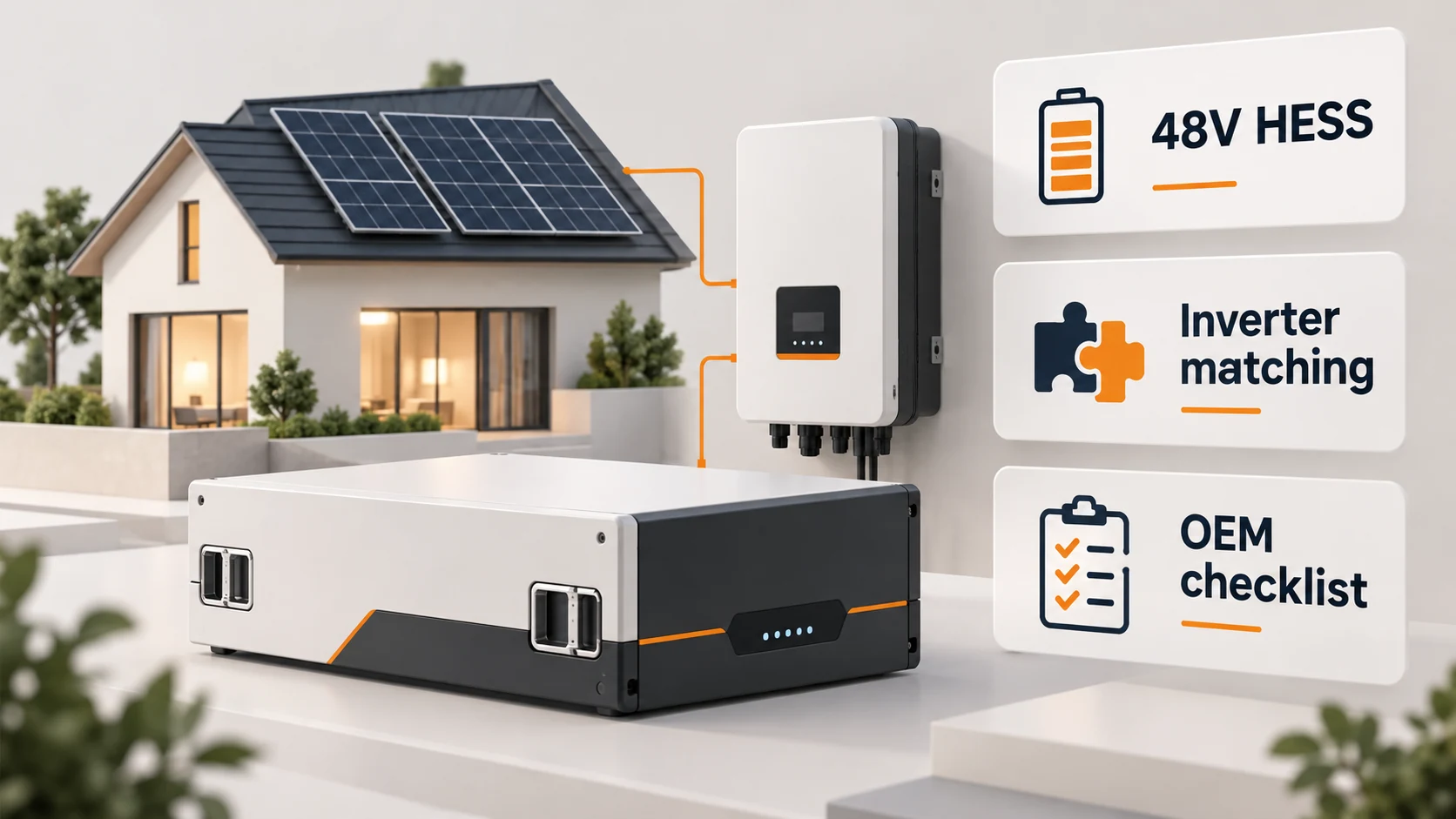
HESS commonly refers to a home or household energy storage system. A battery module can form part of that system without containing an inverter. Its job and its quotation are different from those of an all-in-one unit supplied with power conversion equipment. Start by identifying which components the supplier is responsible for and which components your installation team will supply.
For a battery-only order, describe the existing or proposed inverter and the required battery interface. For an integrated order, identify the included inverter, AC output arrangement, controls and accessories. For a customized order, agree which features are design requests and which already belong to an established model. These distinctions keep two apparently similar offers from being compared as if they contain the same equipment.
Mottcell's home energy storage system range and all-in-one energy storage system range provide separate starting points. Buyers with mounting, interface or branding requirements can also review the customized energy storage range. A residential battery should not be described as a universal solution for heavy factory loads or uninterrupted industrial control power without a separate system assessment.
The phrase 48V-class is often used for a low-voltage battery and inverter category. The specified nominal battery voltage can be different. For example, a design using sixteen series-connected LiFePO4 cells with a nominal cell voltage of 3.2V has a calculated nominal voltage of 51.2V: 16 × 3.2V = 51.2V. That calculation describes a particular configuration, not every product sold under a 48V label.
Ask the supplier to put the actual nominal voltage, series configuration and permitted operating limits in the model specification. Then compare the battery's charge and discharge requirements with the inverter's supported battery range. A catalogue heading alone cannot show whether the inverter can manage the upper charge limit, lower operating limit or the battery's protective disconnect behavior.
Keep those limits separate in the purchasing record. Nominal voltage is a reference for specifications and energy calculations. Maximum charging voltage and discharge limits are operating requirements. An inverter's accepted DC range is another specification. Substituting one for another can create an apparently compatible order that requires changes when the equipment arrives.
For a broader comparison of capacity options, use the 51.2V HESS buying guide. This page focuses on the supplier qualification and inverter-matching process rather than duplicating every capacity-specific configuration.
Mottcell's current home-storage product table lists the following model labels, cell capacities and BMS configurations. These are catalogue references. They should be followed by a dated specification for the particular unit offered, especially when the order includes customization or an alternative capacity.
| Published model label | Listed cell capacity | Listed BMS configuration | Question to settle before ordering |
|---|---|---|---|
| SMJ 5KWh T01 | 100Ah | 16S Software | Which exact model and current specification are quoted? |
| SMJ10KWh T01 | 200Ah | 16S Software | Which enclosure and inverter interface are included? |
| SMJ 15KWh T01 | 280Ah or 314Ah | 16S Software | Which of the two capacities is supplied? |
| SMJ 30KWh T02 | 560Ah or 628Ah | 16S Software | What is the approved assembly and installation arrangement? |
A marketing capacity label is not a substitute for the detailed electrical specification. Record the model code, nominal voltage, ampere-hour capacity and nominal energy together. If an offer changes the cells, BMS, enclosure or accessories, have the supplier identify the revision instead of treating the original catalogue row as proof that every changed feature is covered.
The 48V 100Ah HESS guide addresses the smaller capacity class. The 48V 200Ah HESS guide provides a separate capacity-specific discussion. Use the same qualification file across these options so that an increase in energy does not hide a different current rating or interface requirement.
An OEM buyer needs a written match between two identified products. Ask for the inverter's complete model number and firmware version, followed by the proposed battery's model number, BMS version and connection requirements. A statement such as compatible with a popular inverter brand is incomplete when that brand sells several voltage classes, operating modes and communication arrangements.
The following record helps an engineer or integrator review the proposed combination. Put the supplier's document reference beside each answer. Mark unresolved items as open rather than completing them with an assumption from a similar model. A useful quotation makes it clear which equipment pair has been evaluated and which pair still requires a sample test.
| Item to record | Evidence to request | Why it affects the purchase |
|---|---|---|
| Battery and inverter identities | Model codes and document revisions | Prevents approval of a different variant |
| DC operating limits | Battery limits and inverter battery range | Establishes the electrical match |
| Charge and discharge current | Continuous limits, peak duration and conditions | Checks whether the intended load is supportable |
| BMS communication | Protocol, connection drawing and firmware information | Establishes the control and reporting arrangement |
| Module expansion | Approved quantity, wiring and control arrangement | Defines the proposed complete battery bank |
| Installation environment | Applicable model instructions and enclosure specification | Determines where and how the unit can be installed |
| Sample acceptance | Agreed equipment pair and test record | Turns the proposed match into reviewable evidence |
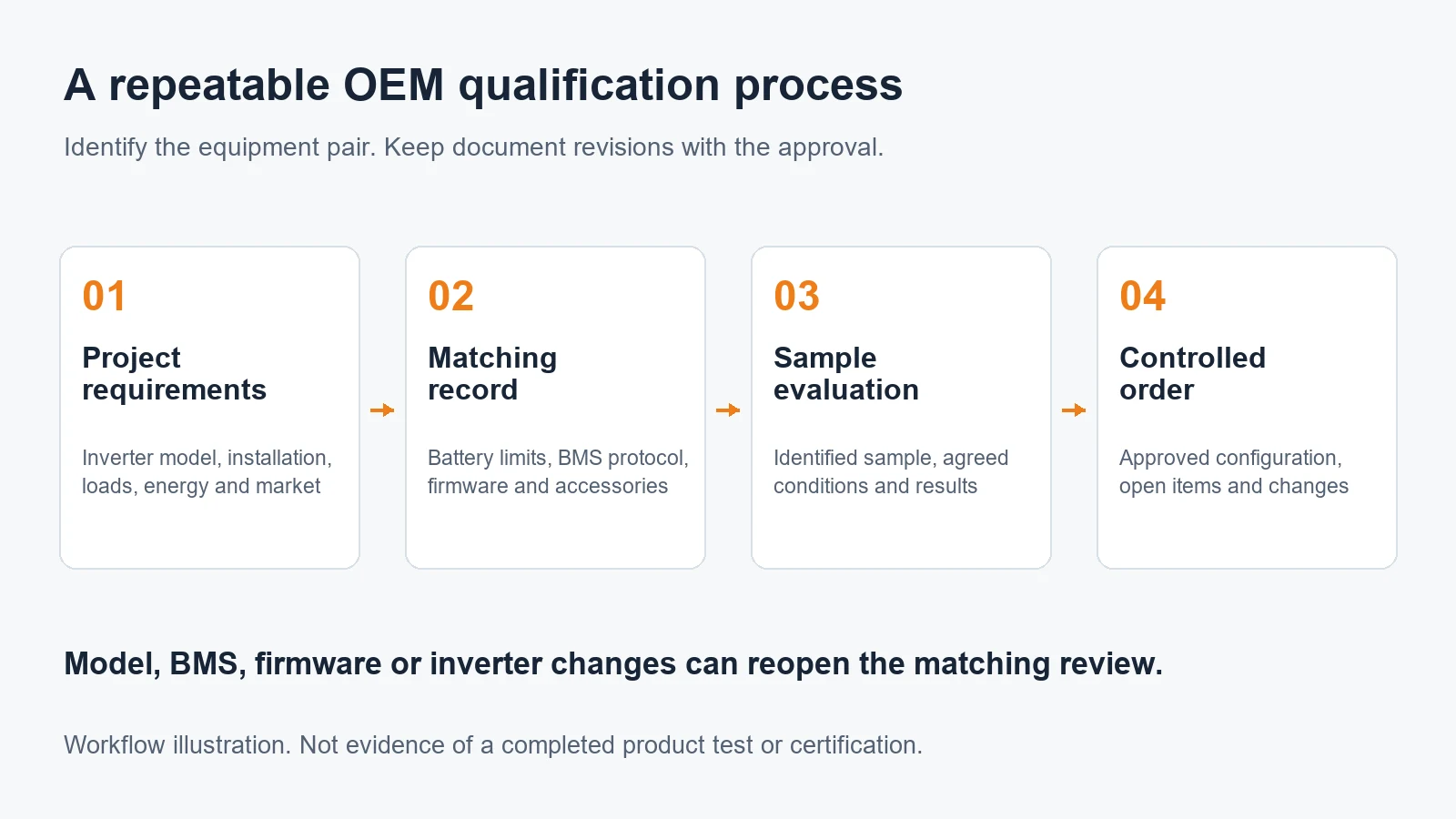
Treat the record as part of the quotation, not a separate conversation that disappears before production. If the inverter changes during a project, reopen the matching review. Approval for one inverter model does not automatically cover a different model that has a similar power rating.
Stored energy and available output power answer different questions. Energy describes the amount stored under specified conditions. Current limits help determine whether the battery can support the inverter's required output at a particular DC voltage. A larger ampere-hour capacity does not, by itself, prove a larger continuous discharge current.
A simple planning relationship is DC current ≈ AC load power ÷ inverter efficiency ÷ battery voltage. Consider a hypothetical 5,000W AC load and an assumed inverter efficiency of 92%. At 51.2V, the calculated battery current is approximately 106A. If the battery voltage under load is 46V, the same calculation gives approximately 118A. The 46V value is an example assumption, not a published operating limit for a Mottcell model.
This calculation does not select a cable, fuse or battery. It shows why a buyer should examine the current limit over the intended operating conditions. Startup loads, protective settings, temperature, other DC consumers and the approved installation also need review. Have the responsible system designer confirm the final arrangement against the actual equipment documents.
For energy, nominal kWh = nominal volts × ampere-hours ÷ 1,000. A hypothetical 51.2V 100Ah configuration gives 5.12kWh nominal energy; 51.2V 200Ah gives 10.24kWh. These figures are not AC-delivered usable energy. Allowed discharge depth, reserve settings, efficiency and operating conditions determine how much is available to the loads.
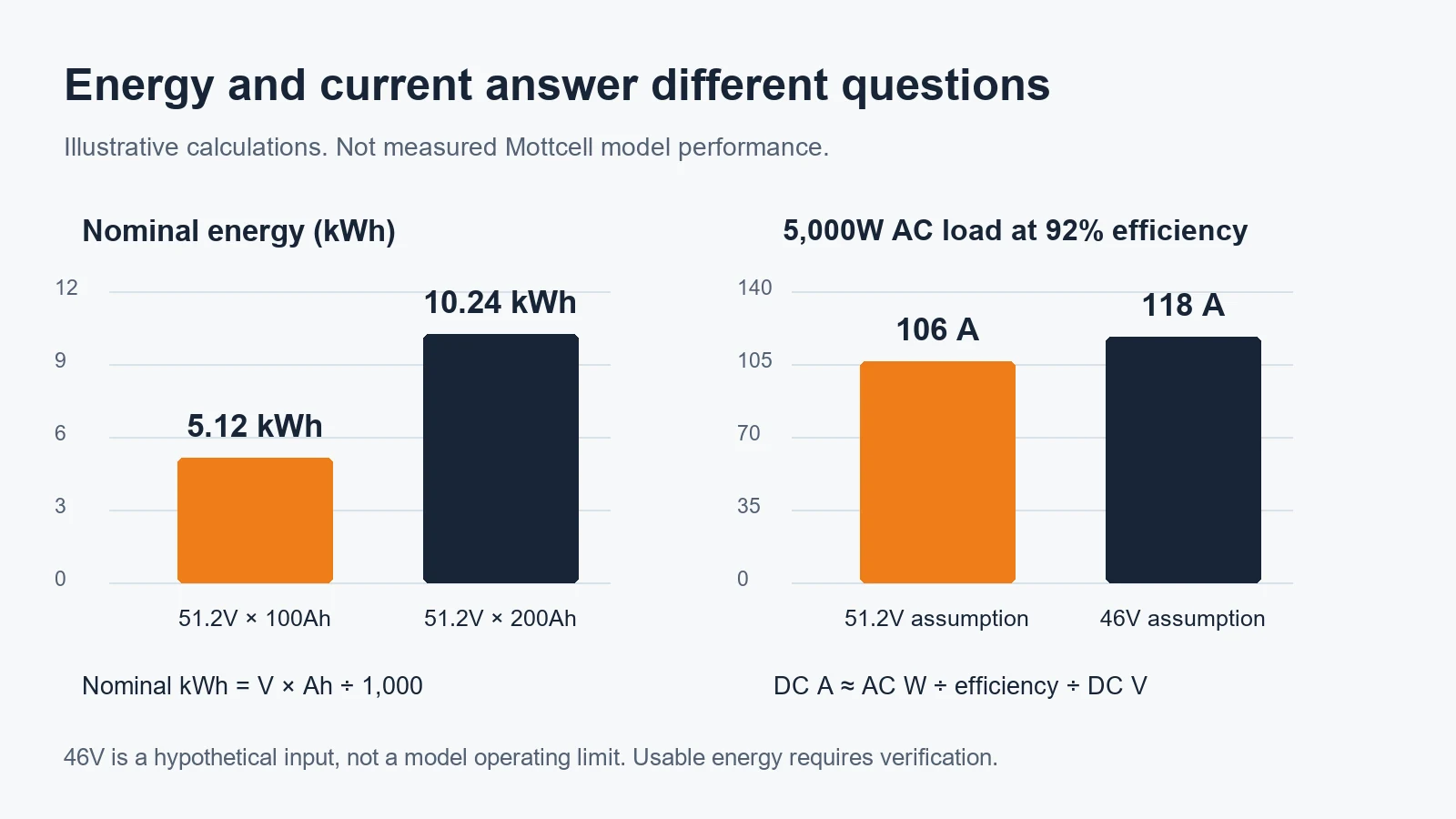
If runtime matters, provide a load schedule and reserve requirement rather than requesting a guaranteed number of backup hours from the nominal capacity alone. Separate essential loads from optional loads, record startup behavior and define the operating scenario to be checked during sample evaluation.
CAN or RS485 identifies an interface, not a complete compatibility agreement. Ask which protocol the battery uses for the proposed inverter, which cable and pin assignment are required, and which firmware versions were used for the documented match. A connector that physically fits does not prove that the two devices exchange the expected information.
The review should identify the values and commands the system needs, such as state of charge, alarms and permitted charge or discharge limits. Have the supplier explain the intended behavior if communication stops, a module is disconnected or a protective condition occurs. The required response depends on the chosen equipment and approved system design, so it belongs in the project-specific matching record.
As an independent example of the level of documentation involved, Victron's battery compatibility documentation separates tested battery information from general guidance for other batteries. Its model-specific instructions can include connection and firmware requirements. That source illustrates a documentation method; it does not certify a Mottcell battery or establish compatibility with a particular Victron inverter.
During sample review, ask for a record of the complete equipment pair in operation. Keep the model and firmware information with the results so that future orders can reproduce the approved setup. If a supplier later changes the BMS firmware, determine whether the approved communication behavior needs to be checked again before shipping the revised product.
Define the installation location before choosing the enclosure. Describe whether the unit is indoors, its mounting arrangement, access for servicing, surrounding temperature and any expected moisture or dust exposure. Ask for the installation instructions and the enclosure rating of the actual quoted model. Do not transfer an outdoor rating from a different product or assume that metal construction establishes environmental protection.
A low-voltage description also does not make a high-current battery installation hazard-free. The final protective devices, disconnect arrangement, conductor selection, connection method and commissioning procedure should be reviewed by the qualified people responsible for the installation. This guide is a purchasing checklist and does not replace the applicable equipment instructions or local installation requirements.
For expansion, ask whether the manufacturer approves the proposed module quantity and combination. Record wiring, communication addressing and any restrictions on mixing revisions or adding modules later. If the customer expects an upgrade after a year, put that requirement in the original RFQ. An expansion promise is useful only when the supplier identifies the conditions and the components that must remain compatible.
An OEM project can involve enclosure dimensions, mounting features, connectors, labels, documentation or communication requirements. Put each request in an approved drawing or specification rather than relying on a product photograph. Identify which changes are cosmetic and which affect electrical behavior, installation, transport or the evidence required for the destination market.
For branding, confirm the label artwork, model identifier, serial-number format and language of the customer instructions. For a connector change, include its mating component and the installation details that the system designer needs. For a different enclosure, confirm access, mounting and the environmental specification. Buyers should be able to identify the supplied configuration without opening the battery or interpreting an informal sales message.
Agree how revisions will be communicated. If the cells, BMS hardware, firmware, connector or enclosure change after sample approval, ask the supplier to identify the change and its effect on the agreed qualification record. A clear change-control process helps the purchasing team distinguish an approved revision from an unexplained substitute.
Mottcell's company information provides a starting point for reviewing the business behind the quotation. Company-level statements and factory photographs help identify a supplier; model-specific performance, certification and compatibility still need their own documents. Do not infer an engineering approval or a product certificate from a general company introduction.
Define acceptance criteria while the quotation is being discussed. The buyer, supplier and installation partner should understand the intended inverter pair, operating scenario, required records and unresolved questions. Otherwise, a sample can arrive without the information needed to decide whether it meets the project requirements.
Begin with identification. Check the product model, serial number, label information, drawing revision and supplied accessories against the agreed file. Record visible condition and packaging. This creates a clear link between the sample being reviewed and the configuration that would enter production. A generic demonstration video of another battery is not evidence about that sample.
Next, review the documentation. The specification, wiring instructions, operating limits and communication description should refer to the same model or clearly identified product family. Ask the supplier to explain any conflicting values before testing. If the offer depends on a particular certificate or transport document, verify the issuer, document scope and model coverage rather than accepting a logo on the quotation.
The qualified test team can then evaluate the agreed battery and inverter combination under a written plan. Useful records can include charge and discharge behavior, communication readings, alarm handling and the required load scenario. Define the conditions and acceptance limits in advance. Deliberate fault or protective-function testing must use suitable equipment and procedures, not improvised customer-site experiments.
Finish by recording the outcome and open items. Identify the specific sample, equipment versions, test conditions, results and any changes required before approval. If a change is made, decide which checks need to be repeated. The final approval should refer to a controlled configuration, not simply to the phrase sample received.
A useful price comparison begins with the same equipment and service scope. Confirm whether the offer includes the battery, communication cable, mounting accessories, protective components, inverter, manuals, packaging and any project-specific work. A lower unit price can describe a smaller scope rather than a more economical product.
Request lead time and minimum order quantity for the actual configuration, destination and order stage. Separate sample timing from production timing. Identify the delivery basis, packaging arrangement and the party responsible for destination documents. These are quotation-specific commercial terms; they should not be filled with an old article's generic price range or a different customer's shipment schedule.
Review warranty conditions as a document. Define the covered product, claim process, required records, service contact and the handling of replacements or repairs. If operating limits or installation conditions affect coverage, ensure the customer-facing instructions reflect them. A headline warranty duration is insufficient for estimating service obligations across an OEM programme.
Lifecycle costs can be compared when the inputs are documented. Use the proposed purchase cost, installation scope, operating assumptions, maintenance obligations and warranty terms. Keep uncertain inputs visible. This is more useful than claiming a fixed payback period, a guaranteed bill-saving percentage or a cycle-life result that has no corresponding test conditions.
A clear RFQ reduces avoidable rounds of clarification. State the target market and whether the order is for battery modules, an integrated system or a customized assembly. Include the inverter's full model number, firmware information where available, the required load scenario, expected energy requirement and installation description. Attach the system documents that your engineering or installation partner can provide.
Then describe the commercial requirements: sample quantity, expected production volume, destination, requested delivery basis and required document language. Identify branding, connector or dimensional requests with drawings where possible. If a requirement remains undecided, label it as an open decision and explain who will approve it. That makes the quotation useful without inviting the supplier to assume a configuration that the buyer has not selected.
Ask for a response that identifies the proposed model and lists confirmed, conditional and unresolved requirements. Include the relevant document revisions and the proposed sample acceptance plan. This creates a common record for purchasing and engineering rather than two separate versions of the same project.
Before issuing a purchase order, check that the approved model, accessories, firmware arrangement, installation scope, document list and commercial terms all appear in the final file. Keep the RFQ, quotation, sample results and approved revisions together. When repeat orders are placed, refer to that file and confirm whether anything has changed.
48V can describe a system class. A sixteen-series LiFePO4 design has a calculated nominal voltage of 51.2V. Confirm the quoted model's nominal voltage, operating limits and series configuration rather than assuming every 48V-labelled product is identical.
No universal match follows from the voltage label. Review the exact equipment pair, DC limits, current requirements, communication arrangement and firmware information, then evaluate the proposed combination against an agreed sample plan.
Request the model specification, inverter-matching record, installation instructions, applicable model documents, customization drawings and sample acceptance plan. Confirm quotation scope, lead time and warranty conditions for the actual order.
Send your inverter model, installation arrangement, required battery energy and load scenario through Mottcell's project inquiry page. Include your OEM drawing or branding requirements and the destination market if they affect the quotation. Ask for a proposed configuration and a list of the documents needed to complete the matching review.
The aim is a quotation that your purchasing and technical teams can evaluate together: an identified battery, a documented equipment match, a defined sample plan and clear commercial terms. Those details give a 48V HESS supplier discussion a practical next step and provide a repeatable basis for future orders.
22650 LiFePO4 Battery Manufacturer: OEM Buying Guide
36V Battery Pack for E-Bikes and AGVs: OEM Buying Guide
12V 100Ah Battery Pack: Compare 3 Models for OEM Buyers
12V 280Ah Battery Pack: Solar Runtime & OEM Buying Guide
18650 Battery Manufacturer: Cell Specs & OEM Checklist
12V 300Ah Battery Pack: Runtime, BMS and OEM Buying Guide
48V HESS Supplier: Inverter Matching & OEM Checklist
4860 Battery Supplier Guide: Cell Specs & OEM Checks
Established in 2005
In 2009, it was awarded the title of "National High tech Enterprise"
 zoe@mottcell.net
WhatsApp: 8617388790296
Fax: 86-0755-84042963
Skype: live:b0ebaecbb8782516
WeChat: +8613428749632

 VR show
 CN
CN Home >


