

 Jan 26, 2026


An 18650 rechargeable battery manufacturer should help you turn an equipment requirement into a documented cell choice. Start with chemistry, operating voltage, load current and mechanical fit. Then agree on the sample tests and production records that will confirm the choice. A higher capacity label alone cannot answer those questions.
Mottcell lists both 3.7V INR18650 and 3.2V IFR18650 cells. This guide compares selected public catalog entries and explains the information an OEM buyer should request before approving a cell or a finished battery pack. It also includes a transparent energy calculation and a sample acceptance checklist that purchasing and engineering teams can use together.
Published by Mottcell. Revised October 19, 2026. Catalog figures below were checked against the public product page on that date. They are selection references. Obtain the current specification for the exact capacity variant before ordering. Calculation examples and proposed acceptance steps are planning tools, rather than product test results.
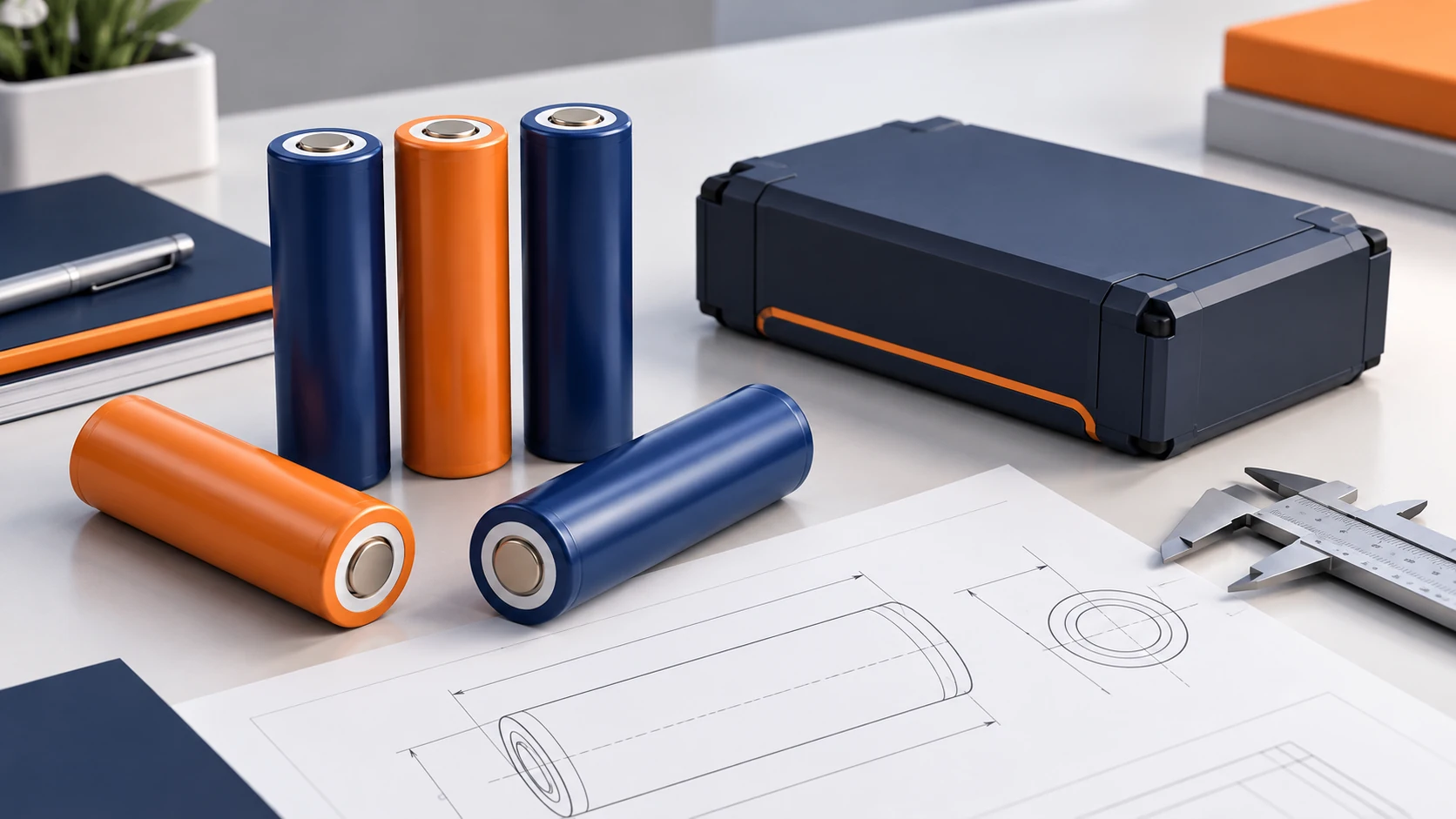
A cell order and a battery pack order require different deliverables. A loose cylindrical cell needs a defined model, capacity variant, terminal arrangement, dimensions and operating limits. A finished pack also needs a configuration drawing, protection design, connectors, mounting details and an agreed equipment interface. State the required delivery form at the start of the request.
For a replacement program, provide the existing battery identification and the equipment specification. Do not assume that two products marked 18650 can be substituted simply because they fit the same holder. A protective circuit, raised terminal or different sleeve can affect the available clearance. The electrical requirements can differ even when the external dimensions appear close.
For a new product, describe what the battery must do during a complete operating cycle. Include normal operation, starting events, standby periods and charging opportunities. The application team can then review energy, current and packaging together. A purchasing request that contains only an annual quantity and an ampere-hour target leaves several important choices unresolved.
The Mottcell cell catalog is a starting point for loose-cell selection. If your project requires an enclosed assembly, review the separate battery pack product range and specify the finished assembly as a separate deliverable. A catalog cell entry does not establish that a particular complete pack has already been designed or approved.
The 18650 designation identifies a cylindrical size family. It does not fix the chemistry, capacity or charging requirements. In Mottcell's public tables, the INR18650 entries use 3.7V nominal voltage, while the IFR18650 entries use 3.2V nominal voltage. Keep those families separate when comparing offers and preparing the charger specification.
Selected entries are shown below. The model name repeats across several capacities in the catalog, so include the capacity in every sample label and order reference. Otherwise, a document that says only INR18650 can leave the actual variant unclear. The final drawing should also identify the terminal style and any added protection or assembly features.
| Catalog entry and capacity variant | Nominal voltage | Capacity | Published diameter | Published height |
|---|---|---|---|---|
| INR18650, 2000mAh | 3.7V | 2000mAh | 18.1 ± 0.3mm | 65.0 ± 0.4mm |
| INR18650, 2600mAh | 3.7V | 2600mAh | 18.3 ± 0.3mm | 65.0 ± 0.4mm |
| INR18650, 3500mAh | 3.7V | 3500mAh | 18.3 ± 0.3mm | 65.0 ± 0.4mm |
| IFR18650, 1500mAh | 3.2V | 1500mAh | 18.3 ± 0.3mm | 65.3 ± 0.4mm |
| IFR18650, 2000mAh | 3.2V | 2000mAh | 18.3 ± 0.3mm | 65.3 ± 0.4mm |
Source: Mottcell public cell tables. These are selected rows, not an availability list or a complete specification. Dimensions include published tolerances. Ask for a controlled drawing before setting holder clearances or accepting a protected-cell version.
Capacity comparisons across these two families need a voltage basis. A cell with a larger mAh figure does not automatically provide proportionally more energy in a different voltage system. Your equipment's permitted voltage range, charging method and protection thresholds must be reviewed alongside the nominal value. Ask the supplier to identify the proposed chemistry explicitly in the quotation.
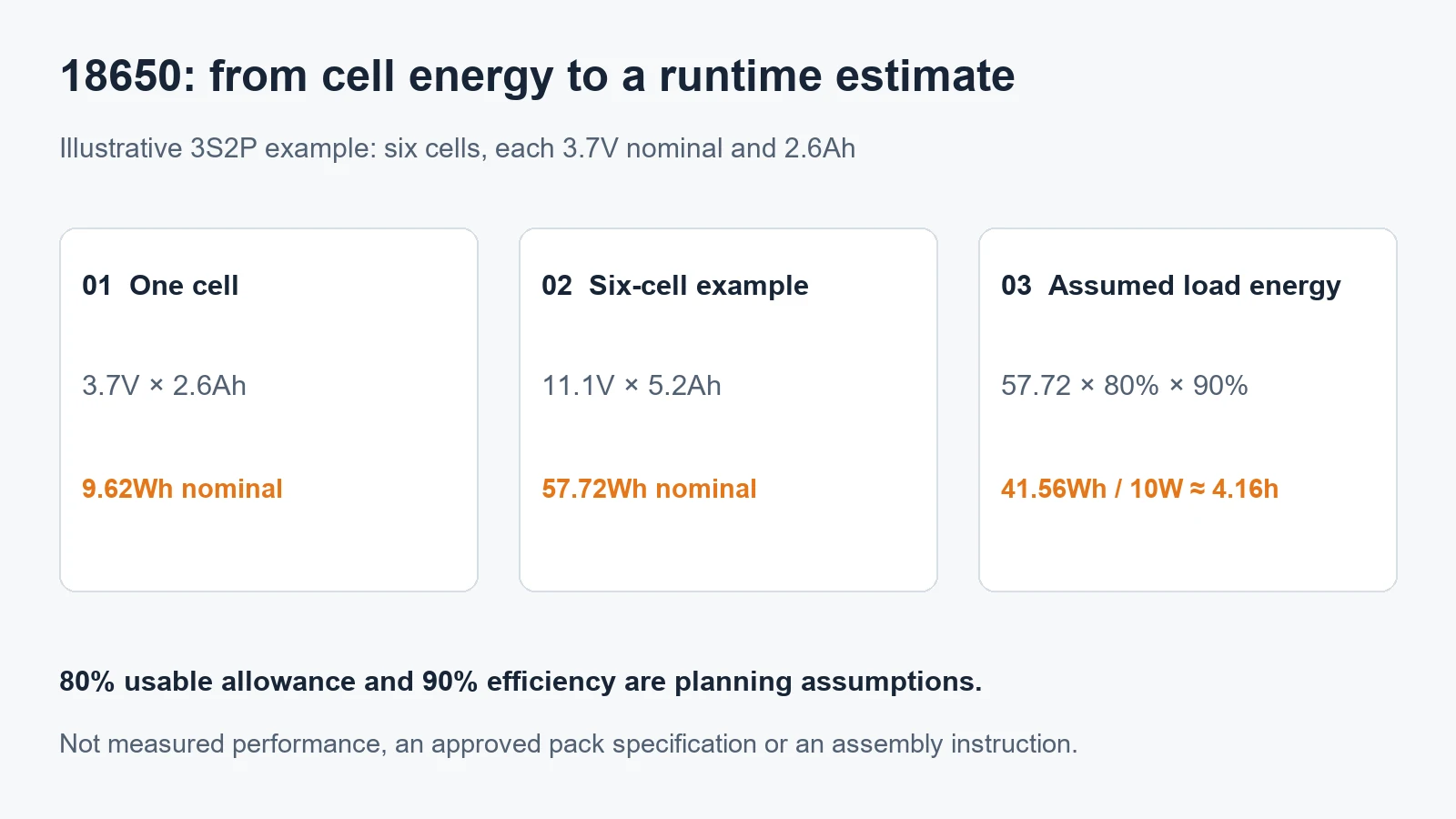
For an initial comparison, nominal watt-hours equal nominal voltage multiplied by capacity in ampere-hours. A 3.7V, 2600mAh example therefore has 3.7 × 2.6 = 9.62Wh of nominal energy. This calculation does not establish usable energy at your equipment connector. Discharge conditions, conversion losses and the equipment cutoff affect the result.
Consider an illustrative 3-series, 2-parallel configuration using that nominal example. Six cells give 11.1V nominal voltage, 5.2Ah capacity and 57.72Wh nominal energy. Series connection increases voltage, while parallel connection increases the group's capacity. This is an arithmetic example for a design discussion. It is not a Mottcell pack specification or an instruction to assemble a battery.
If a preliminary budget assumes that 80% of nominal energy is available and conversion efficiency is 90%, the estimated energy delivered to the load is 57.72 × 0.80 × 0.90 = 41.56Wh. At a constant 10W load, the simplified runtime is approximately 4.16 hours. Both percentages are declared assumptions. They are not measured cell performance, approved operating limits or warranty conditions.
Replace those assumptions with application measurements during qualification. A device that draws short bursts of power, spends time in standby or stops above the cell's specified cutoff needs a more detailed operating profile. Record the measured power over the duty cycle and the test temperature. Compare candidates using the same equipment configuration and the same endpoint.
Energy sizing answers how much energy a system may hold. Current review addresses whether the proposed cell and assembly can supply the load under the required conditions. Ask for the normal current, maximum continuous current and any pulse rating with its duration, recovery interval and temperature conditions. Keep those definitions attached to the figures throughout the purchasing process.
For the illustrative 10W load above, assume a 90% efficient converter and a pack voltage of 9.0V at the point being considered. The calculated input current is 10 ÷ 0.90 ÷ 9.0, or approximately 1.23A. With two ideal parallel paths, the arithmetic share would be about 0.62A per path. Real sharing and thermal behavior require validation. The assumed 9.0V value is not a recommended pack cutoff.
Read the headings in a supplier's table carefully. Recommended discharge current and maximum discharge current describe different quantities. A maximum figure without the associated conditions should not become the continuous design current for an enclosed product. Request the relevant curves and discuss the actual load profile with the responsible engineering team.
A pack's limits also depend on its protection, connections, conductors and thermal arrangement. Cell-level data alone cannot establish the rating of the finished assembly. Put the approved pack limits into the final equipment specification and use the same limits during sample validation. Starting and fault behavior should be reviewed as defined cases rather than hidden inside a general power claim.
Send the charger identification and its available settings with the sample request. Include the intended charge method, maximum voltage, current limits and the equipment behavior during charging. Ask the battery supplier to confirm how these requirements align with the exact cell variant and proposed assembly. Record the answer in the sample specification rather than relying on a product-family description.
Chemistry changes require a fresh review of charging and protection settings. A charger selected for one family should not be carried into another design solely because both products are described as rechargeable 18650 batteries. Review the full operating conditions, including the temperature range in which charging is permitted and how the equipment responds outside that range.
If a charging connector is included, identify the mating part and pin assignment in the drawing. Confirm which party supplies the charger and which party verifies the complete charging arrangement. For equipment with an external power source and simultaneous operation, provide that use case explicitly. It may differ from a battery that is charged only while the device is switched off.
For an industrial device program, the industrial battery application page can help frame the inquiry. Treat application categories as a discussion route. Approval still depends on the specific cell, pack, charger and equipment combination documented for your order.
Use the published dimensions to prepare a shortlist, then request the controlled drawing for the supplied form. Confirm the maximum assembled envelope, terminal geometry, sleeve coverage, polarity markings and required clearances. For a finished pack, include connector access, retention features and the position of any temperature sensing components identified in the agreed design.
A prototype that fits an open bench fixture may behave differently in the final enclosure. Provide the actual space constraints and the intended mounting arrangement before finalizing the sample. Engineering should review the assembly with its supporting components installed. Purchasing can then attach the approved drawing revision to the order instead of relying on a photograph.
Keep sample identification visible without treating the sleeve color as a model identifier. Record the manufacturer marking, capacity variant and batch information available for the delivered sample. If labels or terminal features change between the sample and production supply, request a documented comparison. An apparently small mechanical change can still require a fit review.
When the available volume cannot support the proposed 18650 arrangement, ask for an alternative platform review. The separate 26700 cell procurement guide discusses another size family. Compare alternatives against the same equipment needs rather than assuming that a larger format is automatically the better purchase.
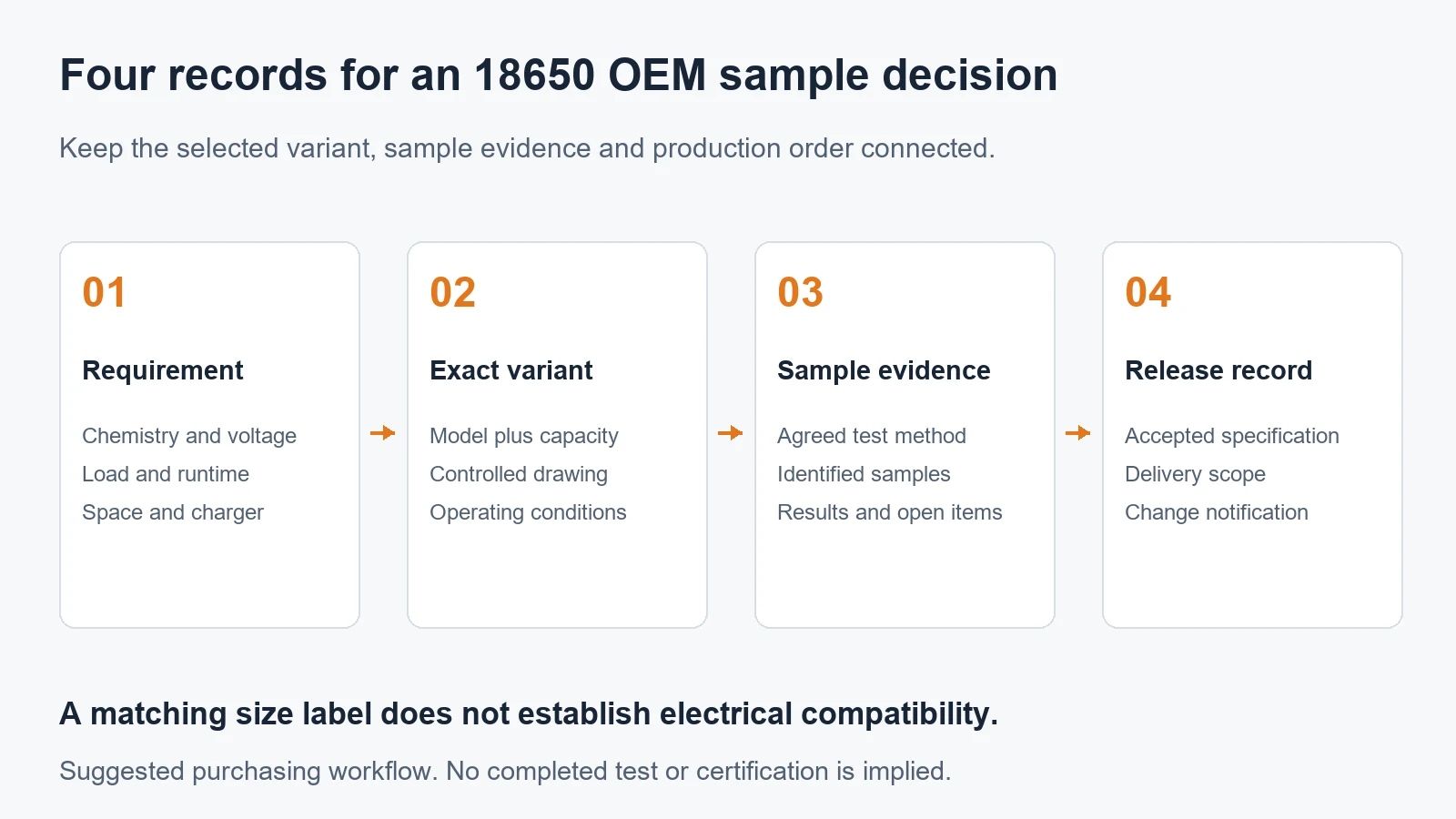
A useful sample order includes a written acceptance plan. Identify the exact variant, the number of samples, the test conditions and the records expected with delivery. Agree on what engineering will measure and what purchasing will verify. Set numerical acceptance limits through the project specification instead of copying thresholds from an unrelated battery model.
| Review area | Information to agree before testing | Record to retain |
|---|---|---|
| Identity and dimensions | Model, capacity variant, drawing revision, supplied form | Sample identifiers and dimensional results |
| Capacity measurement | Charge method, rest periods, discharge current, temperature, endpoint | Test procedure and measured results |
| Load operation | Duty cycle, starting events, equipment voltage limits | Logged behavior and unresolved exceptions |
| Resistance measurement | Method, instrument settings, temperature and state of charge | Results with measurement conditions |
| Charging and protection | Charger configuration, agreed operating limits and responses | Integration review and test observations |
| Production release | Approved specification, packaging, traceability and change rules | Signed sample reference and release decision |
A result without its method is difficult to compare. For example, resistance measurements taken with different methods or at different states of charge should not be treated as directly equivalent. Ask for the measurement conditions and retain them with the values. If supplier and customer results disagree, align the procedure before deciding whether the sample fails the agreed requirement.
Separate observations from decisions. A measured value belongs in the test record. Whether that value meets the requirement belongs in the acceptance decision. List open questions and the person responsible for resolving each one. Release the sample only after the relevant requirements have been addressed, and preserve the approved sample reference for production comparison.
Company information helps establish whom you are dealing with, while product documents identify what you are buying. Mottcell's company and quality information provides a starting point for supplier review. A company-level statement does not establish certification, performance or suitability for every 18650 variant. Request evidence that names the proposed product and its scope.
For documents supplied during qualification, compare the model, capacity, manufacturer identity and revision with the sample and quotation. If a report describes a different pack configuration, ask the supplier to explain the relationship. An image of a certificate or an unexplained compliance logo should not replace a document review by the party responsible for the finished product's requirements.
Transport documentation deserves its own check. PHMSA provides lithium battery test summary guidance explaining the role of the UN 38.3 test summary. Ask for the applicable documentation and have the responsible shipping specialist confirm the requirements for the actual shipment. This guide does not establish that a Mottcell variant has passed a particular test or approve a shipping method.
Traceability should connect the agreed model to the delivered lot. Ask what identifiers appear on cells, sample records, packaging and shipment documents. Decide how substitutions and specification changes will be communicated. Retaining these references makes a later quality discussion more precise than comparing wrapper colors or informal descriptions from previous quotations.
Before comparing prices, align the proposed cell variant, quantity, included services, packaging and delivery scope. Ask whether a quotation covers loose cells, matched groups or a completed pack. Identify which documents and sample work are included and which require separate agreement. Record the quotation validity and the assumptions behind the proposed production schedule.
An offer that includes a charger, protection electronics and final assembly is different from an offer for cells alone. Put the differences into a comparison record rather than dividing both totals by the number of cells. The relevant purchase is the approved deliverable for your equipment. A low unit price provides little information when the delivered scope remains unclear.
For repeat orders, agree on the procedure for changing a cell variant, component or drawing. Identify which changes require notification and which require renewed sample approval. Define how retained reference samples and production records will be used if a concern arises. These are proposed commercial controls for discussion, not a statement of standard terms already offered by Mottcell.
Avoid planning around an unconfirmed lead time, minimum order quantity or warranty. Request the current terms for the exact variant and delivery scope. Put the confirmed terms into the order documents. If your launch depends on an approval milestone, include that dependency in the schedule rather than assuming that sample delivery automatically means production release.
A concise request can include the equipment application, delivery form, permitted voltage range, normal and starting load, runtime target, available space, charging arrangement and expected order stages. Add the destination market and documents your organization requires. Attach the equipment or enclosure drawing when available, and clearly identify any details that are still preliminary.
Ask Mottcell to propose a specific cell variant or pack configuration and identify the documents needed for evaluation. Request a quotation that separates samples, engineering work, production supply and any accessories. The response should let your team trace the proposed solution back to the requirements. Resolve differences before treating the quotation as a final design agreement.
For a larger rechargeable-cell comparison, the 4860 battery sourcing guide follows a separate size and supply discussion. Keep this 18650 article focused on its own cell families and OEM qualification process. Related guides can support a shortlist without making different products interchangeable.
Use the Mottcell inquiry page to send the load profile, target capacity, drawing and sample requirements. Ask for a current specification and an application review for the proposed model. That gives purchasing and engineering a common document set for the next decision, with clear limits on what has been confirmed and what still needs testing.
No. Confirm chemistry, operating voltage, charging requirements, capacity variant, current limits and assembled dimensions. Mottcell lists both INR and IFR families. Similar size markings do not establish electrical compatibility or approval for the same equipment.
Request cells when your organization controls and validates the pack design. Request a finished assembly when the required scope includes protection, connections, packaging and equipment integration. Define the responsibilities and deliverables in either case before sample approval.
Ask for the exact variant, current specification, drawing, sample identifiers, proposed acceptance conditions and available model-specific documents. Confirm commercial scope separately. General claims about certifications, cycle life or compatibility should be supported by evidence for the proposed product and conditions.
12V 300Ah Battery Pack: Series vs Parallel OEM Guide
12V 50Ah LiFePO4 Battery Pack: Size, Runtime & OEM Guide
22650 LiFePO4 Battery Manufacturer: OEM Buying Guide
36V Battery Pack for E-Bikes and AGVs: OEM Buying Guide
12V 100Ah Battery Pack: Compare 3 Models for OEM Buyers
12V 280Ah Battery Pack: Solar Runtime & OEM Buying Guide
18650 Battery Manufacturer: Cell Specs & OEM Checklist
12V 300Ah Battery Pack: Runtime, BMS and OEM Buying Guide
Established in 2005
In 2009, it was awarded the title of "National High tech Enterprise"
 zoe@mottcell.net
WhatsApp: 8617388790296
Fax: 86-0755-84042963
Skype: live:b0ebaecbb8782516
WeChat: +8613428749632

 VR show

 CN
 Home >


