

 Jun 25, 2026


A 12V 280Ah battery pack can be a useful starting point for a solar backup specification when the equipment needs a low voltage supply and several kilowatt-hours of stored energy. For a proposed 12.8V LiFePO4 configuration, nominal energy is 12.8 × 280 = 3,584Wh. Actual runtime depends on the load, conversion losses, usable capacity allowance and the selected pack's operating limits.
For a buyer comparing suppliers, the first task is to turn that capacity label into a written requirement. The enclosure, BMS, charging equipment and acceptance criteria all need to match the application. Start with the published energy storage battery range and ask which existing model or custom configuration can meet your requirement.
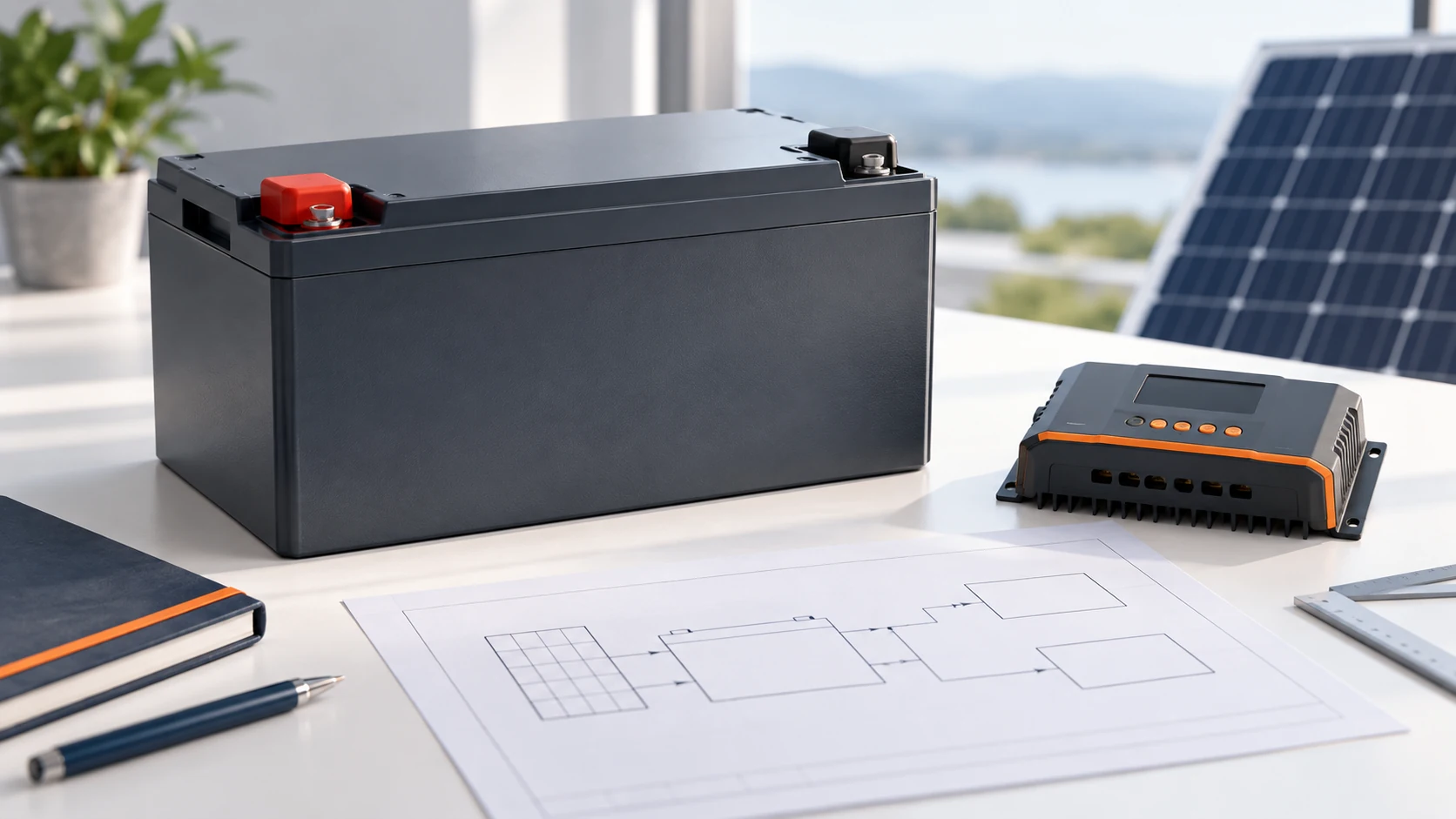
“12V” often describes the system voltage class, while a LiFePO4 quotation may use 12.8V as nominal pack voltage. Keep both terms clear in the purchasing specification. The device's permitted input range, the pack's charge limit and its discharge cutoff are separate values that require confirmation for the selected configuration.
Ampere-hours measure charge capacity under stated test conditions. Watt-hours help compare stored energy across voltage classes. A 280Ah label alone does not show how much AC energy reaches a load, how long a motor can start, or how much current the BMS permits continuously.
Specify the chemistry and nominal voltage before calculating energy. The 3.584kWh figure in this guide assumes 12.8V and 280Ah together. It is a planning calculation, rather than a measured result for an approved Mottcell 280Ah model.
The public product tables reviewed on October 21, 2026 list several neighboring capacities, including 200Ah and 300Ah. Those tables do not establish a complete 12.8V 280Ah pack specification. Request a controlled datasheet or a written custom proposal before treating current, dimensions, weight or protection features as confirmed.
Build the requirement from the equipment's daily energy use and its backup period. A remote monitoring cabinet that runs continuously has a different duty cycle from a pump that operates occasionally. Add the load's running watts, operating hours, standby consumption and any separate conversion equipment to the calculation.
For example, an assumed 50W DC load operating for 24 hours consumes 1,200Wh per day. An assumed 200W AC load operating for six hours also consumes 1,200Wh at the load, before accounting for inverter losses. Equal daily energy does not mean identical peak current or identical charging requirements.
Record essential loads separately from loads that can stop during poor solar conditions. Give each item a required backup duration. This makes it possible to discuss load shedding or a different system voltage instead of simply increasing the capacity number.
For a broader capacity comparison, use the 12V LiFePO4 capacity guide alongside the actual equipment list. The 280Ah page focuses on a specific purchasing requirement; the capacity guide helps decide whether that requirement is appropriate in the first place.
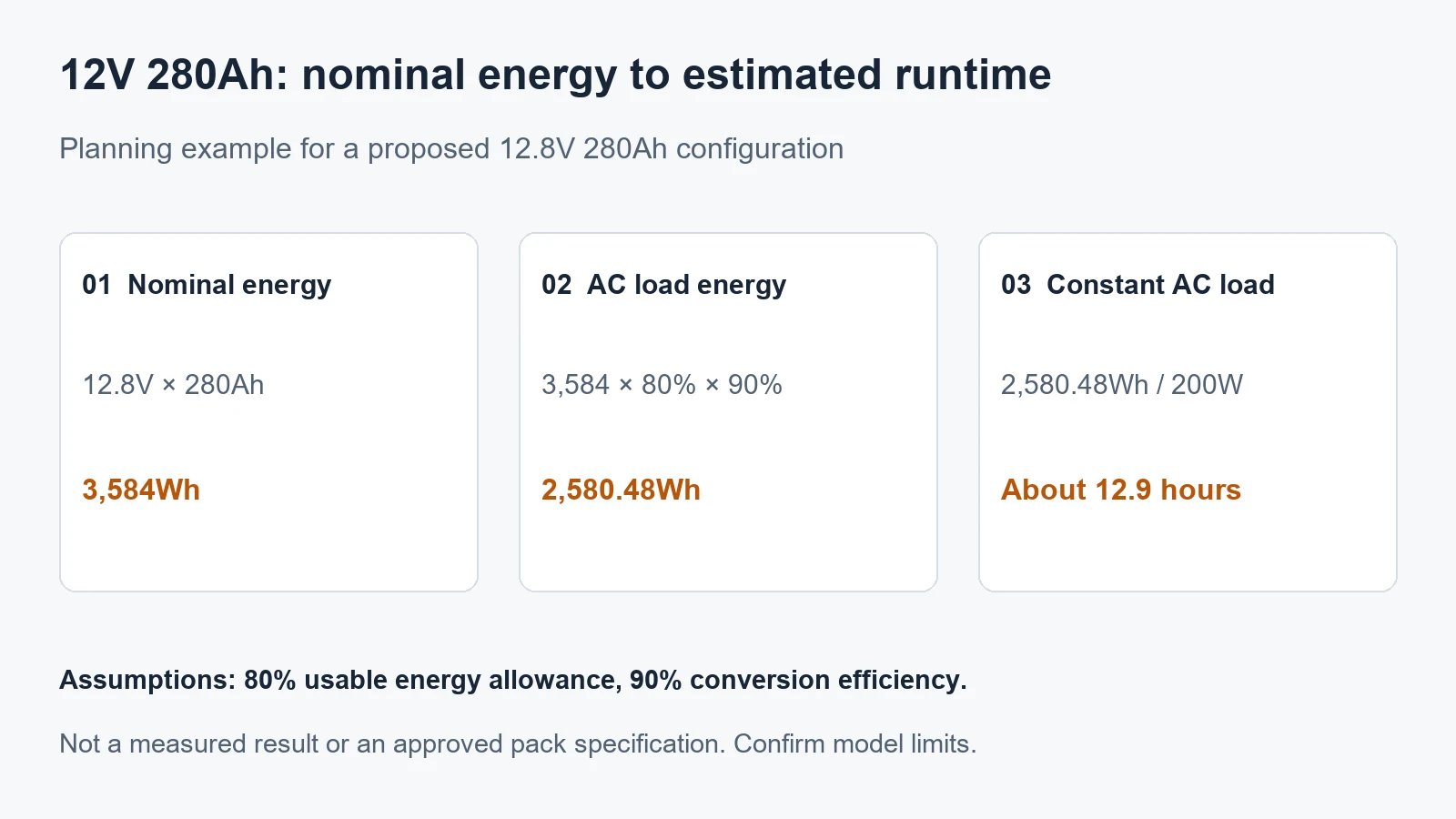
Estimate runtime from energy available to the load, then divide by load power. In the illustrative AC example here, 3,584Wh × 80% usable energy allowance × 90% conversion efficiency gives 2,580.48Wh. At a constant 200W load, that is approximately 12.9 hours. The two percentages are assumptions, not product guarantees.
The usable energy allowance leaves part of nominal energy outside the planning estimate. It is not a statement that a particular pack permits a particular depth of discharge. The selected cell, BMS, temperature, aging allowance and warranty conditions must support the final operating window.
For an assumed 100W direct DC load, applying the same 80% allowance gives 2,867.2Wh and approximately 28.7 hours, before DC conversion or other losses. Add those losses when the load uses a regulated converter. Do not apply the AC inverter efficiency factor to a direct DC circuit without checking the actual power path.
Compare the estimate with measured consumption from the intended equipment. Inverters may draw standby power, while compressors and motors may cycle rather than run continuously. A useful sample report states the load profile, starting state, temperature and stopping criterion so that another engineer can reproduce the result.
Energy capacity does not establish power capability. A hypothetical 1,000W AC load at 90% inverter efficiency would draw about 86.8A at an assumed 12.8V battery voltage. Current can rise as battery voltage falls. This arithmetic is a load estimate and does not establish a 280Ah pack's allowable current.
Ask the supplier to state continuous discharge current, peak current, the permitted peak duration and the conditions behind each value. Also ask what happens after an overcurrent trip. Automatic recovery, manual reset and charger assisted recovery can have different consequences for unattended equipment.
The BMS needs to suit the proposed cell arrangement and equipment behavior. A communication connector alone does not prove that a controller can interpret the messages. Where monitoring is required, request the protocol, pin assignment, supported data fields and a compatibility check with the exact receiving device.
Keep protection functions distinct from routine control. A BMS cutoff should not become the normal way an inverter manages every discharge cycle. The integrator should coordinate operating limits and recovery behavior, with the battery supplier reviewing the proposed settings for the selected configuration.
If the required power implies difficult current levels or cable routing, review the system voltage with the equipment designer. The metal enclosure battery pack range offers a starting point for discussing different voltage classes and custom requirements, without assuming that any listed model suits this installation.
Reusing a controller requires checking its available settings against the approved battery specification. “Lithium compatible” is too broad to establish a match. Give the battery supplier the controller model, firmware, charging stages, voltage settings, current settings and any temperature related functions before approving the pairing.
A controller's maximum charging current and its photovoltaic input limits are separate from battery energy capacity. The array design must stay within the controller's documented limits across expected conditions. The battery must also accept the proposed charging current under the applicable temperature and operating conditions.
Ask whether any lead acid functions remain enabled, including equalization or a charging profile that the battery supplier has not approved. Do not copy voltage settings from another LiFePO4 brand, from a different series arrangement, or from this guide's nominal energy arithmetic.
For a lithium replacement project, document the existing charger and load behavior before ordering. The 12V battery manufacturing and OEM guide explains the broader requirement and sample review process. Keep the approved charging profile attached to the exact pack revision in the purchase file.
Size solar replenishment around the daily energy budget and local solar resource. As a simple illustration, replacing 1.2kWh per day with four assumed equivalent full sun hours and a 75% overall energy yield requires 400W of array rating: 1,200Wh ÷ 4h ÷ 0.75. This is an illustrative energy balance, not an array design.
The assumptions must reflect the actual location and season. Shading, orientation, weather, controller behavior and energy used while charging change the result. A system that balances energy on a clear average day may still fail to recover after several poor solar days.
Specify how quickly the system must recover after a backup event. Restoring a large energy deficit while continuing to operate the load is different from replacing an ordinary day's consumption. The designer must check both the daily energy balance and the available charging power within approved battery limits.
For sites with a second power source, describe when grid charging or a generator becomes available. Record any restrictions on charging hours. This allows the supplier and integrator to review the battery requirement against the operating plan instead of promising a fixed number of “days of autonomy” without a defined load.
Use published configurations as reference points while keeping unconfirmed targets separate. The current energy storage table lists SMG12200BE at 200Ah and 2,560Wh, and SMG12300BE at 300Ah and 3,840Wh. A proposed 12.8V 280Ah configuration calculates to 3,584Wh, but its remaining specifications need a supplier proposal.
| Capacity choice | Energy reference | Evidence available | Purchasing implication |
|---|---|---|---|
| SMG12200BE, 200Ah | 2,560Wh in the public table | Listed model and dimensions L531 × W206 × H217mm | Confirm the current controlled specification and available configuration |
| Proposed 12.8V 280Ah | 3,584Wh by nominal voltage × capacity | Calculation only; complete target pack specification not established by the reviewed tables | Request a model identifier, drawing, current limits and sample plan |
| SMG12300BE, 300Ah | 3,840Wh in the public table | Listed model and dimensions L522 × W238 × H221mm | Compare the approved model against the same load and installation requirement |
The energy difference between the proposed 280Ah configuration and the listed 300Ah reference is 256Wh, about 7.1% of 3,584Wh. That difference alone does not determine value. Available space, approved current, charger matching, sample cost and delivery scope can be more important for a particular purchase.
If 300Ah remains an option, the 12V 300Ah procurement guide provides a separate model focused comparison. Ask for quotations against the same requirement sheet so the team can identify what actually changes between the alternatives.
An actionable quotation identifies the supplied configuration and the evidence needed to accept it. Include required quantity, destination market, load profile, backup duration, available space, charging equipment and environmental conditions. Ask the supplier to return a clear list of confirmed values, proposed options and unresolved questions.
| Review item | Information to request | Record needed before approval |
|---|---|---|
| Pack identity | Model, chemistry, nominal voltage, capacity and revision | Controlled specification linked to the quotation |
| Power and protection | Charge/discharge limits, peak duration, cutoff and recovery conditions | Agreed operating limits and protection behavior |
| Mechanical fit | Dimensions, mass, mounting, terminal arrangement and service access | Approved drawing and installation review |
| System interface | Charger settings, controller details and any communication protocol | Compatibility review for the exact equipment |
| Sample acceptance | Capacity method, load profile, temperature and inspection criteria | Identified sample report with pass conditions |
| Supply and documentation | Packaging, transport documents, lead time, warranty and change notification | Written delivery scope and model relevant documents |
Price comparisons should use the same delivery scope. Check whether terminals, connectors, communication cables, packaging and sample reports are included. List recurring order quantities separately from prototype quantities so the quotation does not hide different production or approval assumptions.
For transport documentation, ask for the relevant UN 38.3 test summary and verify that it applies to the supplied type. PHMSA's test summary guidance explains this documentation requirement. A test summary does not by itself establish every shipment's compliance or prove suitability for the intended application.
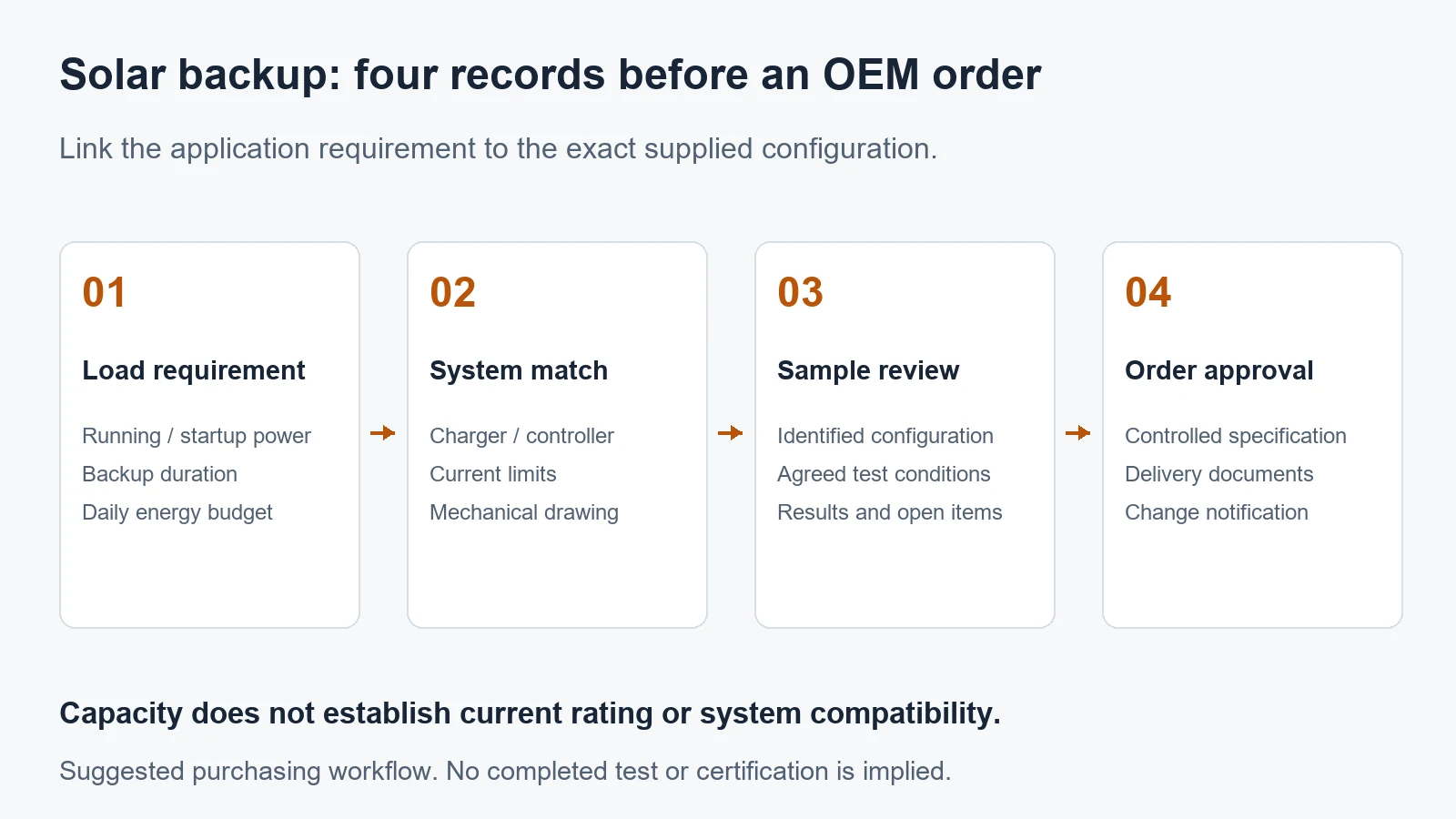
Agree on sample acceptance before dispatch. Identify the sample configuration, document revision, equipment and measurement conditions. A report that only says “passed” gives a procurement team little basis for comparing suppliers or investigating a later difference between the sample and a production delivery.
Capacity evaluation should state the charge procedure, rest period if applicable, discharge conditions, temperature, end criterion and measured result. Keep nominal energy separate from delivered energy under the test. The parties should resolve the method and acceptance threshold rather than choosing whichever result looks best afterward.
Review the intended system behavior as well as steady operation. An integrator may need to observe load startup, approved charging transitions, loss of the charging source and recovery following a controlled shutdown. Any test involving protection limits or abnormal conditions requires a supplier agreed procedure and suitable test facilities.
Inspect the drawing against the available installation space. Include room for terminal protection, mounting, ventilation where required by the system design and maintenance access. A case that fits inside a cabinet can still be unsuitable if the service team cannot reach its disconnect or remove it safely.
Record open items with an owner and an agreed resolution. A successful sample should lead to an approved configuration and acceptance record, rather than a general statement that every pack with the same capacity is equivalent.
For example, if the sample meets the energy target but trips when the load starts, retain both results in the review. Ask whether the startup demand, protection threshold or equipment configuration explains the interruption. Changing the acceptance record to “capacity passed” would leave the original application requirement unresolved, even though the capacity measurement itself may be valid.
Include the intended storage interval before installation. A sample tested immediately after delivery does not represent every later storage condition. Ask the supplier for the approved storage instructions, inspection schedule and preparation needed before commissioning, then assign responsibility for those steps within the receiving and installation teams.
Connect the approved sample to the production order through a model identifier, drawing and specification revision. Request notice of changes that could affect performance, fit, protection behavior or interface compatibility. The purchasing team needs a way to distinguish an accepted substitute from an undocumented production change.
Agree on the records that accompany each delivery, such as model identification, quantities and the inspection results included in the order. Traceability arrangements should be explicit in the supply agreement. Do not infer a particular level of cell or pack traceability from a generic factory description.
Keep the warranty discussion tied to the intended use. Ask about temperature, cycling conditions, storage, approved charging equipment and the information required for a claim. A cycle count without its test conditions and end of life criterion cannot support a useful lifetime comparison.
The company About page can help establish who the supplier is and what capabilities it describes. Model documentation and sample evidence answer a different question: whether the specific proposed configuration meets your project. Keep both forms of evidence in the review rather than substituting one for the other.
No. 3.584kWh is nominal energy when the assumed configuration is 12.8V and 280Ah. Usable AC energy depends on the approved operating window, conversion losses, temperature and load. With the illustrative 80% allowance and 90% efficiency used here, load energy is about 2.58kWh.
Only use an arrangement that the supplier explicitly approves for the exact pack and BMS. Request the permitted number of packs, matching requirements, protection design and charging arrangement. Capacity and nominal voltage labels do not establish permission to connect packs together.
Send the load's running and startup power, required backup hours, charger/controller details, operating conditions, installation drawing, quantity and destination market. Request a quotation that identifies an existing model or proposed custom configuration. Mark any unconfirmed values so the sample review can resolve them.
Send the requirement sheet through the Mottcell inquiry page, including whether 280Ah is mandatory or whether a documented neighboring capacity is acceptable. Ask for the exact configuration, controlled drawing, operating limits and a sample acceptance proposal. This gives purchasing and engineering a common basis for reviewing the offer.
Editorial basis, updated October 21, 2026: this guide uses the public product tables linked above and explicitly stated planning calculations. It does not report a completed 280Ah product test, a customer installation or model specific certification. Confirm the proposed pack specification and application conditions with the supplier before approval.
12.8V 200Ah Battery Pack Factory: OEM Sourcing Guide
12V 200Ah Battery Pack: Solar Charge Controller Guide
Top 18500 Lithium-Ion Battery Manufacturer (Guide)
15kWh HESS for Solar Systems: AC vs DC Coupling Guide
12V LiFePO4 Battery Capacity Guide: Ah, Wh and Runtime
12V 300Ah Battery Pack: Series vs Parallel OEM Guide
12V 50Ah LiFePO4 Battery Pack: Size, Runtime & OEM Guide
22650 LiFePO4 Battery Manufacturer: OEM Buying Guide
Established in 2005
In 2009, it was awarded the title of "National High tech Enterprise"
 zoe@mottcell.net
WhatsApp: 8617388790296
Fax: 86-0755-84042963
Skype: live:b0ebaecbb8782516
WeChat: +8613428749632

 VR show

 CN
 Home >


