

 Nov 04, 2026


A 15kWh HESS for solar systems can be considered for either an AC-coupled retrofit or a DC-coupled solar-and-storage design. The useful starting question is which equipment and operating modes the project needs to retain. Battery capacity alone does not determine the architecture, keep solar running during an outage, or establish compatibility with an existing inverter.
This guide helps solar installers, distributors and OEM buyers compare those two purchasing routes. It concentrates on the interfaces between solar generation, conversion equipment, storage and backed-up loads. For capacity variants and runtime calculations, use the existing 15kWh HESS capacity and backup guide. Here, the objective is an architecture decision that can be carried into a model-specific quotation and acceptance plan.
The examples describe planning situations, not completed Mottcell installations. References to inverter manufacturers explain general architecture choices; they do not certify a Mottcell battery pairing. Final electrical design, protection and installation must follow the selected equipment instructions and the site's applicable requirements.
Coupling describes where the solar and storage power paths meet. An AC-coupled arrangement connects them through an AC network, commonly with a PV inverter and a separate bidirectional battery inverter. A DC-coupled arrangement brings solar charging and storage together on the DC side through the specified conversion equipment. The battery itself stores DC energy in either case.
In a typical AC charging path, solar DC passes through the PV inverter to become AC, then through the storage conversion stage to charge the battery. In a DC charging path, solar energy reaches storage through the relevant DC conversion stage before the stored energy is converted for AC loads. These are functional descriptions, not connection instructions.
A hybrid inverter can combine several functions, but the word “hybrid” does not identify every supported operating mode. Some projects also combine AC-coupled existing PV with additional DC-coupled solar. Compare the proposed power paths and approved equipment combinations rather than assuming that one product label defines the entire installation. Yaskawa's AC/DC coupling comparison provides a manufacturer reference for the distinction between the two coupling points.
An existing solar installation changes the purchasing decision because replacing working equipment has a cost and a practical scope. Record the PV inverter model, installed solar configuration, monitoring arrangement and current grid connection before comparing batteries. Also establish who owns the equipment and which existing service or warranty arrangements the project intends to preserve.
SMA's battery inverter overview describes both retaining an existing PV inverter while adding battery conversion equipment and modifying a system with a hybrid inverter. That supports considering both routes. It does not mean every existing inverter can participate in every backup configuration, or that one route will always be cheaper.
Ask the installer for a proposed system boundary drawing identifying retained, replaced and added equipment. Include the meter, backed-up circuits and any export-control device. This drawing makes competing offers comparable: a battery-only quotation should not be mistaken for an installed retrofit package that includes the conversion, switching and monitoring equipment.
The best architecture is the one that meets the required operating modes with an approved equipment set and a manageable installation scope. An existing PV inverter can make an AC retrofit attractive. A new installation can make shared DC conversion worth evaluating. Neither starting point eliminates the need to check backup operation and control compatibility.
| Project question | AC-coupled route to investigate | DC-coupled route to investigate |
|---|---|---|
| What happens to existing PV equipment? | Identify the PV inverter and monitoring equipment that can remain. | Identify any inverter replacement, PV-side redesign or retained equipment. |
| How does solar reach the battery? | Follow PV conversion to the AC network, then battery charging conversion. | Follow the approved PV-to-storage DC conversion path. |
| Which loads remain powered during an outage? | Check the battery inverter, backup boundary and PV control arrangement. | Check the hybrid or inverter/charger backup outputs and supported modes. |
| Which evidence establishes compatibility? | Review the battery pair and the behavior of retained PV equipment. | Review the battery pair plus PV input and charging requirements. |
| What must be included in the price? | Battery conversion, metering, backup equipment and retrofit work as applicable. | Hybrid/DC conversion, PV changes, metering and backup equipment as applicable. |
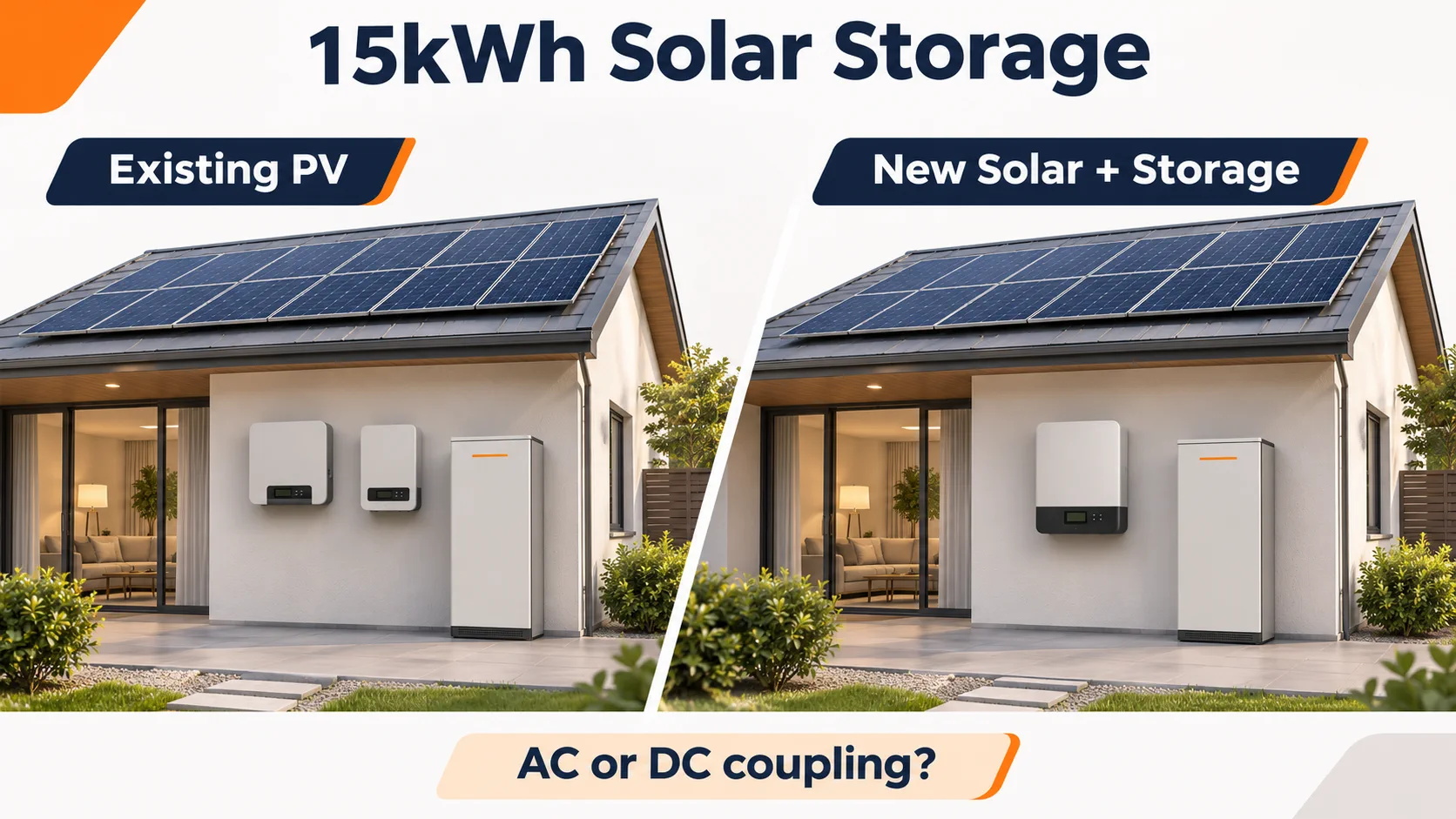
Investigate AC coupling first when the project wants to retain a suitable PV installation and add storage through a separate conversion path. This can keep the solar-generation and storage functions distinct. The practical advantage depends on the actual equipment, the site layout and the changes required to deliver the requested operating modes.
Consider a house with an established rooftop array and a functioning PV inverter. The customer wants to shift some daytime generation into evening use. A retrofit proposal should explain how surplus generation is measured, which device controls charging and how import or export limits are managed. Simply adding a cabinet does not answer those questions.
If the customer also expects backup power, extend the review beyond normal grid-connected operation. Establish where the retained PV inverter sits relative to the backup boundary and whether its output can be controlled in the proposed mode. Ask for documented behavior during loss of grid, full battery, low battery and return of grid. These are separate acceptance questions.
Investigate a DC-coupled design when solar and storage are being specified together, or when replacing existing conversion equipment is already part of the project. The design can offer a direct solar-to-storage charging path. Its value depends on energy use, approved equipment, installation work and the complete operating strategy.
A new-build project has more freedom to coordinate the PV inputs, battery and conversion equipment from the beginning. The quotation should identify the exact hybrid inverter or charge-controller architecture. Record which functions share hardware, what service access is needed and what happens if a shared component is unavailable. Fewer enclosures do not automatically mean simpler service.
Keep PV input requirements distinct from battery input requirements. A battery's nominal voltage does not establish an inverter's allowable solar input. Ask the responsible designer to review the proposed PV configuration against the selected device instructions. If an offer replaces a working inverter, include the replacement and commissioning scope when comparing its commercial value with a retrofit alternative.
Conversion stages matter, but a coupling label is not a measured system efficiency. Compare the energy route that matches the customer's use: solar directly supplying daytime loads, solar charging storage, battery supplying evening loads, or grid charging where permitted. Each route has its own operating conditions and measurement boundary.
A household using most solar generation immediately does not send all generated energy through storage. Applying a battery-path loss to the entire PV output would exaggerate its effect. Conversely, a customer expecting substantial evening use needs a comparison that includes the charging and discharge paths, auxiliary consumption and relevant part-load operation.
Request efficiency evidence for the proposed equipment and an explanation of the modeled use pattern. For financial comparisons, keep energy-price assumptions, throughput, export treatment and maintenance scope visible. Do not turn an advertised converter figure into a whole-system savings guarantee. A lower conversion loss can be useful without proving that the complete installation has the lowest lifecycle cost.
Storing solar energy and supplying loads during a grid outage are different requirements. A battery capacity label does not identify the backed-up circuits, transfer behavior, power limit or the conditions for solar generation to continue. Specify the outage behavior explicitly before approving an AC or DC architecture.
The Victron ESS design manual distinguishes PV and loads on the input side from equipment on the inverter/charger output side. In its described arrangements, that location changes which loads and PV remain available during grid loss. This is an example of why the system boundary matters; it is not an approval of another manufacturer's equipment combination.
Define whether backup covers selected circuits or a larger part of the property, and list loads that must remain excluded. Ask how the proposed system handles an abrupt load change, a nearly full battery and a prolonged outage. Record the expected behavior in plain terms so the customer, installer and supplier are accepting the same operating result.
Recovery behavior can decide whether a solar-storage architecture meets the customer's needs. Ask what happens after the battery reaches its permitted low-energy condition, after protective shutdown and after grid restoration. A system that performs well during a short demonstration may still need a defined recovery path for a longer interruption.
AC-coupled backup systems need coordinated control of the PV inverter and the equipment establishing the local AC supply. Victron's AC-coupling documentation describes specific sizing and control constraints for its own inverter/charger arrangements. Such limits should be checked in the selected manufacturer's documents rather than copied as universal rules for all solar batteries.
Include a scenario in which solar becomes available while storage is at its approved minimum operating state. Ask which equipment starts first, what energy source enables that start and whether an operator action is required. The installer should define a safe, manufacturer-approved demonstration. A generic claim of “solar backup” is not a substitute for a documented restart sequence.
Specify the control priorities when more than one energy source returns. For example, the proposal should explain whether restored solar first serves loads or replenishes the approved battery reserve, and what changes when grid power returns. Record whether these priorities depend on a local controller or an external service. If internet access is unavailable, the agreed local operating behavior should still be clear. Test only the supported modes, using the delivered settings and the manufacturer's approved commissioning procedure.
The proposed battery and the complete solar-storage architecture must be identified separately. Mottcell lists a separate storage-battery family and an all-in-one family. Those catalogue categories help define the equipment being purchased, but they do not establish an AC retrofit mode, a particular inverter pairing or a finished site design.
The published home energy storage system table lists SMJ 15KWh T01 with 280/314Ah variants, a 16S software BMS description and an 850 × 450 × 250mm enclosure. The all-in-one system table separately lists SMJ 15KWh&10KW T01 with 314Ah and a 10kW rated-capacity field. These describe different equipment formats, not interchangeable configurations.
For either family, ask Mottcell to identify the exact supplied model and the conversion equipment included or required. Obtain written evidence for the proposed mode and pairing. Do not infer AC-coupling capability from the presence of an AC output, or infer universal inverter support from a software BMS description. The complete configuration still needs review.
A useful quotation comparison includes the equipment and work required to deliver the same agreed outcome. Separate battery price from conversion equipment, backup switching, metering, installation changes and commissioning. An attractive cabinet price can leave important project functions outside the offer, particularly when one supplier quotes a battery and another quotes a complete package.
| Review item | Evidence or scope to request | Acceptance question |
|---|---|---|
| Retained PV equipment | Model list and proposed retained/replaced boundary | Does the offer deliver the intended retrofit scope? |
| Battery and conversion pair | Exact model identities, approved limits and control arrangement | Is the quoted combination supported for the specified modes? |
| Backup operation | Backed-up circuit schedule and operating-mode description | Which loads and PV functions remain available? |
| Metering and export control | Included devices, installation scope and control responsibilities | Can the proposed system observe and regulate the required boundary? |
| Recovery and handover | Agreed checks, settings record and customer instructions | Can the customer operate and recover the delivered system as intended? |
Also allocate responsibility for resolving interface issues. A battery supplier may document its battery while an installer designs the AC arrangement and configures the retained PV equipment. Name who provides the complete system review and who closes any unresolved requirement. This prevents a collection of individually plausible components from being treated as an approved installation.
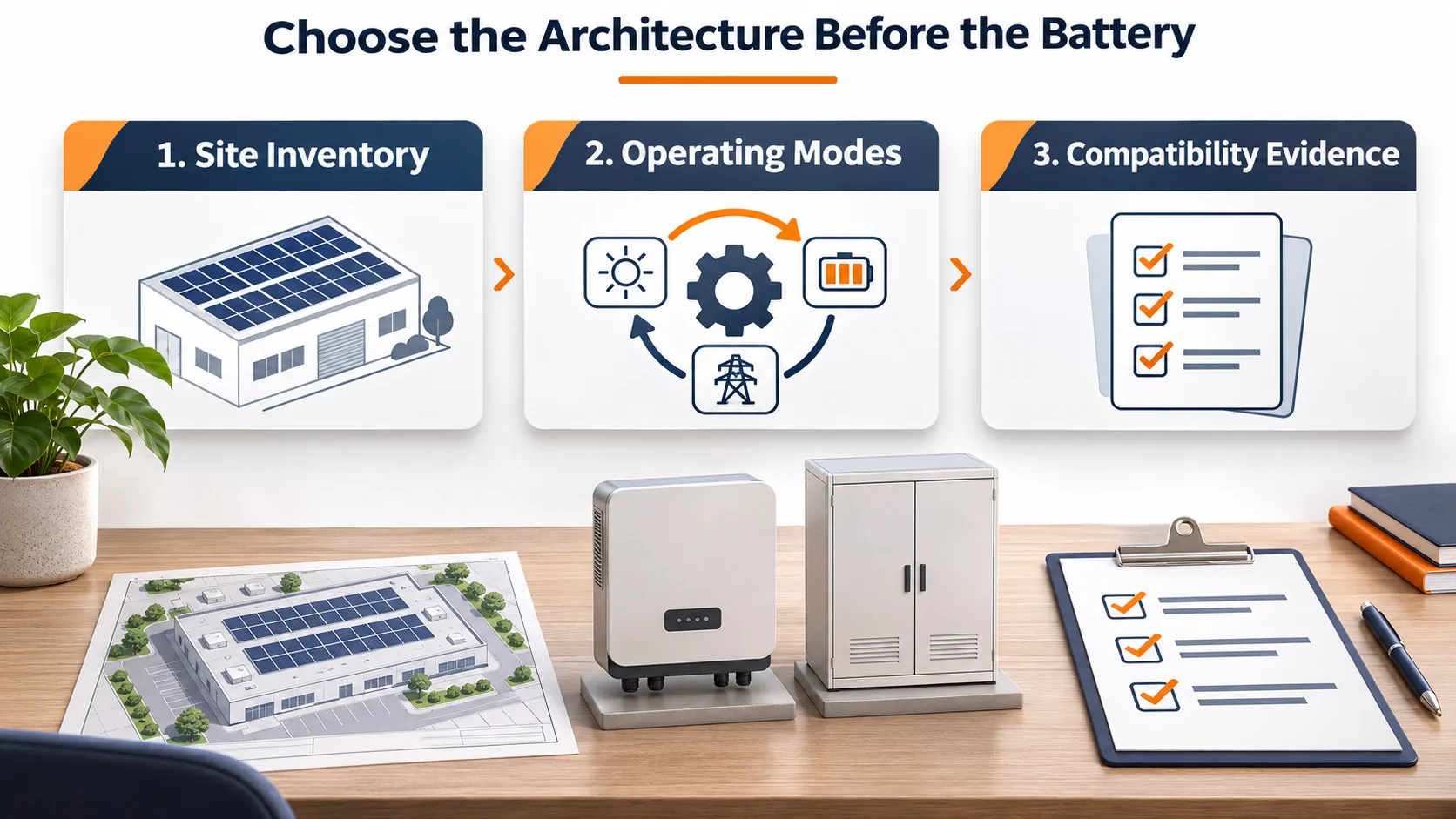
Compare each architecture against a concrete project situation before selecting it. A short scenario exposes assumptions that a capacity-led product comparison can miss. Use the same required loads, outage expectations and site constraints for both proposals, then ask each supplier to explain the retained equipment, added components and acceptance scope.
Assume the customer wants to retain a working PV inverter and primarily use surplus solar in the evening. Compare an AC retrofit that retains the inverter with a proposal replacing it for shared DC conversion. Evaluate installation disruption, equipment replacement, monitoring and service responsibilities. If backup is optional, price and describe it separately so it is not silently included in one proposal and excluded from the other.
Assume solar and storage are being ordered together and the customer requires a defined set of circuits during an outage. Compare how each proposal powers those circuits, manages solar when demand falls and recovers after low-battery shutdown. A DC-coupled design may be a sensible starting option, but the approved modes and equipment evidence should decide the purchase.
Send Mottcell and the responsible installer a brief that describes the current solar installation, the intended coupling route and the required operating modes. Include existing equipment identities, available site drawings, the backed-up load schedule and destination market. Mark decisions that remain open rather than presenting assumptions as confirmed requirements.
Ask the response to identify the battery model, conversion equipment, control responsibilities and supporting documents. For detailed battery-to-inverter questions, use the inverter matching checklist. Keep the architecture review connected to that evidence, without repeating a capacity calculation or approving a pairing solely because its nominal voltage looks suitable.
The commercial discussion should end with an agreed scope and a short list of unresolved interfaces. Require the revised offer to show how each item was closed. This gives OEM buyers and distributors a repeatable way to compare projects while allowing the selected installer to make site-specific design decisions.
It may be possible through a suitable AC retrofit or a redesign using other conversion equipment. Identify the existing inverter and required modes first. Ask for a supported complete arrangement; a battery capacity label alone does not establish compatibility.
No. Compare conversion paths, equipment replacement, installation scope and the expected operating pattern. A new-build design and a retrofit can have different costs. Request a complete offer rather than choosing on a converter-efficiency claim alone.
Only if the proposed equipment and backup arrangement support that behavior. Confirm the PV location, local-grid control, power constraints and recovery sequence. Ordinary grid-connected operation does not establish solar availability during an outage.
A 15kWh-class battery is one part of the solar-storage purchase. First decide what equipment to retain and which grid-connected, backup and recovery modes are required. Then compare documented AC and DC routes at the same scope. Send the project brief to the Mottcell enquiry team to discuss the battery format and the information needed for a model-specific quotation.
15kWh HESS for Solar Systems: AC vs DC Coupling Guide
12V LiFePO4 Battery Capacity Guide: Ah, Wh and Runtime
12V 300Ah Battery Pack: Series vs Parallel OEM Guide
12V 50Ah LiFePO4 Battery Pack: Size, Runtime & OEM Guide
22650 LiFePO4 Battery Manufacturer: OEM Buying Guide
36V Battery Pack for E-Bikes and AGVs: OEM Buying Guide
12V 100Ah Battery Pack: Compare 3 Models for OEM Buyers
12V 280Ah Battery Pack: Solar Runtime & OEM Buying Guide
Established in 2005
In 2009, it was awarded the title of "National High tech Enterprise"
 zoe@mottcell.net
WhatsApp: 8617388790296
Fax: 86-0755-84042963
Skype: live:b0ebaecbb8782516
WeChat: +8613428749632

 VR show

 CN
 Home >


