

 Jul 02, 2026


Published by Mottcell | Updated September 8, 2026
A 15kWh HESS supplier should help you answer two practical questions before you order: how much energy will reach the household's essential loads, and how much power can the complete system supply at one time? For installers, distributors and solar brands, those answers determine whether a proposed battery meets the customer's expectations. A capacity label alone cannot establish either result.
Quick answer: under an illustrative 90% discharge window and 94% conversion efficiency, a nominal 15kWh battery delivers about 12.69kWh to AC loads. That is approximately 12.7 hours at a constant 1kW load, assuming the system can support that load. Actual runtime depends on the model, starting state of charge, reserve settings, operating conditions and auxiliary consumption.

This guide combines Mottcell's published product tables with transparent planning examples. It is written for purchasing and project scoping; the calculations are not measured product performance. Use the selected model's current datasheet and the installer's design to replace the example assumptions before making a capacity commitment.
In this guide: capacity labels, product options, backup duration, reserve and recharge, power and compatibility, quotation requirements, and project enquiry.
HESS here means a home energy storage system. It may refer to a separate battery connected to a compatible inverter or to a combined battery and inverter product. Establish which equipment the supplier is quoting before comparing capacities, dimensions or price. An enclosure photograph does not reveal the full supply scope.
Energy capacity, measured in kilowatt-hours, describes the amount of energy stored. Power, measured in kilowatts, describes the rate at which energy is delivered. A 15kWh capacity label therefore does not imply a 15kW inverter. The US Department of Energy's solar energy and storage overview explains this energy-versus-power distinction and why storage involves conversion losses.
Ampere-hours are meaningful only alongside the battery's nominal voltage. For an illustrative 51.2V LiFePO4 configuration, nominal energy is voltage multiplied by ampere-hours and divided by 1,000. A 280Ah configuration calculates to 14.336kWh; a 314Ah configuration calculates to 16.0768kWh. Both may be discussed within a broadly described capacity class, but their arithmetic energy values differ.
Nominal energy in kWh = nominal voltage in V × capacity in Ah / 1,000. Use nominal voltage for this comparison. Using a maximum charging voltage would overstate the nominal energy calculation. The figures above illustrate the calculation at 51.2V; they do not replace a confirmed rating for every product marketed as 15kWh.
Ask the supplier to state the exact configuration, rated energy and usable energy definition on the quotation. Also ask which operating conditions apply to the stated capacity. If one offer says 280Ah and another says 314Ah, a difference in price may partly reflect a different quantity of stored energy. Compare the same specification before deciding which quotation is more competitive.
For related nominal-voltage and capacity questions, see the 51.2V HESS capacity guide. Keep these calculations separate from performance promises: nominal energy does not describe the energy available after reserve settings, conversion losses or the battery's condition are considered.
Mottcell's Energy Storage System range lists the SMJ 15KWh T01 battery module. The all-in-one energy storage range lists the SMJ 15KWh&10KW T01. The table below summarizes selected published fields checked on September 8, 2026. These are different product configurations.
| Published item | SMJ 15KWh T01 | SMJ 15KWh&10KW T01 |
|---|---|---|
| Equipment format | Separate storage battery | Battery and inverter in one unit |
| Listed cell capacity | 280/314Ah variants | 314Ah |
| Published electrical field | Charge/discharge range up to 100A | 10kW in the rated power field |
| Published dimensions | 850 × 450 × 250mm | 1300 × 640 × 160mm |
| Key project question | Which external inverter is compatible? | Does the complete unit match the site's supply and backup requirements? |
The battery-only format can be a starting point for a project with an existing inverter, provided the exact combination is supported. An all-in-one product can be evaluated for a new installation where the battery and inverter are procured together. Neither route removes the need to review installation scope, operating limits and the destination's project requirements.
Do not transfer a specification from one column to the other. In particular, the module's current figure and the all-in-one unit's power figure are not interchangeable ratings. Confirm the current datasheet, complete model designation and any variant suffix before ordering. The quotation should identify supplied accessories and any external equipment required for backup operation.
Begin with the circuits the customer wants to keep available. A selected-load backup plan might include refrigeration, communications, selected lighting and a workspace. Whole-home backup is a different requirement when cooking, space conditioning, water heating or vehicle charging may run together. Record the customer's actual appliances instead of relying on a generic household size.
For each load, record average consumption over the backup period and its operating schedule. Equipment that cycles may use less energy than its maximum input power multiplied by the entire outage duration. At the same time, its starting demand may be higher than its average consumption. Keep an energy calculation and a separate simultaneous-power assessment.
A useful load worksheet has columns for the circuit, evidence source, average power, planned operating hours and priority. Measurement over representative days is preferable when consumption determines the purchase. If a value comes from an appliance label or an estimate, mark that origin so the installer can identify which assumptions need checking.
Consider a planning example with an average 0.6kW essential load for eight hours, an additional 0.8kW workspace load for two hours, and a 1.5kW appliance used for half an hour. The corresponding energy is 4.8 + 1.6 + 0.75 = 7.15kWh at the loads. These are deliberately chosen inputs, not a survey of typical homes or a Mottcell customer case.
If all three loads operate together, their combined running demand is 2.9kW before any starting surge. That power requirement must be checked independently. A battery with enough stored energy could still fail to meet expectations if the inverter, battery current limit or backup output cannot support the simultaneous demand.
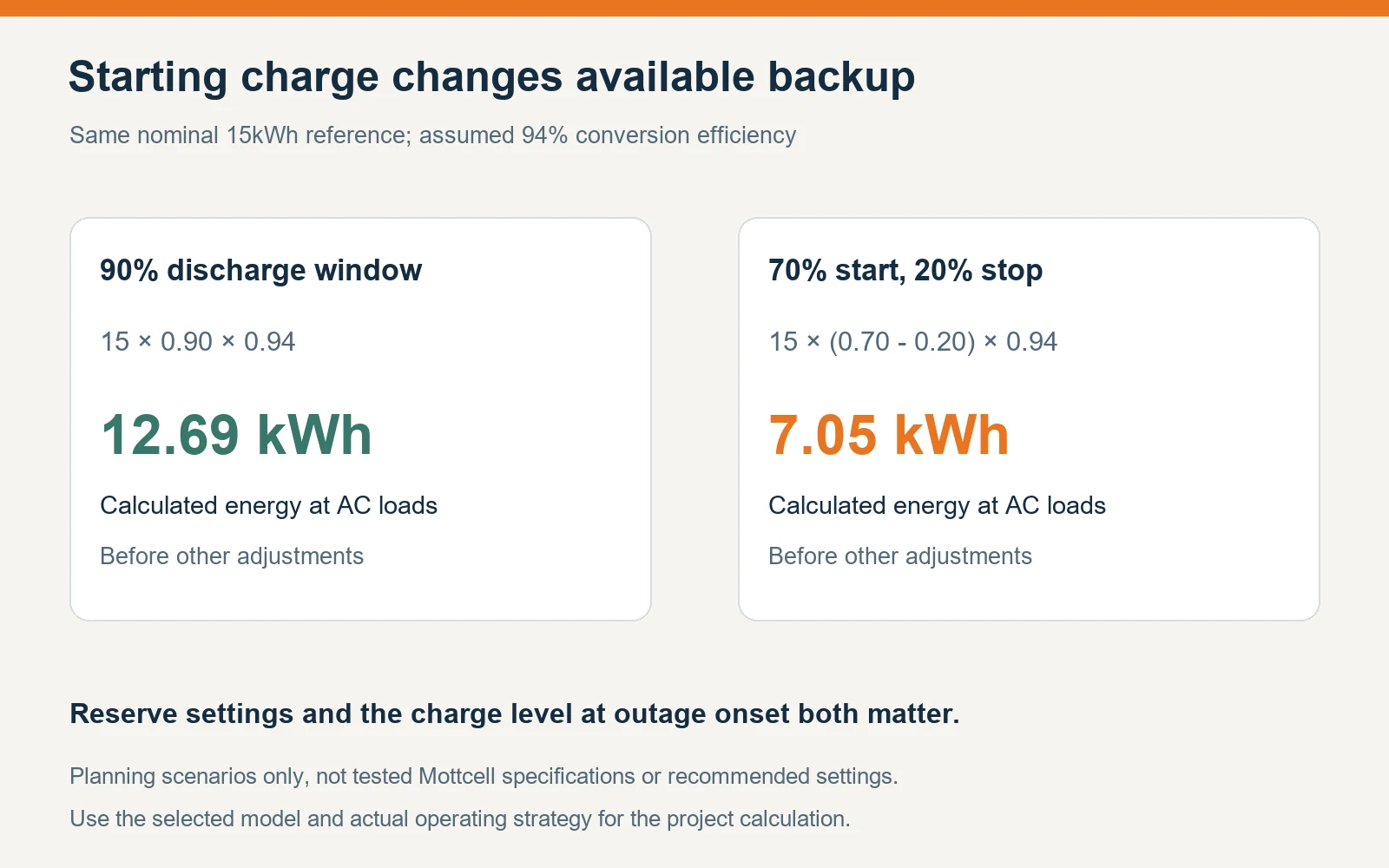
Now assume a nominal 15kWh reference battery, a 90% discharge window and 94% conversion efficiency. The simplified available AC energy is 15 × 0.90 × 0.94 = 12.69kWh. This exceeds the example's 7.15kWh load requirement arithmetically, but the margin is not a guarantee of performance under every starting charge level or operating condition.
| Constant average load | Illustrative duration using 12.69kWh | Interpretation |
|---|---|---|
| 0.5kW | 25.4 hours | Low continuous demand, without solar recharge |
| 1kW | 12.7 hours | Half the duration of the 0.5kW example |
| 2kW | 6.3 hours | Energy is consumed twice as quickly as at 1kW |
| 4kW | 3.2 hours | Requires a separately verified 4kW-capable system |
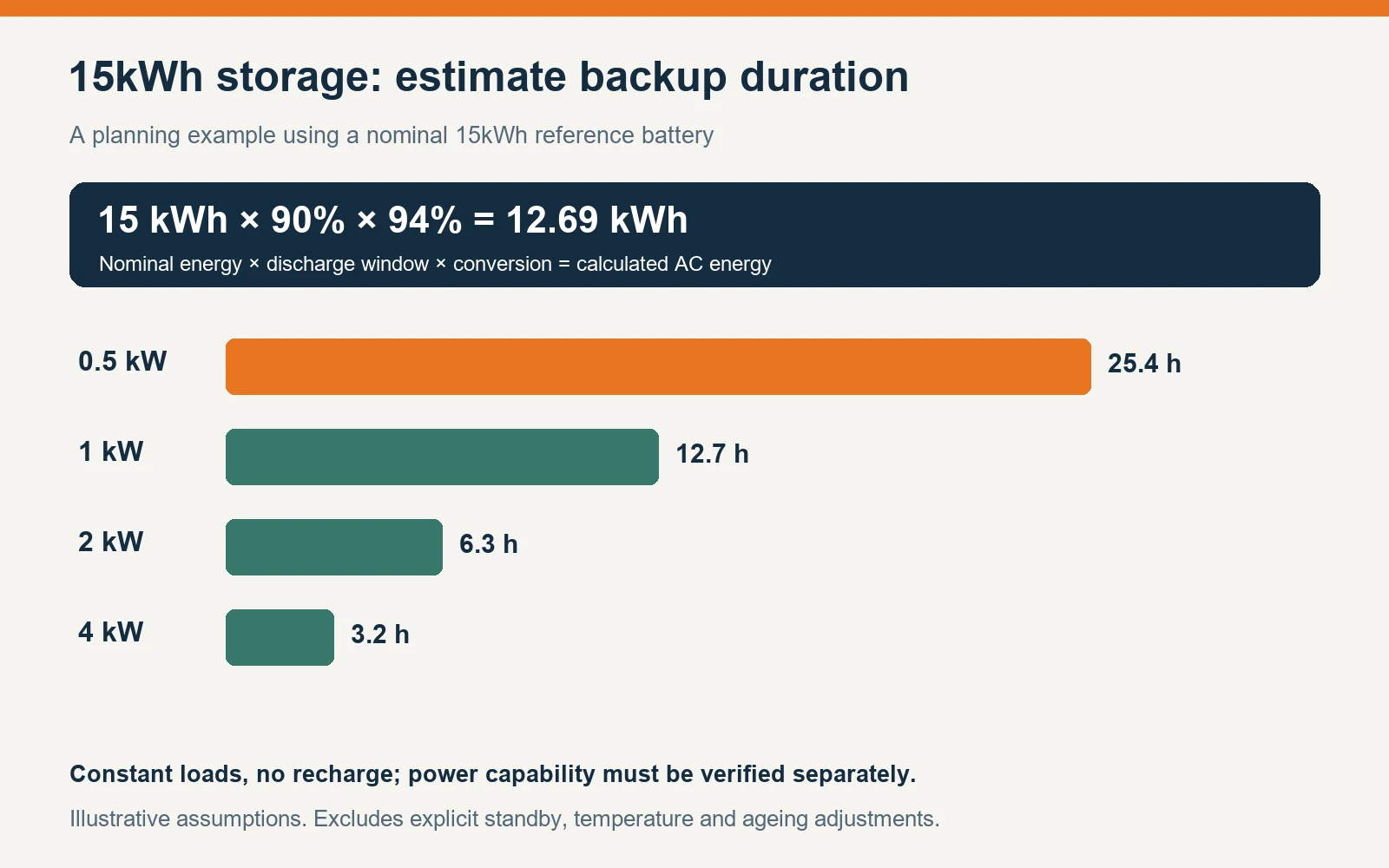
The table excludes explicit standby consumption, temperature effects, ageing and variable household demand. If auxiliary consumption is material, include it in the model rather than treating every stored watt-hour as available to appliances. Avoid subtracting the same reserve twice if the supplier's usable-energy rating already incorporates the proposed operating window.
A project with lower measured consumption may be better served by a smaller configuration. The 10kWh home storage buying guide provides a comparison starting point. A larger capacity becomes useful when it solves a documented energy requirement and can be recharged in the intended operating cycle.
Published capacity is not the same as energy available at the moment an outage starts. A battery used for evening self-consumption may already be partly discharged. Ask the customer whether the main objective is daily solar shifting, scheduled tariff operation or outage resilience, and agree how the operating strategy balances those objectives.
For another simplified example, assume the same nominal 15kWh reference, an outage starting at 70% state of charge and a planned stopping level of 20%. The available window is 50 percentage points. At the assumed 94% conversion efficiency, the calculation becomes 15 × (0.70 - 0.20) × 0.94 = 7.05kWh at the AC loads, before other adjustments.
At a constant 1kW, that is about 7.1 hours. The earlier 7.15kWh evening requirement would slightly exceed this simplified allowance. This illustrates why quoting runtime from a fully charged battery can mislead a customer whose normal control strategy leaves less energy in reserve. It does not establish a recommended reserve setting for a particular model.
Use solar surplus after daytime household consumption, rather than total panel generation, when estimating energy available for charging. If the project has only 6kWh of relevant surplus on a given day, a larger battery cannot create the missing energy. Review seasonal production and the charging strategy for periods with poor solar availability.
Charging duration also depends on the allowed charging power. A simplified requirement to restore 10kWh at an average 2kW entering the battery represents five hours before considering variations in charging power and other constraints. Maximum charger power is not necessarily the average achieved throughout a charging session. Request a project estimate that identifies the limiting equipment and assumptions.
Discuss what happens after consecutive outages or several low-generation days. If grid charging is part of the plan, confirm that the chosen equipment and operating arrangement support it. The customer should understand which loads are prioritized, when energy is reserved and what circumstances require reducing consumption. A clear operating plan is more useful than a promise of unlimited independence.
Stored energy answers how long; the complete system's power capability answers what can run together. Start with continuous demand, starting surge and the required backup operating mode. Ask for the inverter's continuous output rating and any surge duration, together with the battery's applicable charge and discharge limits across its operating conditions.
The published SMJ 15KWh T01 module table lists a discharge range up to 100A. At an illustrative nominal 51.2V, multiplying voltage by current gives 5.12kW of DC power. This is an arithmetic reference, not a confirmed continuous AC output rating. Actual voltage, current restrictions, conversion losses and thermal conditions affect the achievable output.
That reference explains why the separate module should not inherit the integrated unit's 10kW rating in a sales description. A larger inverter connected to a battery does not by itself increase the battery's allowable current. Have the supplier identify the supported battery arrangement for the required power and provide the exact configuration in writing.
For a separate battery, list the inverter brand, model, firmware version, battery model, communication method and intended operating mode. Ask whether the proposed combination appears on an applicable compatibility list or has documented integration evidence. A shared voltage class or matching connector shape does not establish complete compatibility.
The review should establish how operating limits, state of charge and alarms are communicated. Ask how the system responds when charging is restricted, available battery energy is low or communication is interrupted. These are acceptance questions for the suppliers and installer; follow approved procedures rather than improvising fault tests or bypassing protective functions.
For an all-in-one unit, verify the destination supply arrangement, backup output behavior and which accessories are included. A product description using “all-in-one” does not establish automatic support for every household circuit, phase arrangement or grid requirement. Keep any promised operating mode tied to the actual model and project documentation.
A useful request to a 15kWh HESS supplier includes the destination country, project type, preferred equipment format, measured load information, backup duration and planned quantity. For a retrofit, attach the existing inverter details. For a new installation, explain whether the supplier is expected to propose the battery, inverter or complete equipment package.
Provide the proposed equipment location, available dimensions and access route. Ask the installer to check mounting, clearances, service access and environmental suitability against the selected model's manual. Enclosure dimensions in a catalogue are not the entire installation footprint, and a home storage label does not confirm outdoor suitability.
Clarify who supplies external protection, metering, communications accessories and any equipment needed to separate backup loads. Identify responsibility for electrical design, installation, commissioning and customer handover. Putting these items in the quotation reduces the chance that a low initial equipment price hides an incomplete project scope.
Ask for the current datasheet, operating manual, warranty terms and the model-specific documents relevant to the destination and installation. Match the model name and product revision across those documents. A company-level statement or a report covering another battery family should not silently stand in for evidence about the unit being purchased.
When comparing cycle-life claims, ask for the test conditions and end-of-life definition. Depth of discharge, temperature, rate and remaining-capacity criteria can change how a claim should be interpreted. This guide does not assign an unverified cycle count, certification or warranty period to the 15kWh options. Those terms belong in the confirmed offer.
For an OEM programme, separate cosmetic requests from electrical changes. Branding, packaging, interface preferences and enclosure requirements may have different implications for documentation, testing and lead time. Mottcell's customized energy storage service is a route for discussing feasibility and sample scope before a production commitment.
Put equipment, accessories, shipping assumptions, installation scope and service terms in separate quotation lines. Confirm the delivery basis and which destination costs are included. Keep any energy-savings estimate tied to actual tariffs and the operating plan; a higher nominal capacity does not establish a universal payback period.
Agree on a documented sample acceptance plan before volume ordering. It should identify the exact configuration, inspection scope, approved functional checks, required records and who signs off the result. For capacity checks, establish the conditions and measurement boundary so battery-side energy and AC-side delivered energy are not confused.
Preserve the approved sample's model, revision and documentation with the production order. If the proposed configuration changes, review the affected assumptions before treating the new units as equivalent. This creates a practical connection between the household requirement, the quoted equipment and what the customer actually receives.
It depends on usable energy and demand. The illustrative 12.69kWh AC allowance in this guide gives about 12.7 hours at a constant 1kW. Starting charge, reserve, losses and power limits can change the result.
No. kWh is energy and kW is power. Mottcell lists a separate SMJ 15KWh T01 battery and an SMJ 15KWh&10KW T01 all-in-one option. Confirm the exact equipment scope and ratings.
Send the destination, battery-only or all-in-one preference, inverter details if applicable, load profile, backup duration, installation conditions, quantity and customization requests. Ask for a model-specific offer and supporting documents.
Define the required delivered energy, highest simultaneous demand and recharge opportunity first. Then compare the actual 280Ah or 314Ah configuration and the battery-only or all-in-one supply scope. This gives the supplier a clear basis for recommending equipment and helps your customer understand the expected operating limits.
Send Mottcell your 15kWh HESS project enquiry with the load worksheet, destination, preferred format and planned quantity. Request a quotation that states the model, energy rating, power limits, included equipment and applicable documentation so the proposal can be reviewed against the real project requirements.
48V 300Ah HESS Supplier: Voltage, Runtime and OEM Guide
48V 100Ah HESS Supplier: 5.12kWh Solar OEM Buying Guide
12.8V 200Ah Battery Pack Factory: OEM Sourcing Guide
Commercial HESS Supplier: Factory Microgrid Sizing Guide
51.2V HESS Battery Supplier: 100Ah to 314Ah Capacity Guide
12V LiFePO4 Battery Pack Manufacturer: 50Ah-314Ah OEM Guide
16kWh HESS Supplier: 51.2V 314Ah Buyer’s Guide
5kWh HESS Supplier: Indoor Modular Battery Buying Guide
Established in 2005
In 2009, it was awarded the title of "National High tech Enterprise"
 zoe@mottcell.net
WhatsApp: 8617388790296
Fax: 86-0755-84042963
Skype: live:b0ebaecbb8782516
WeChat: +8613428749632

 VR show
 CN
CN Home >


