

 Jul 07, 2026


Choosing a 16kWh HESS supplier requires more than matching a capacity label. Buyers need to know what the published product table confirms, what must be calculated, and what remains specific to the delivered configuration. Those distinctions matter because stored energy in kilowatt-hours, discharge power in kilowatts, inverter capability, protection settings and usable runtime describe different parts of the system.
This guide uses Mottcell’s public product information as its factual starting point. The published Energy Storage System range lists the SMJ 15KWh T01 with 280Ah and 314Ah cell-capacity options, a 16S software BMS, listed charge and discharge current from 0 to 100A, 150A instantaneous current for four seconds, an SPCC sheet-metal enclosure and dimensions of 850 × 450 × 250mm. The page does not publish every item needed for a final design. Consequently, this article labels calculations as calculations and identifies the questions that must be answered in a model-specific quotation and specification sheet.
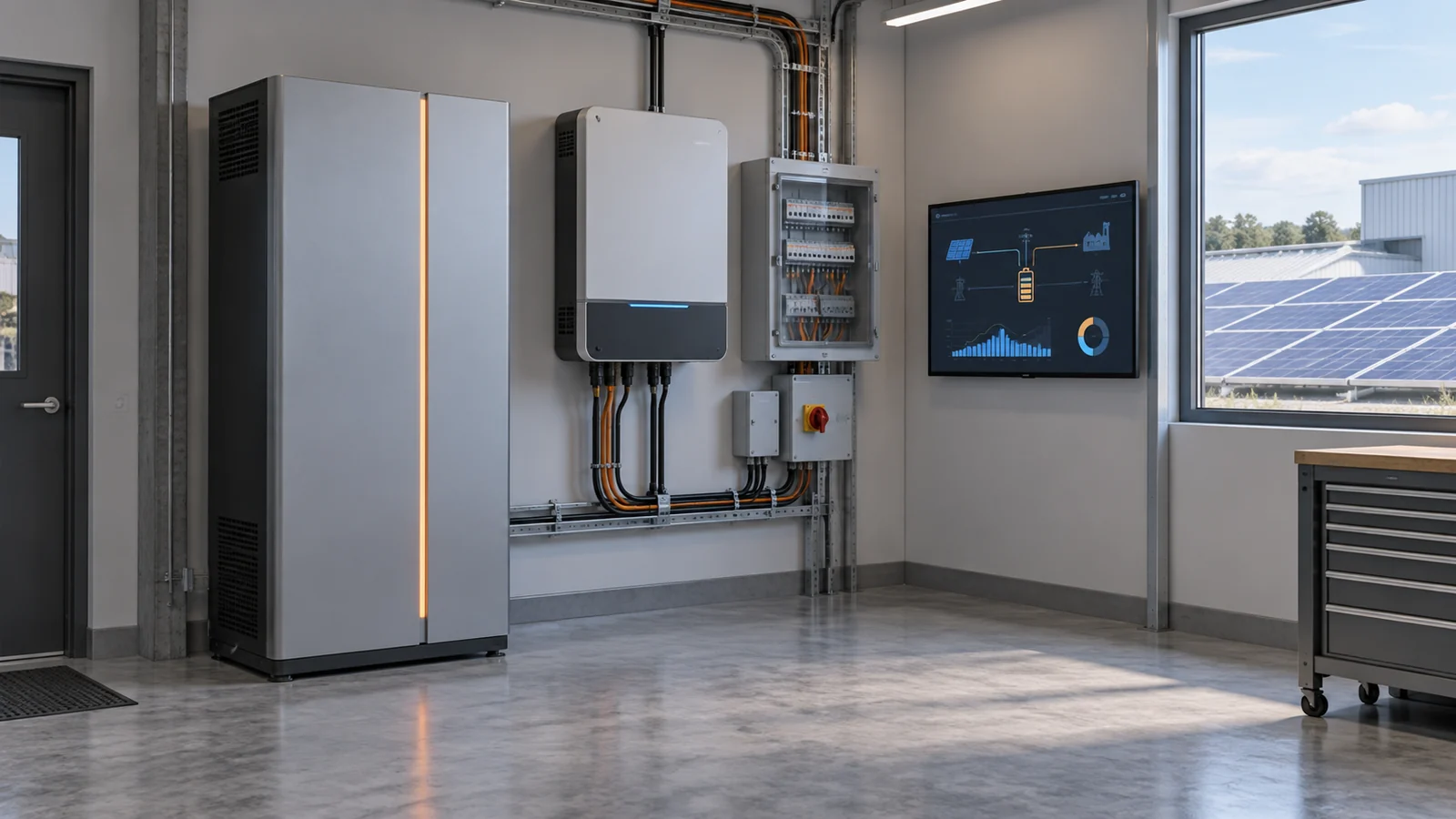
A HESS can mean a battery module, a battery cabinet with protection equipment, or an integrated battery-and-inverter package. The name alone does not define the supply boundary. Mottcell publishes separate pages for battery-based energy storage and for its all-in-one energy storage system range. A procurement comparison must therefore begin by asking whether the quoted item includes the inverter, AC protection, battery disconnect, monitoring gateway, cables, meter, current transformers or installation accessories.
This distinction changes the engineering work. A battery-only proposal must be checked against a separately selected inverter. An all-in-one proposal has a published AC output specification, but the buyer still needs to confirm grid standard, phase arrangement, PV input limits and local installation requirements. A low price may reflect a narrower supply boundary rather than a better commercial offer. Ask each supplier to mark included, optional and excluded items on one line-item schedule before comparing quotations.
Product names are often rounded capacity classes. The energy calculation is voltage multiplied by ampere-hours. If the delivered battery uses 16 series-connected LiFePO4 cells with a nominal cell voltage of 3.2V, the nominal pack voltage is 51.2V. Under that stated assumption, a 314Ah configuration calculates to 16.0768kWh, normally written as 16.08kWh. The 280Ah configuration calculates to 14.336kWh, or 14.34kWh. These calculations explain why a product family labelled “15KWh” may appear in both 15kWh and 16kWh sourcing conversations.
The calculation is not a substitute for the delivered datasheet. The public table lists “16S Software” for the BMS, but the purchase document should still identify cell chemistry, nominal cell voltage, nominal pack voltage, voltage range, exact capacity variant and model revision. It should also state whether the quoted capacity is nominal, usable, or measured under a defined test method. The supplier should resolve any difference between the marketing capacity label and the engineering nameplate before the purchase order is approved.
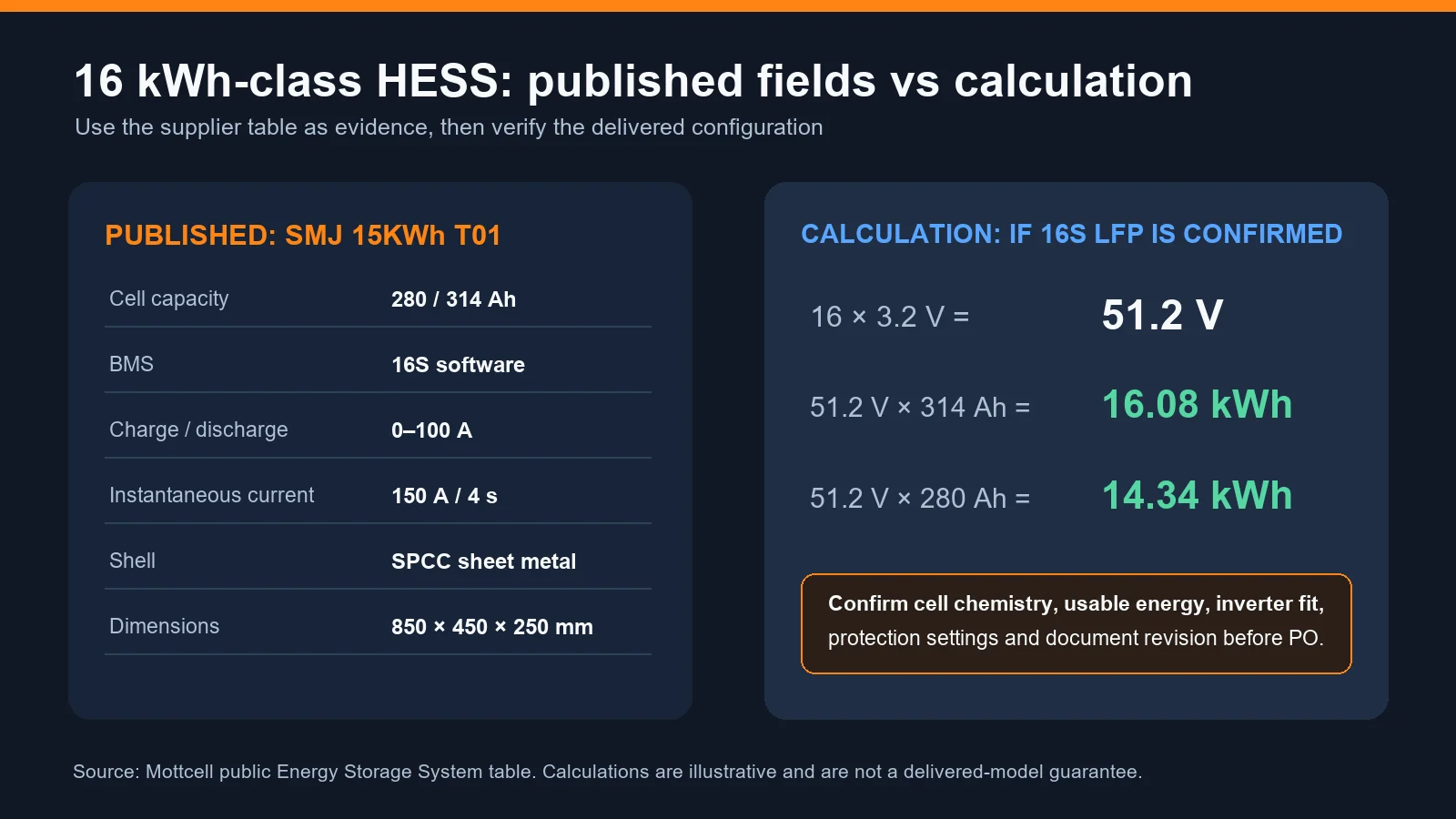
Kilowatt-hours describe stored energy; kilowatts describe the rate at which power is delivered. A 16kWh battery does not automatically provide 16kW. Mottcell’s table lists charge and discharge current from 0 to 100A for the SMJ 15KWh T01 and an instantaneous current of 150A for four seconds. If a 51.2V nominal configuration is confirmed, 100A corresponds to 5.12kW of nominal DC power before considering voltage movement, BMS settings, temperature limits, cable losses, inverter efficiency or system derating. The four-second value is a short current allowance, not a continuous AC power rating.
A buyer should request the continuous current limit across the permitted temperature and state-of-charge range, plus the time-current curve for short peaks. The inverter’s DC current demand must remain within the battery limits. Protection devices, conductor size, connector rating and isolation equipment must also suit the continuous and fault conditions. If the project includes motors, compressors or pumps, provide the starting method, inrush current and start duration. Those loads cannot be evaluated from average energy consumption alone.
| Item | Published or calculated value | What the buyer must confirm |
|---|---|---|
| Cell-capacity option | 280Ah / 314Ah published | Exact variant in the quotation and nameplate |
| BMS | 16S software published | Chemistry, voltage window, firmware and inverter protocol |
| Continuous current | Charge/discharge 0–100A published | Temperature, SOC and duration conditions |
| Short current | 150A / 4s published | Repeat interval, protection coordination and load inrush |
| Nominal energy | 16.08kWh calculated for 51.2V × 314Ah | Confirmed nominal voltage, usable window and test basis |
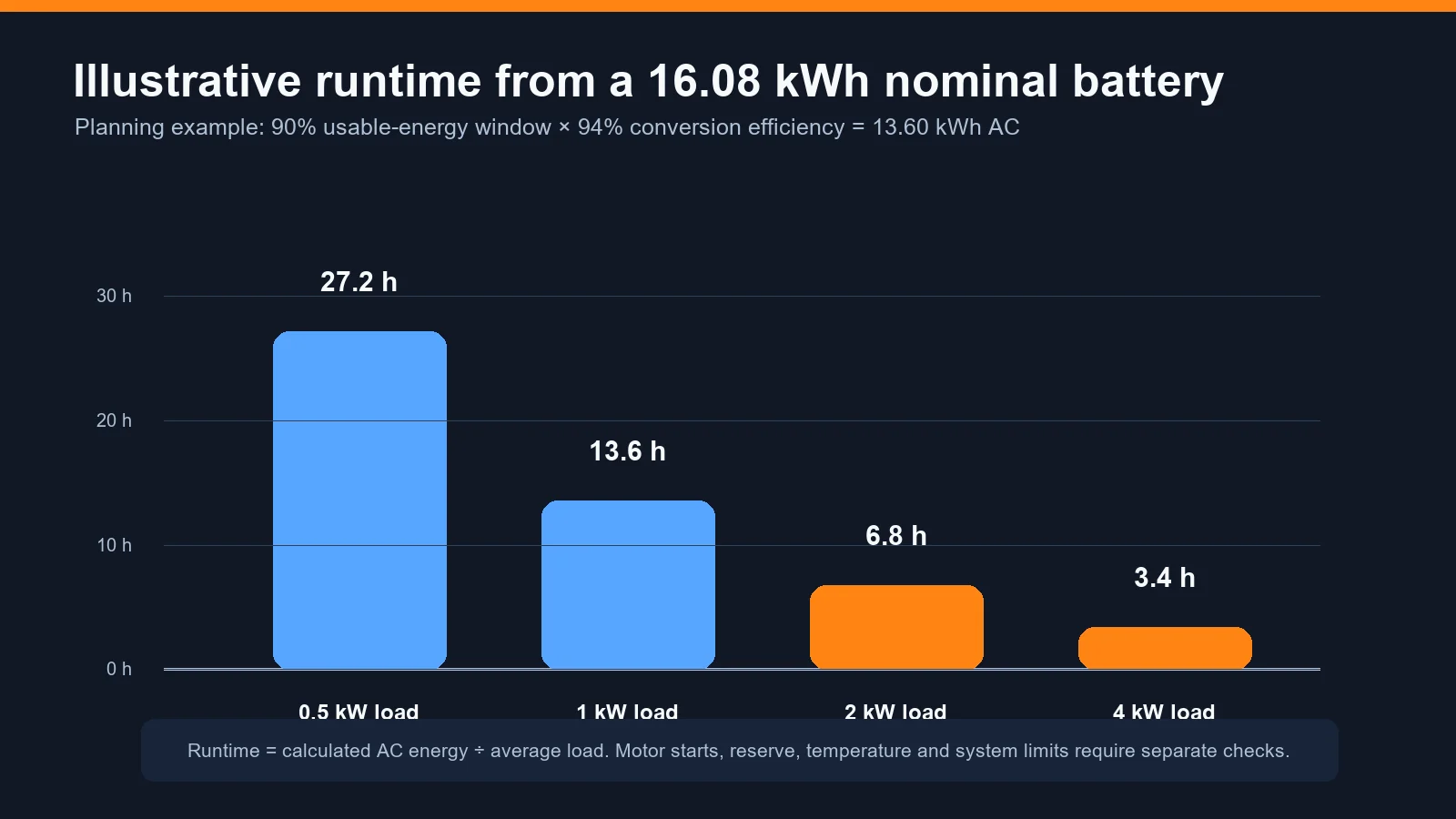
Runtime depends on usable battery energy and the average AC load. A planning equation is: nominal energy × assumed usable-energy window × assumed conversion efficiency ÷ average load. For an illustrative 16.08kWh battery, a 90% usable-energy assumption and 94% conversion-efficiency assumption produce about 13.60kWh at the AC load. That would support a constant 1kW average load for about 13.6 hours, a 2kW load for about 6.8 hours or a 4kW load for about 3.4 hours.
These figures are planning examples, not Mottcell performance guarantees. The applicable usable-energy window, inverter efficiency, auxiliary consumption, reserve state of charge, temperature and battery ageing must come from the selected configuration and project design. Runtime also becomes shorter when the average load rises. The calculation says nothing about whether the battery and inverter can start or continuously power the equipment, so power checks remain separate.
A 16kWh-class battery can be useful for selected factory loads, but the phrase “factory microgrid” can create an unrealistic expectation that one cabinet will support an entire production site. Begin with a protected-load list. Typical candidates might include controls, networking, security, lighting, monitoring, office equipment or a limited process that can remain within the battery and inverter limits. Large heating loads, air compressors, welders, chillers and high-inrush motors may require a different system architecture or a much larger storage plant.
Record each essential load’s running power, starting power, start duration, daily operating hours and acceptable interruption time. Then produce a 24-hour or higher-resolution load profile. The design objective should be explicit: backup during outages, solar self-consumption, time-of-use shifting, controlled peak reduction, or a combination. Each objective produces a different dispatch strategy and reserve requirement. The Commercial HESS Sizing Guide for Factory Microgrids provides a broader framework for facility-level sizing.
For backup, define the expected outage duration and the loads that must remain online. For solar self-consumption, compare the daytime PV surplus with the battery’s charge acceptance and the evening load. For peak control, identify the interval used by the utility demand charge and the peak events that the system must cover. A useful request for quotation includes the load profile rather than a single monthly energy total.
The battery and inverter form one operating system. Compatibility should be demonstrated through a written interface matrix that lists battery voltage range, charge and discharge limits, communication method, protocol version, cable pinout, termination settings, alarm mapping and start-up sequence. “CAN” or “RS485” on two datasheets does not prove compatibility because the register map and control logic can differ.
Ask the supplier whether the proposed inverter model has been tested with the exact BMS firmware and battery revision offered. The quotation should identify who is responsible for protocol configuration and commissioning support. If communication is unavailable, the system designer must state how voltage-based control will operate and which protections remain active. The buyer should also confirm whether the battery is supplied separately or through a packaged all-in-one configuration.
For a solar application, verify PV input voltage and current on the inverter, permitted array size, maximum charging power, grid input arrangement and local AC requirements. The battery capacity cannot correct an inverter or PV design mismatch. Provide the installation country because grid codes, wiring practice, required protection and documentation differ by market.
Mottcell’s public table lists an SPCC sheet-metal enclosure and dimensions of 850 × 450 × 250mm for the SMJ 15KWh T01. Those fields help with an initial layout, but they do not by themselves confirm an ingress-protection rating, installed weight, mounting method, clearance requirement or environmental suitability. Request a dimensioned drawing for the ordered revision, including cable entry, terminal location, door or service access and minimum clearances.
The site review should cover indoor or outdoor location, ambient temperature, humidity, dust, corrosive atmosphere, vibration, water exposure, ventilation, fire strategy, floor or wall structure and access for service. The enclosure rating must match the actual location. An indoor cabinet should not be treated as outdoor equipment merely because it is made from sheet metal. Any heating, cooling, smoke detection or suppression requirement should be defined by the system designer and local rules.
Confirm shipping dimensions and mass separately from installed dimensions and mass. Also request lifting instructions, packaging method and transport classification documents applicable to the delivered battery. These practical details affect the project schedule and total installed cost even though they do not appear in the search keyword.
A useful supplier file contains documents tied to a model and revision. Request the technical datasheet, user manual, installation drawing, wiring diagram, BMS protocol, protection settings, cell and pack identification, warranty conditions and applicable test reports. Document names should match the model on the quotation. A general certificate for a different product family does not establish compliance for the supplied configuration.
The About Mottcell page describes the company’s battery and energy-storage activities. For a purchase decision, verify the legal supplier, manufacturing scope, quality-control responsibilities and after-sales contact on the commercial documents. If customization is required, use Mottcell’s customized energy storage route to discuss enclosure, electrical interface, communication, labeling and order quantity. Treat every requested change as an engineering change that requires a revised drawing, specification and approval record.
Avoid relying on generic phrases such as “Grade A,” “long life,” “certified” or “high efficiency” without a defined basis. Ask which cell model is used, how cells are identified, which test applies, what conditions govern the warranty and which measured values will appear on the factory acceptance record. This evidence makes quotations comparable and reduces disputes after delivery.
A sample program should reproduce the intended electrical interfaces and operating conditions. Agree on the sample configuration, firmware version, connectors, labels and accessories before production. Define inspection items such as model identity, appearance, dimensions, terminal polarity, open-circuit voltage, communication, protection behaviour and documentation completeness. The acceptance plan should state the test equipment, tolerances and responsibility for any retest.
For inverter integration, run a controlled commissioning sequence that checks start-up, charge, discharge, current limiting, state-of-charge reporting, alarm handling, shutdown and recovery. Load tests should remain within the documented limits. If a motor or other high-inrush load is important, test that load or an agreed representative profile rather than assuming the four-second current field guarantees successful starting.
Volume production should use the approved sample as the reference. The purchase agreement should control changes to cells, BMS hardware, firmware, connectors, enclosure or protective components. Require notification and approval before substitution. Record serial numbers and document revisions so field issues can be traced to a production batch and configuration.
Capacity labels should guide the first comparison, but the load profile and product data decide the result. The 15kWh HESS capacity and runtime guide explains the difference between a separate battery and an integrated 15kWh-and-10kW product. The current 16kWh guide focuses on the 314Ah capacity calculation, current limits and factory microgrid interface. Buyers considering a smaller distributed installation can read the 5kWh HESS supplier guide.
Do not select the larger label automatically. A smaller system may be sufficient for a narrow backup circuit, while a 16kWh-class configuration may provide useful runtime for a broader selected-load group. A site with high continuous power or long outages may need several modules or a higher-voltage commercial system. Parallel expansion limits, master control, protection coordination and inverter capability must be confirmed for the proposed architecture.
State whether the request is for a battery module, battery cabinet or all-in-one system.
Provide the required nominal and usable energy, backup duration and reserve requirement.
Attach the load list and time-based load profile, including motor or compressor starts.
Identify the inverter model, DC voltage window, communication protocol and AC/grid requirements.
Describe the PV array, available charging window and operating objective.
Provide indoor/outdoor location, temperature, humidity, dust, vibration and clearance conditions.
Specify destination country, quantity, sample plan, labeling and branding requirements.
Request the model-specific datasheet, drawings, protocol, warranty and applicable test evidence.
A complete RFQ lets the supplier identify conflicts early and quote the correct scope. It also gives purchasing, engineering and installation teams one shared technical basis. Send these project inputs through the Mottcell contact form when requesting a configuration review.
No. Kilowatt-hours measure stored energy, while kilowatts measure power. The battery current limit, voltage range and inverter rating determine continuous and peak power. A 16kWh energy label does not establish 16kW output.
The published table lists both 280Ah and 314Ah variants. If a 51.2V nominal 16S LFP configuration is confirmed, 314Ah calculates to about 16.08kWh, while 280Ah calculates to about 14.34kWh. Confirm the delivered variant and nameplate rather than relying only on the family label.
Runtime depends on usable energy and average load. With illustrative assumptions of 90% usable energy and 94% conversion efficiency, a 16.08kWh nominal battery supplies about 13.60kWh AC. That is about 6.8 hours at a constant 2kW load. Use the selected model data and measured load profile for an actual design.
Check the DC voltage range, continuous and peak current, charge limits, protocol version, cable pinout, termination, alarm mapping, start-up sequence and protection coordination. Ask for written compatibility with the exact battery, BMS firmware and inverter model.
It depends on the factory load, but one 16kWh-class cabinet is usually better evaluated against a defined group of essential loads. Large motors, heating, compressed air and production lines may exceed its energy or power capability. Measure the loads and size the complete microgrid around the operating objective.
The best 16kWh HESS supplier comparison separates published evidence from calculations and project assumptions. Mottcell’s public table provides a practical starting point: 280/314Ah capacity options, a 16S software BMS, listed current fields, an SPCC enclosure and published dimensions. The 314Ah option can be discussed as a 16kWh-class battery only after the nominal voltage and chemistry are confirmed.
Before ordering, define the supply boundary, load profile, inverter interface, environmental conditions and required documentation. Request a revision-controlled proposal that names the exact configuration. That approach turns a search keyword into an engineering decision that purchasing and project teams can verify.
48V 280Ah HESS Supplier: Solar Battery OEM Buying Guide
12V 314Ah Battery Pack Manufacturer: OEM Buying Guide
48V 300Ah HESS Supplier: Voltage, Runtime and OEM Guide
48V 100Ah HESS Supplier: 5.12kWh Solar OEM Buying Guide
12.8V 200Ah Battery Pack Factory: OEM Sourcing Guide
Commercial HESS Supplier: Factory Microgrid Sizing Guide
51.2V HESS Battery Supplier: 100Ah to 314Ah Capacity Guide
12V LiFePO4 Battery Pack Manufacturer: 50Ah-314Ah OEM Guide
Established in 2005
In 2009, it was awarded the title of "National High tech Enterprise"
 zoe@mottcell.net
WhatsApp: 8617388790296
Fax: 86-0755-84042963
Skype: live:b0ebaecbb8782516
WeChat: +8613428749632

 VR show
 CN
CN Home >


