

 Nov 11, 2026


A 12V 100Ah battery pack can look correctly specified on a summer quotation and still leave an outdoor system unable to recharge on a winter morning. The missing information is often the permitted charging temperature, where the battery measures that temperature, and how the charging source responds when charging is inhibited. For OEM buyers and solar integrators, these are acceptance requirements to resolve before placing a production order.
This guide explains how to build a cold-weather charging review for a LiFePO4 auxiliary power project. It covers the questions to put in an RFQ, the evidence to request, and a practical sequence for checking a sample. It does not assign a universal low-temperature setting to Mottcell batteries. Protection thresholds, heater availability, recovery behavior and current limits must be confirmed for the exact model and configuration being supplied.
Cold-weather operation includes several different states: storing the battery, supplying a load, accepting a charge and returning to service after a cold shutdown. Permission for one state does not establish permission for another. A battery that can supply a modest overnight load at a particular temperature may still need charging to remain disabled at sunrise. Your project specification should distinguish those states instead of using one broad “operating temperature” line.
The temperature reported by a weather service is also different from the temperature used by a battery protection system. An insulated cabinet, recent discharge, direct sunlight and the location of a temperature probe can all affect the relationship. Ask the supplier which measurement controls charge permission and where the sensor is located. A temperature display on a solar controller does not establish that the controller knows the temperature inside the battery.
Published limits differ between product families. For example, Victron’s Lithium Battery Smart safety manual specifies charging from +5°C to +50°C for its own batteries. That is an example of a manufacturer-defined charging window, not a setting to copy into a Mottcell project. Use the selected Mottcell model’s current documentation and written configuration confirmation when establishing your limits.
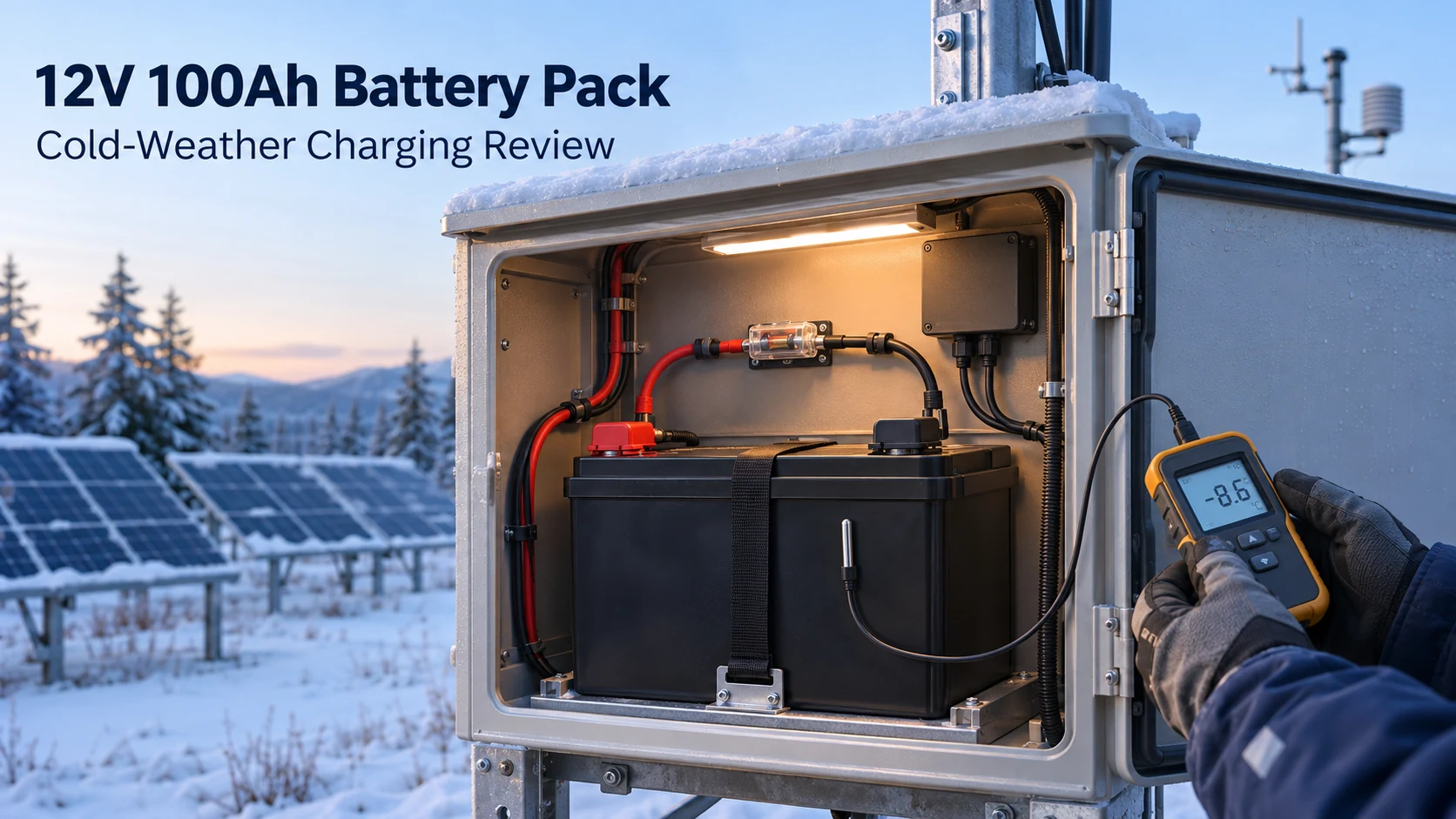
A 100Ah label describes charge capacity under stated conditions. It does not by itself establish winter runtime, permissible charging current or a built-in heating function. In the Mottcell 12.8V, 100Ah examples, multiplying nominal voltage by capacity gives 1,280Wh of nominal energy. That arithmetic is useful for identifying the capacity class; it is not a promise that the load will receive the full nominal energy at every temperature.
Start with the actual load schedule, including overnight standby consumption, communications equipment, pumps or intermittent electronics. Record the length of the expected period without usable charging. Then ask for the relevant discharge and capacity information at your planned conditions. Include the battery’s permitted discharge limits, the system’s low-voltage shutdown behavior and losses in any downstream conversion. Keep measured sample results separate from estimates in the project file.
Use the existing 12V 100Ah battery pack model comparison to compare enclosure options and purchasing information. This winter review adds the charging and commissioning requirements; it does not replace that model comparison. When comparing different capacity classes, work through the 12V LiFePO4 battery capacity guide before assuming that a larger pack solves a missing charging window.
A useful RFQ describes the installation and asks for a documented response. “Suitable for winter” is too vague to become a repeatable acceptance criterion. Share the lowest expected battery temperature, charging sources, enclosure conditions, daily duty cycle and destination market. Ask the supplier to identify the exact battery variant, BMS configuration and documents that support the proposed operating behavior.
| RFQ topic | Information to request | What the answer helps you decide |
|---|---|---|
| Charge temperature window | Model-specific permitted range, charge inhibit threshold and recovery conditions. | Whether the installation has a usable charging window. |
| Temperature measurement | Sensor location, available readings and which reading controls charge permission. | Whether the protection responds to battery conditions. |
| BMS response | How charging is interrupted and restored; whether discharge remains available. | How loads and charging sources behave during a cold event. |
| Charging equipment | Charger or solar controller model, settings and response to charge interruption. | Whether the complete charging chain needs changes. |
| Heating, if proposed | Written confirmation of availability, power source, control logic and limitations. | Whether heating is part of the supplied configuration. |
| Acceptance evidence | Sample identifier, configuration revision and proposed test procedure. | How to approve and reproduce the agreed behavior. |
Request explicit answers where the standard document is silent. If the supplier confirms that a function is optional, record whether it is included in your quotation and sample. A screenshot from a different model or an unqualified catalogue phrase is not enough to establish the configuration being purchased. An unresolved item should remain an open technical question rather than becoming a reassuring sentence in a customer proposal.
A cold-charge protection function and a compatible charging system perform different jobs. The battery may need to prevent charging under an unacceptable condition, while the charger or controller must behave appropriately when the battery does not accept current. Ask how your proposed equipment handles interruption, reconnection and a return of solar input. Also confirm the equipment manufacturer’s requirements for battery connection and operating sequence.
List every charging path. A solar controller may be only one source; a mains charger, vehicle charging system or service connector may provide another. Review each path against the battery requirements. A protection arrangement that has been checked with one charging source should not be assumed to cover a second source with different control behavior. Include the installed wiring and protective devices in the system review conducted by a qualified integrator.
For solar projects, the solar charge controller selection guide explains the separate checks for controller limits and battery charging requirements. Its worked capacity example differs from this 100Ah project, so do not copy its numerical assumptions into your design. Select settings from the actual controller documentation and the approved battery configuration.
Do not defeat a battery protection cutoff to make a demonstration appear successful. Likewise, a controller restarting is not proof that the battery is within its permitted charging conditions. The acceptance record should show the temperature measurement, charge permission, charging source status and relevant fault indication together. This makes the result understandable to a reviewer who was not present during the test.
A project may address a cold charging window through installation location, an approved thermal design, a heating option or a different operating schedule. These choices have different consequences. A protected indoor location might change the battery’s exposure, while an outdoor cabinet may still need condensation and ventilation review. Assess the intended installation rather than treating insulation as an automatic substitute for a verified charging range.
If a heated battery or an external heater is proposed, ask what powers it and what conditions must be satisfied before charging begins. Determine whether heating can operate after a long period without charge input, and include its energy demand in the load schedule. Ask how temperature is monitored and how the system responds if the heating function is unavailable. Do not infer any of these behaviors from the word “heated.”
For Mottcell procurement, record heating as “to be confirmed” until the selected configuration is documented. The existence of a BMS does not prove that a heater is present, and an optional monitoring function does not establish its control logic. If heating is not included, state that clearly in your internal approval sheet so the installation team does not expect a function that was never ordered.
Agree the procedure with the battery supplier and qualified system integrator before attempting temperature testing. Use suitable equipment and the approved model limits. The purpose is to verify agreed controls and system behavior within an authorized procedure, not to explore how far a battery can be pushed beyond its specification. Destructive, abusive or uncontrolled testing does not belong in an ordinary purchasing demonstration.
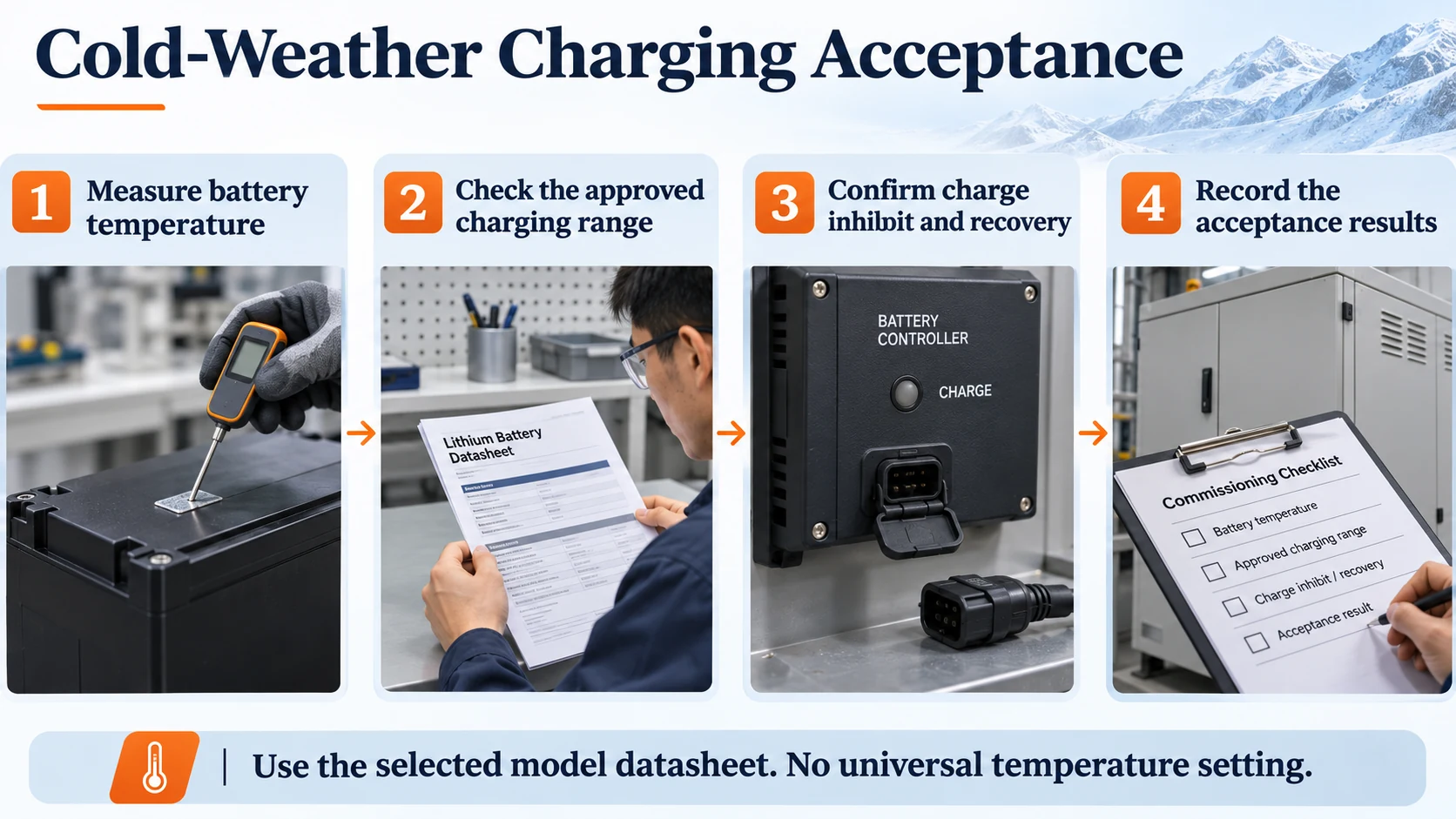
Identify the sample by model, serial number and relevant configuration revision. List the charger, controller, load equipment, temperature instruments and enclosure arrangement. Record which values are read directly and which are inferred. A clear setup description helps distinguish a battery issue from a sensor placement problem, a charger configuration error or a difference between the sample bench and the customer’s installation.
| Acceptance stage | Evidence to capture | Review question |
|---|---|---|
| Baseline setup | Sample identification, configuration, charging source and initial instrument readings. | Does the setup match the agreed project? |
| Approved temperature condition | Measured battery temperature and the supplier-approved stabilization procedure. | Is the controlling measurement understood? |
| Charge inhibit observation | Charge permission indication, source status and observed current. | Is charging handled as the agreed protection logic requires? |
| Controlled recovery | Temperature readings, recovery indication and charging behavior. | Does recovery follow the documented conditions? |
| Load continuity review | Load status during the agreed charge interruption scenario. | Does the application behave as intended? |
| Final record | Results, deviations, corrective actions and approval responsibility. | Can another team reproduce and assess the result? |
Define an acceptable result in advance for each observation. If a reading is unavailable, state the limitation rather than filling the record with an assumed value. If the behavior differs from the written proposal, pause acceptance and request clarification. A revised document or configuration should be versioned so that a later production order is tied to the change that resolved the issue.
An outdoor installation review should include moisture exposure, drainage, cable entry and the route used for maintenance. A general battery photograph cannot establish an enclosure protection rating or approval for a particular location. Confirm the ratings and installation conditions for both the battery and the cabinet as supplied. Ask who is responsible for the combined installation when the cabinet comes from a different vendor.
Pay attention to the movement of equipment between cold outdoor air and a warmer service environment. Follow the supplier’s handling and inspection instructions, including any requirements related to moisture or condensation. Do not start charging simply because an enclosure feels warm on the outside. The controlling temperature measurement and the permitted charging condition still need to be established.
Plan how a technician will read the relevant status and identify a fault without improvised changes. Keep the current datasheet, charging configuration and troubleshooting contacts with the installation documentation. For remote sites, ask which monitoring information is available for the selected option and how the operator will know that charging is inhibited. Avoid promising remote diagnostics unless that capability has been confirmed for the supplied system.
After the sample review, convert the approved behavior into a concise purchasing specification. Include the model variant, case dimensions, connections, BMS options, agreed charging limits and acceptance document revision. Identify any settings controlled by the installer rather than the battery factory. This prevents a successful sample from becoming disconnected from the equipment and configuration ordered in quantity.
Ask how a change to a relevant component, protection configuration or supplied charger will be communicated. Decide which changes require another review before shipment. A sample approval should describe its scope: approving one battery and controller combination does not automatically qualify every capacity or enclosure variant in the same product family. Keep the approved bill of configuration and test evidence accessible to procurement, engineering and after-sales teams.
Compare supplier quotations on this documented scope. A lower price that omits a required sensor, heating option or suitable charging arrangement may describe a different deliverable. Conversely, a winter project may not need every optional feature if its installation and charging window are already adequate. Let the confirmed duty cycle and acceptance criteria determine the configuration instead of adding features without a project reason.
Include handover responsibilities as well as hardware requirements. Specify who records final charger settings, who retains the sample report and who answers a field query about charging inhibition. Give operators a clear escalation route when the system behaves differently from the approved record. This small administrative step helps avoid unnecessary battery replacement when the underlying issue is an undocumented setting or an installation change.
When requesting a 12V 100Ah LiFePO4 battery review, explain what the battery powers, where it is installed and which charging equipment is already specified. Include the expected duty cycle, longest period without useful charging, available mounting space and cable connection requirements. State whether the enclosure is supplied by your team and whether the system is accessible for winter maintenance.
Add a short cold-weather section to the inquiry: expected battery temperature conditions, preferred installation arrangement, required charge inhibit behavior and any heating requirement. Attach the proposed acceptance checklist and ask Mottcell to mark confirmed functions, optional configurations and unresolved points. Request the model-specific documentation relevant to the destination market; do not assume a certificate or test report applies to an unlisted variant.
The Mottcell energy storage battery range provides a starting point for discussing the capacity and case format. Use the Mottcell contact page to send the project brief and request a configuration review. This article provides a procurement framework, while the quotation, current datasheet and agreed sample evidence establish what the selected battery can do.
Do not assume that it can. Use the exact battery model’s permitted charging range and protection instructions. Some configurations may offer approved heating or other controls, but their presence and operating sequence require written confirmation. Permission to discharge at a low temperature does not establish permission to charge there. A generic 100Ah rating provides no answer to that temperature question.
The label BMS alone does not establish its functions, sensor arrangement or settings. Ask which protections are enabled in the selected configuration, what measurement controls charge permission and how recovery occurs. Confirm the charging source’s response as part of the system review. Treat optional Bluetooth monitoring and any heater as separate features to verify, not proof of a particular charging protection.
Request the selected model’s current datasheet, configuration identification, approved charging conditions and an agreed acceptance procedure. Document the temperature instruments, charging equipment and intended installation. Record the observed inhibit and recovery behavior, any load interruption and unresolved deviations. Approve the specific combination that was reviewed, then carry that configuration and document revision into the production order.
A well-prepared winter project connects battery temperature, charge permission, charging equipment and load requirements in one review. The key procurement outcome is a documented configuration that the supplier, integrator and customer understand. Confirm the limits, test the agreed behavior and retain the evidence before committing to volume delivery. That approach gives a 12V 100Ah battery pack inquiry a clear technical purpose and a repeatable path to approval.
12V 100Ah Battery Pack: Cold-Weather Charging Guide
10kWh HESS Backup Loads: Circuit Commissioning Guide
12.8V 200Ah Battery Pack Factory: OEM Sourcing Guide
12V 200Ah Battery Pack: Solar Charge Controller Guide
Top 18500 Lithium-Ion Battery Manufacturer (Guide)
15kWh HESS for Solar Systems: AC vs DC Coupling Guide
12V LiFePO4 Battery Capacity Guide: Ah, Wh and Runtime
12V 300Ah Battery Pack: Series vs Parallel OEM Guide
Established in 2005
In 2009, it was awarded the title of "National High tech Enterprise"
 zoe@mottcell.net
WhatsApp: 8617388790296
Fax: 86-0755-84042963
Skype: live:b0ebaecbb8782516
WeChat: +8613428749632

 VR show

 CN
 Home >


