

 Nov 06, 2026


A 12V 200Ah battery pack for a solar system needs a charge controller selected against both the solar array and the exact battery specification. The capacity label does not tell an OEM buyer which PV voltage is acceptable, how much charging current is permitted, or how the controller should respond when the battery management system restricts charging.
This guide helps equipment buyers, solar distributors and integrators turn those questions into a purchasing review. It concentrates on the solar charging interface. For enclosure variants, supplier evidence and general purchasing checks, start with Mottcell's 12.8V 200Ah battery pack OEM sourcing guide. Keep that main product decision separate from the controller approval described here.
The calculations below are hypothetical planning examples, not Mottcell charging settings or installation instructions. Final electrical design, protection and commissioning belong to a qualified professional using the selected equipment documentation. References to controller manufacturers explain their published principles; they do not confirm a compatible Mottcell pairing.
Write a short operating brief before requesting a controller recommendation. Identify whether solar is the primary energy source or a supplement, which loads remain active while charging, and whether an AC charger or another source can operate at the same time. A controller that appears sufficient in a battery-only comparison may leave the daily load requirement unmet.
Separate the battery capacity from the energy that must be restored on a typical day. A system using only part of its permitted operating range has a different replenishment requirement from one expected to recover after a long interruption. Include the available solar resource and seasonal constraints in the integrator's design brief rather than assuming rated panel power is available continuously.
Record the destination market, installation environment and service access. Ask who owns the PV design, who approves the battery charge profile, and who accepts the combined system. Naming those responsibilities early prevents a battery supplier's product quotation from being mistaken for approval of every controller, panel configuration and field setting.
Ah describes charge capacity; multiplying it by nominal voltage gives nominal energy. For a hypothetical 12.8V, 200Ah battery, the calculation is 12.8 × 200 = 2,560Wh. This is useful for comparing capacity, but 12.8V is not a charging setpoint and 2,560Wh is not a promise of usable delivered energy.
Mottcell's published energy storage battery catalogue lists SMG12200BE and SMG12200PLUS entries at 200Ah and 2,560Wh. Confirm the exact model and current specification in the quotation. The shared capacity does not establish identical installation space, approved charging behavior or suitability for the same controller.
A controller may be described as suitable for a 12V battery system while accepting a different PV input voltage range. These are separate interfaces. Request the battery's permitted charging envelope and the controller's input and output limits independently. For the broader distinction between capacity, energy and runtime, refer to the 12V LiFePO4 capacity guide.
MPPT charge controller selection should start with the planned PV arrangement and operating conditions. Victron's technical comparison of PWM and MPPT explains that PWM operation brings array voltage toward battery voltage, while MPPT tracks an input power point and converts power for charging. Its comparison also shows why operating conditions matter.
That principle does not justify a fixed yield improvement for every project. Compare the actual module characteristics, temperature range, controller limits and expected operating pattern. For a small existing system, replacement work and service familiarity may affect the purchase. For a new design, the available array configuration may make one route more suitable.
| Buyer question | PWM review | MPPT review |
|---|---|---|
| How is the array matched? | Check the module voltage characteristics against the battery system and controller instructions. | Check the allowed PV voltage window, maximum input values and tracking requirements. |
| What limits charging? | Review the specified controller behavior and battery limits together. | Review battery-side current limiting as well as PV-side limits. |
| What proves suitability? | Document the proposed array, approved battery profile and operating conditions. | Document the same items, including tracking and conversion constraints. |
| What should not be assumed? | A matching nominal voltage does not approve an array or battery pairing. | An MPPT label does not establish universal battery compatibility or a fixed energy gain. |
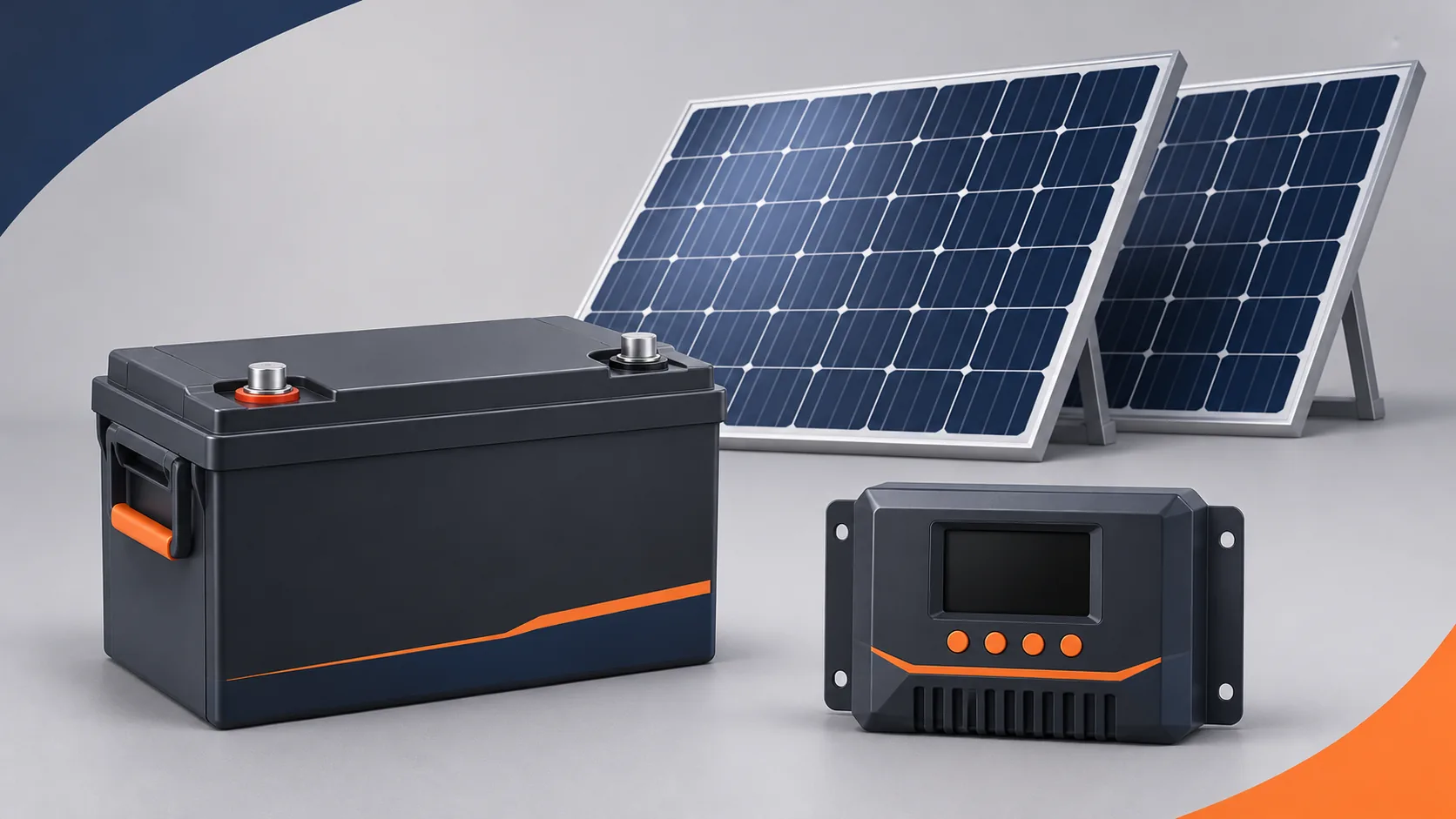
Ask the designer to document the proposed module identities and array arrangement against the exact controller manual. The review should cover the manufacturer's maximum PV voltage, relevant current limits and permitted array sizing. Cold-weather open-circuit voltage and the expected operating-voltage range deserve explicit attention; a wattage comparison alone cannot establish compliance.
Do not confuse a controller's battery charging current rating with its PV input current rating. Likewise, a published allowance for PV oversizing does not mean a voltage or current limit can be exceeded. Require the supplier to identify which limit applies, where it is measured, and the conditions attached to any allowable array sizing.
For a retrofit, obtain the existing panel label and arrangement rather than relying on the customer's recollection of total watts. Record whether future expansion is required. Ask for a documented expansion envelope and the equipment changes it would need. Avoid approving a larger array on the assumption that the controller will safely limit every possible input condition.
Make environmental assumptions visible in competing proposals. A controller rating quoted without its specified operating conditions may not describe continuous operation in the intended enclosure. Ask the equipment supplier to explain relevant temperature derating, ventilation and mounting requirements. The buyer's role is to require the assessment and retain its result, rather than invent a universal safety margin that may not fit the selected equipment.
An MPPT conversion stage can produce a battery-side current different from the PV-side current. For preliminary reasoning, estimated charging output current equals available PV power multiplied by assumed conversion efficiency, divided by the charging-bus voltage at that moment. Each input needs a clear boundary and an operating condition.
Consider an illustrative 500W of available PV input, an assumed 95% conversion efficiency and a hypothetical 14V charging bus. The estimate is 500 × 0.95 ÷ 14, or about 33.9A. The 14V value is only a calculation assumption; it is not a recommended Mottcell setting. Real output is constrained by the selected controller, battery permission and changing conditions.
If an 80W DC load draws from that same 14V bus, its idealized current is about 5.7A. In this simplified steady-state example, approximately 28.2A remains for the battery before other losses. This illustrates why controller output and net battery charging current differ. It is not a sizing rule or a substitute for the designer's circuit and energy assessment.
A menu option marked “lithium” is a starting point for review. Obtain the exact profile values and operating stages for the proposed controller model and firmware. Ask the battery supplier to confirm them against the delivered battery specification. Nominal voltage, Ah capacity and a LiFePO4 chemistry description do not define every approved setting.
Morningstar's lithium custom-programming guidance emphasizes consulting the battery manufacturer about appropriate settings and identifying that a solar controller will be used. Apply that evidence to a model-specific discussion. Do not copy settings from another battery, or treat one manufacturer's terminology as identical across all controllers.
The review should address charging stages, voltage limits, current permission and temperature-dependent behavior. Explicitly resolve equalization, temperature compensation and any recovery or maintenance mode in the chosen controller's documentation. Record approved values and disabled functions where applicable. A screenshot of the final settings is more useful at handover than an unqualified statement that the equipment has a lithium preset.
The battery management system protects the battery according to its design; it does not automatically coordinate every external charger. Establish whether the proposed arrangement communicates a charging limit, uses a supported control input, or relies on independently configured limits. A communication socket alone does not prove the required control function is available.
Ask what happens if charging is restricted or disconnected while solar input remains available. Morningstar's programming guidance discusses controller-specific concerns around BMS disconnection. That is a reason to obtain the selected controller manufacturer's instructions, not evidence that every controller behaves identically. Review the supported sequence and recovery behavior for the actual equipment.
Also resolve temperature restrictions, loss of communication and return from a protective state. The agreed behavior should say which device reduces charging, which device reports the condition and whether operator action is required. Any demonstration must follow an approved procedure. Do not provoke unsafe battery conditions merely to show that a protection function exists.
Keep control permission separate from display information. A monitoring application may show state of charge or battery temperature without being able to command a charger. Ask which signals are actually exchanged and which device acts on them. If the system uses independent limits instead of communication, require an explanation of how those limits remain valid throughout the agreed operating conditions.
Solar may not be the only charging source. Identify any AC charger, alternator interface or second controller that can feed the battery. Have the responsible designer review their combined operation against the battery's approved total charging limit. An acceptable limit on each individual device does not establish that simultaneous operation is acceptable.
Keep charging-time estimates equally explicit. If an illustrative 100Ah must be replenished and the average net battery current during active charging is assumed to be 30A, simple charge-throughput arithmetic gives about 3.3 hours. This excludes changing solar input, charging-stage behavior, other losses and interruptions. It is not a full-charge guarantee or an estimate of elapsed daylight.
For an operating forecast, request the integrator's daily energy balance using the project's actual loads and solar assumptions. Distinguish a clear-day estimate from a seasonal service requirement. If the design cannot meet the brief, compare changes to the array, load schedule or charging strategy before changing battery capacity simply to make a headline number larger.
Consider a hypothetical remote monitoring unit that runs continuously and must recover its daily consumption through solar. Its purchasing review needs a seasonal energy balance and a clear plan for extended low-generation periods. Now consider an intermittently used mobile display that can also charge from an approved AC source between events. The same nominal battery capacity may appear in both enquiries, but the expected replenishment route and service risk differ.
For the remote unit, ask the integrator to explain the assumed generation, continuous demand and recovery requirement together. For the mobile display, ask how solar and AC charging overlap and how the customer confirms readiness before an event. These are illustrative briefs, not completed Mottcell projects. They show why a controller cannot be selected from Ah alone and why the RFQ should describe actual use.
A useful sample review checks the interface that will actually ship. Identify the battery revision, controller model, firmware, intended settings and permitted operating range. Agree the acceptance evidence before ordering volume units. A sample approved with one firmware or profile should not silently authorize a later unreviewed configuration.
Separate open questions from failed checks in that record. Missing documentation means approval remains pending; it does not prove that a component is defective. Conversely, a successful demonstration under one condition does not resolve every untested mode. This distinction lets purchasing teams move forward on confirmed items while assigning specific evidence requests to the responsible supplier.
| Review area | Evidence to retain | Question to close |
|---|---|---|
| PV input | Module data, proposed arrangement and controller limit review | Does the array remain within the documented input envelope? |
| Battery charging | Battery specification and approved controller settings | Are charging stages, current and temperature behavior agreed? |
| BMS interaction | Supported restriction, disconnection and recovery behavior | Does the complete arrangement respond as required? |
| Concurrent sources | Charger inventory and combined-operation assessment | Who controls total charging when sources overlap? |
| Production release | Model revisions, settings record and agreed sample report | Will production units match the accepted configuration? |
Use measurements with stated conditions rather than a photograph of a controller displaying a charging icon. A report should identify what was observed, at which boundary and under which approved conditions. Ask the integrator to explain any difference between expected and measured behavior. This creates a practical release decision without inventing a universal test method.
Send Mottcell the exact battery capacity requirement, intended application and installation constraints together with the proposed solar charging equipment. Include the controller model, available PV information, active loads and other charging sources. Mark unresolved decisions clearly. This allows the response to distinguish a battery quotation from a complete integration assessment.
Request a model-specific battery specification, the proposed charge-profile review and a list of compatibility questions requiring the controller manufacturer or integrator. For broader production and configuration discussions, use the 12V battery pack manufacturing overview. Do not interpret general OEM capability as approval of an unnamed controller.
Before release, retain the final settings, revision identities and acceptance records with the purchase specification. Define who can change settings and what triggers another review. Include a practical handover explaining normal charging indications, supported recovery actions and service contact details. A repeatable configuration gives distributors a clearer basis for supporting later orders.
Treat substitutions as controlled purchasing changes. If a distributor replaces a controller, a firmware revision changes a preset, or the battery specification changes, compare the replacement against the accepted configuration before shipment. Update the review only where the change affects an interface, while preserving the earlier evidence. This keeps repeat orders efficient without assuming that a familiar product name guarantees identical behavior.
Capacity alone cannot determine it. Review the PV input envelope, expected battery-side output, battery charging permission, active loads and concurrent chargers. The integrator should approve an exact controller and array against the battery specification, with assumptions documented.
Only consider it if the exact controller supports an appropriate, configurable and approved charging profile. Review all relevant stages and functions with both manufacturers. A shared nominal voltage or a controller that previously charged another battery is insufficient evidence.
No. Battery protection and charger coordination are separate questions. Confirm permitted charging, supported control behavior and the response to restrictions or disconnection. Keep a model-specific settings and acceptance record before approving the combination.
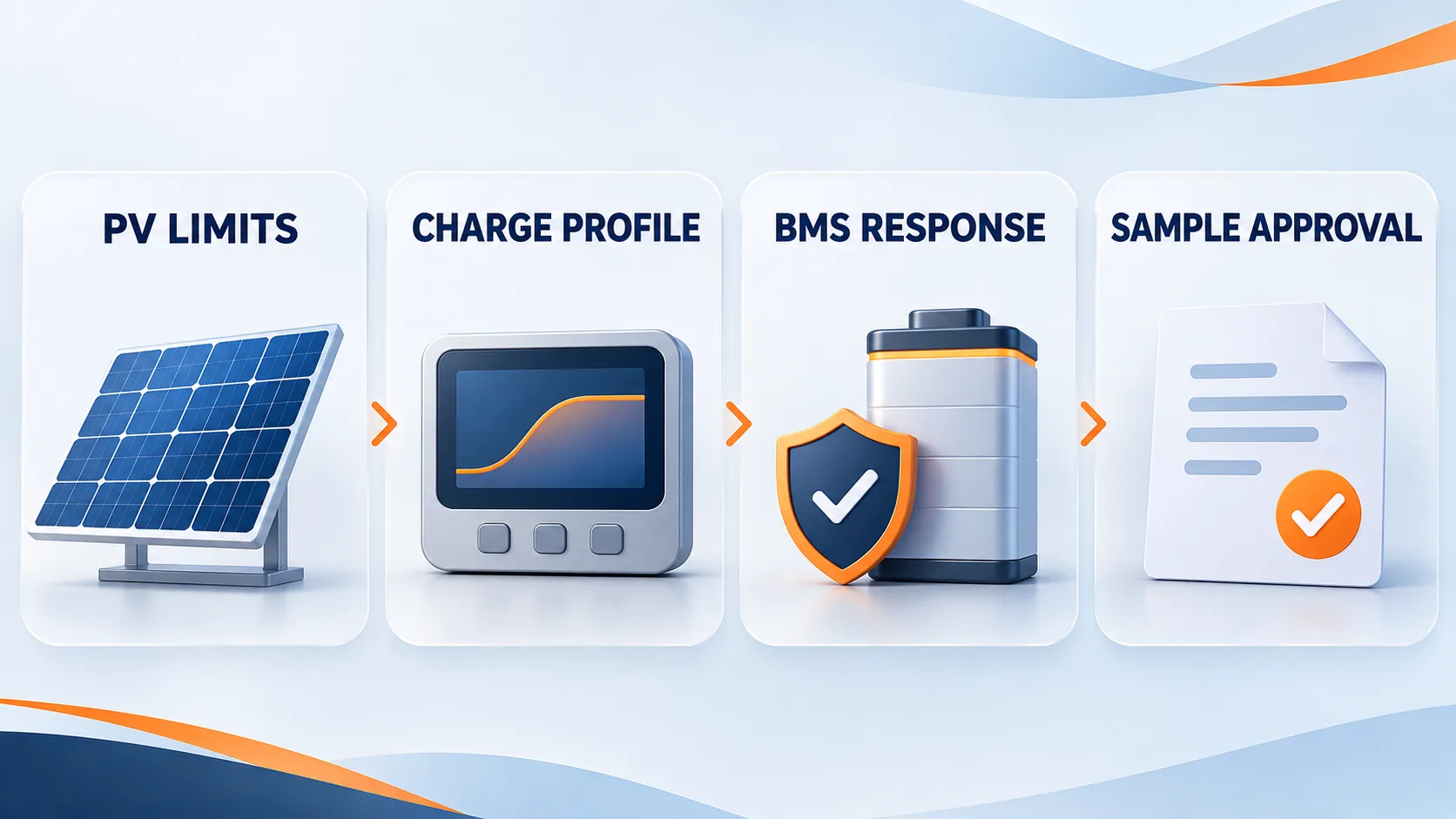
A 12V 200Ah battery pack can be evaluated for solar charging by separating four decisions: PV input suitability, battery-side charging permission, charge-profile settings and BMS coordination. Add realistic load and replenishment assumptions, then close the remaining questions through a documented sample review. Send your proposed equipment and operating brief to the Mottcell enquiry team for a model-specific discussion and OEM quotation.
12.8V 200Ah Battery Pack Factory: OEM Sourcing Guide
12V 200Ah Battery Pack: Solar Charge Controller Guide
Top 18500 Lithium-Ion Battery Manufacturer (Guide)
15kWh HESS for Solar Systems: AC vs DC Coupling Guide
12V LiFePO4 Battery Capacity Guide: Ah, Wh and Runtime
12V 300Ah Battery Pack: Series vs Parallel OEM Guide
12V 50Ah LiFePO4 Battery Pack: Size, Runtime & OEM Guide
22650 LiFePO4 Battery Manufacturer: OEM Buying Guide
Established in 2005
In 2009, it was awarded the title of "National High tech Enterprise"
 zoe@mottcell.net
WhatsApp: 8617388790296
Fax: 86-0755-84042963
Skype: live:b0ebaecbb8782516
WeChat: +8613428749632

 VR show

 CN
 Home >


