

 Aug 04, 2026


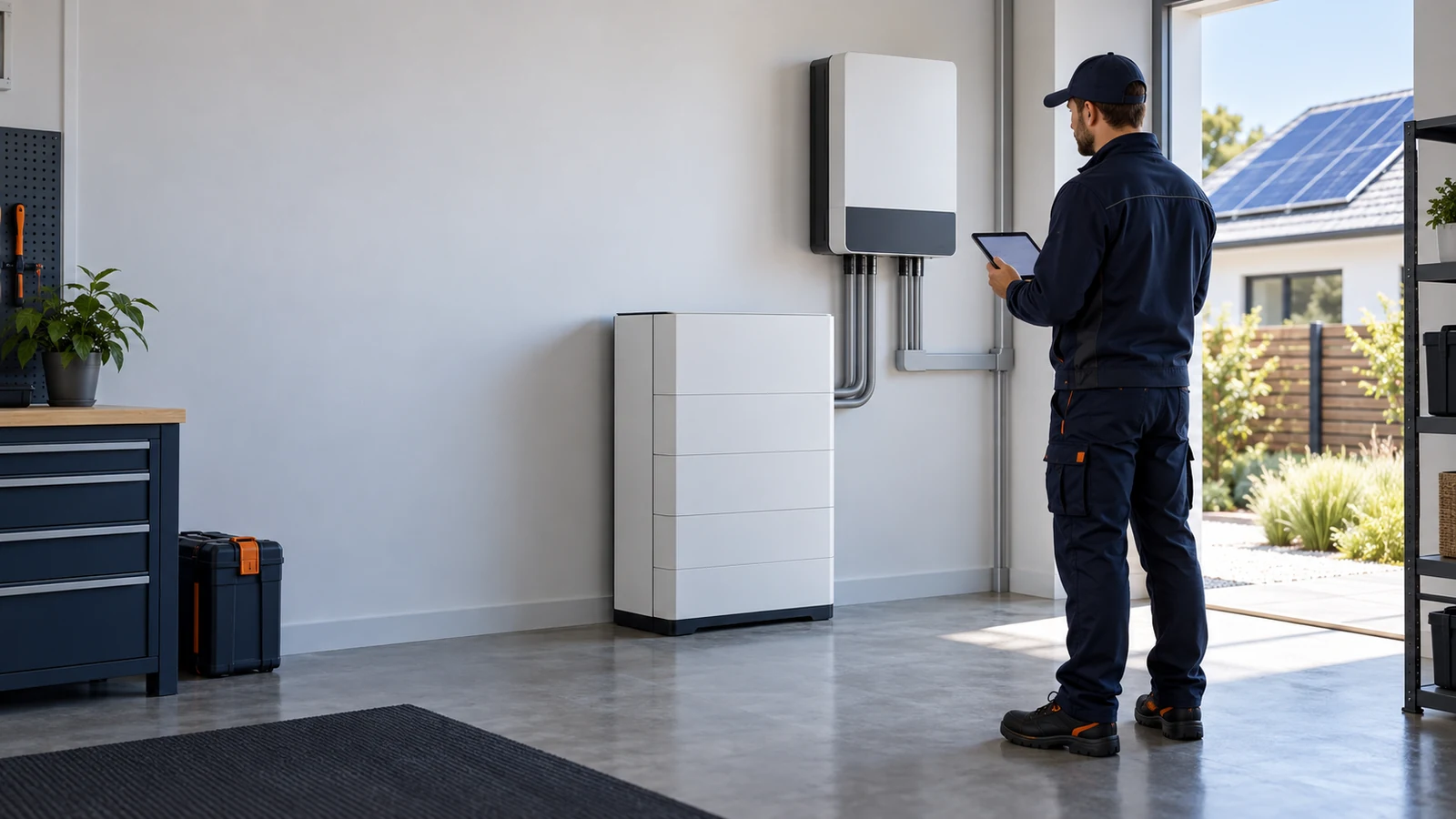
Choosing a 5kWh HESS supplier is easier when the quotation separates what is published, what is calculated and what still needs project-specific confirmation. A short label such as “5kWh indoor modular battery” can refer to a battery module, an integrated battery-and-inverter product, or a capacity class used for marketing. Those are different supply scopes, and each one creates different technical and commercial responsibilities.
This buying guide is written for solar distributors, installers, EPC teams and brands preparing an OEM or ODM enquiry. It uses Mottcell's published SMJ 5KWh T01 table as the factual starting point, then shows how to convert those entries into a useful request for quotation. All arithmetic examples are identified as calculations. Runtime figures are planning examples rather than guaranteed results for a particular installation.
The immediate objective is practical: before comparing prices, confirm the energy basis, BMS and current limits, enclosure version, inverter relationship, installation environment and acceptance documents. That process reduces the chance that two apparently similar 5kWh offers are compared on different assumptions.
A battery module stores DC energy. An all-in-one energy storage system combines a battery with an inverter and may also include switching, display or energy-management functions. Both can be described as household energy storage, but they should not be treated as the same product in a quotation.
For a battery-only offer, identify who selects and supplies the inverter, who confirms the battery-to-inverter settings, and which party performs commissioning. For an integrated offer, identify the exact inverter rating, AC input and output details, operating modes, included accessories and system-level documentation. A single photograph cannot establish these boundaries.
The published Mottcell Energy Storage System range presents 5–30kWh solar-compatible battery options. Mottcell also publishes a separate all-in-one energy storage system range. Use the two pages to decide which supply scope should appear in the enquiry. If the project needs a non-standard enclosure, label or interface, describe that requirement through the customized energy storage route.
Ask every supplier to state the supply boundary in the first page of the quotation. A clear line such as “battery module only; external inverter excluded” is more useful than a broad phrase such as “complete solar solution.” It also makes freight, warranty and commissioning responsibility easier to compare.
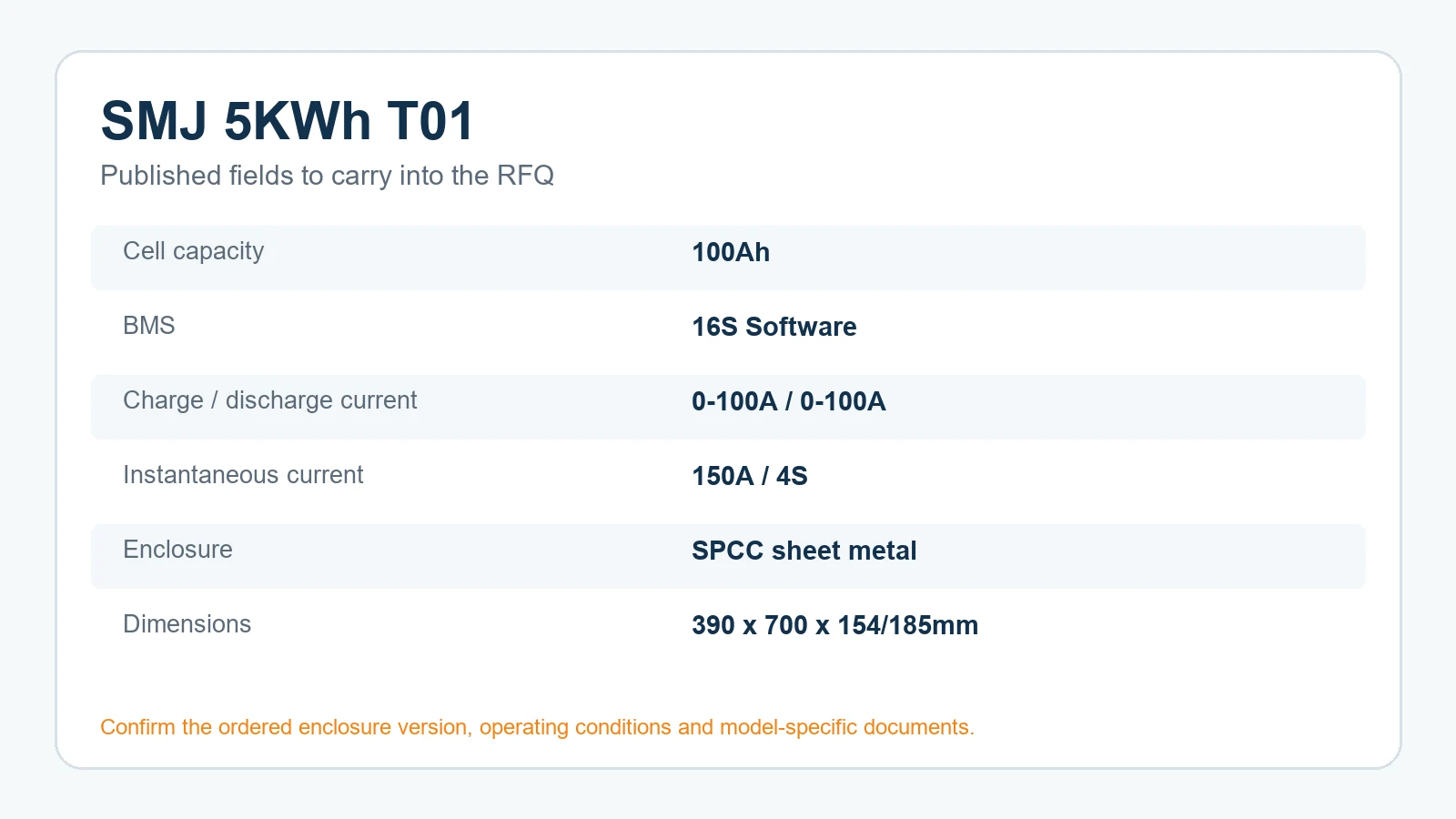
Mottcell's public product table identifies the model SMJ 5KWh T01 and lists a 100Ah cell capacity, 16S Software BMS, 0–100A charging current, 0–100A discharging current, 150A instantaneous current for 4 seconds, an SPCC sheet-metal enclosure, and dimensions shown as 390 × 700 × 154/185mm.
Those entries are useful evidence, but several still need an approved drawing or model-specific specification before an order is fixed. The two depth figures should be matched to the selected enclosure version. “16S Software” identifies the BMS field shown in the table, but it does not by itself confirm a particular communication protocol, inverter model or firmware combination. Likewise, the instantaneous-current entry cannot be used as a continuous-current rating.
| Published SMJ 5KWh T01 field | Value shown on the Mottcell page | Procurement follow-up |
|---|---|---|
| Cell capacity | 100Ah | Confirm rated-capacity test conditions and tolerance |
| BMS | 16S Software | Request operating limits, interface details and approved settings |
| Charging current | 0–100A | Confirm continuous conditions and any derating |
| Discharging current | 0–100A | Match to inverter demand and battery operating voltage |
| Instantaneous current | 150A / 4S | Treat as short-duration only; request the applicable conditions |
| Enclosure material | SPCC sheet metal | Confirm finish, mounting method and ordered enclosure version |
| Dimensions | 390 × 700 × 154/185mm | Obtain a revision-controlled drawing and clarify both depth figures |
The table above deliberately keeps the public data separate from interpretation. A supplier should be able to provide a configuration record that connects the ordered model to the drawing, electrical limits and accessories. Buyers can then evaluate later changes against an agreed baseline instead of relying on an undated screenshot.
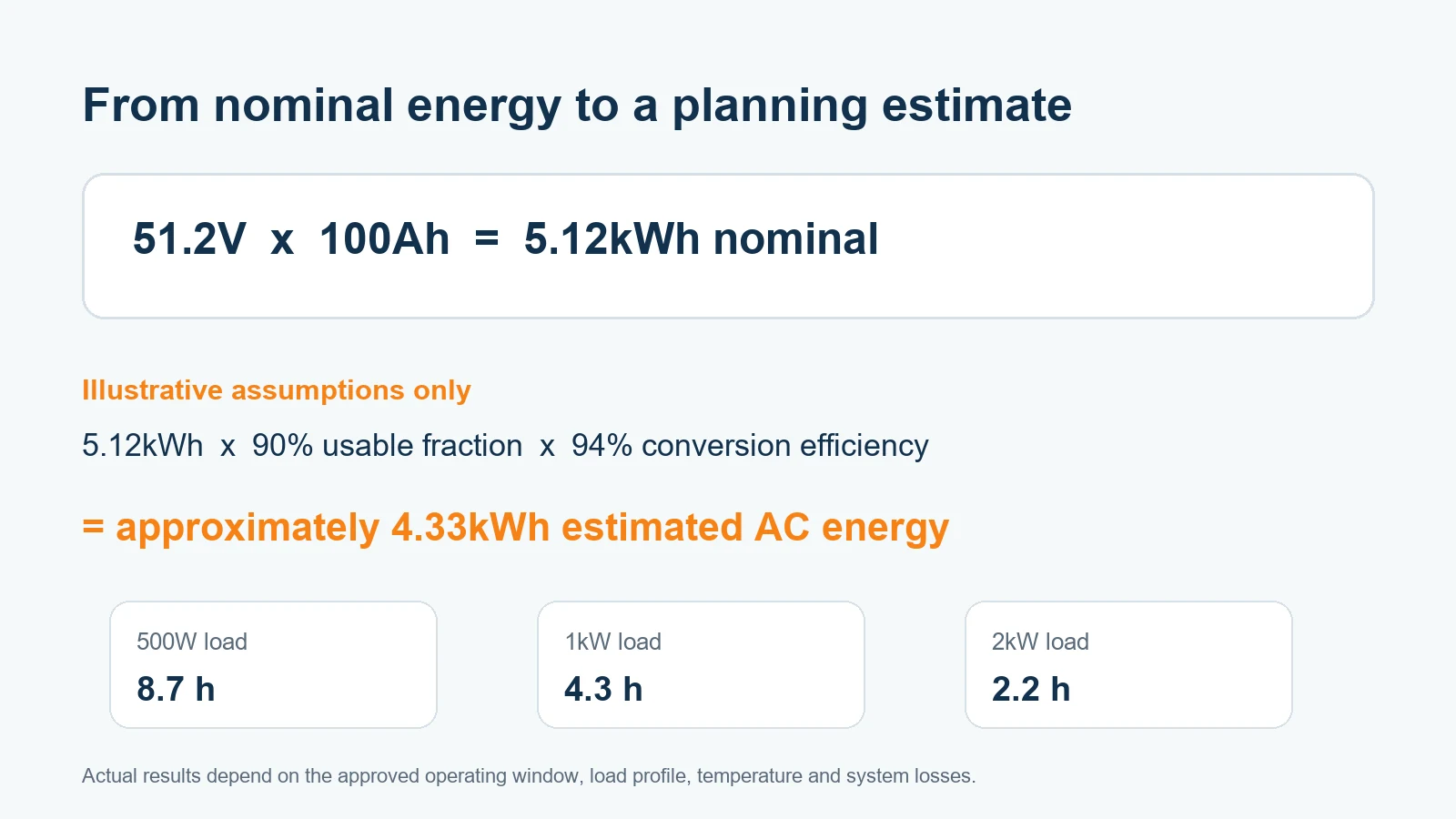
Nominal energy is calculated as nominal voltage × amp-hours ÷ 1,000. A common 16-series LiFePO4 calculation uses 3.2V per cell, which gives 51.2V nominal for the series string. Multiplying 51.2V by 100Ah gives 5.12kWh of calculated nominal energy.
That arithmetic explains why buyers frequently search for a “51.2V 100Ah HESS” when comparing the 5kWh class. It does not replace the rated-energy and voltage information on the approved specification for the supplied model. Cell nominal voltage is an engineering reference value; actual battery voltage changes during charge and discharge, while usable energy depends on the permitted operating window and other conditions.
Do not use 5.12kWh as a promise of AC energy delivered to appliances. State-of-charge limits, conversion losses, auxiliary consumption, temperature, load profile and battery condition all affect the result. The correct comparison records nominal energy, usable DC energy under stated conditions and expected AC delivery as separate values.
For an illustrative planning example, assume 5.12kWh nominal energy, a 90% usable-energy fraction and 94% conversion efficiency. The calculation is 5.12 × 0.90 × 0.94, or approximately 4.33kWh of estimated AC energy before any auxiliary consumption not already included in the efficiency assumption. The 90% and 94% figures are chosen assumptions, not published SMJ 5KWh T01 performance values.
Under the same assumptions, a steady 500W load corresponds to roughly 8.7 hours, a 1kW load to about 4.3 hours, and a 2kW load to about 2.2 hours. Real homes do not hold a perfectly constant load, solar generation may add energy, and equipment can impose startup demand. These values help structure a conversation; they are not a design guarantee.
The letters matter. Kilowatt-hours measure energy capacity, while kilowatts measure the rate at which power is supplied. A 5kWh battery does not automatically deliver 5kW continuously. Continuous output depends on the battery's allowed current, operating voltage, inverter efficiency and whichever component imposes the lowest limit.
At a nominal 51.2V, 100A corresponds to 5.12kW on the DC side by multiplication. This remains a nominal-voltage calculation. Voltage varies, protection settings apply, and the available AC output is lower after conversion losses. It is therefore incorrect to convert a 100A table entry into an unconditional “5kW continuous AC output” claim.
For another transparent example, a 5kW AC load at an assumed 94% conversion efficiency requires about 5.32kW from the battery before separately accounting for other losses. At 51.2V, that is approximately 104A. The example shows why a headline 5kW inverter needs a detailed current review when the published battery table shows 0–100A discharge current.
The short-duration 150A/4S entry has a different purpose from the 0–100A range. Ask for the exact conditions and the behavior expected when a load exceeds the permitted continuous current. A four-second figure should never be presented as a continuous-load capability, and it should not be treated as proof that every motor or compressor can start successfully.
Prepare a load schedule for the responsible installer. Record continuous loads, loads that may operate at the same time, startup characteristics and any circuits that must remain powered during an outage. Then evaluate the inverter, battery, protective devices and installation requirements as one system.
Search demand often uses the phrase indoor IP20 modular HESS. IP20 is an enclosure-protection designation, not a complete statement of environmental suitability, electrical safety or system performance. It generally describes protection against access to hazardous parts by fingers and solid objects of a stated size, while offering no water protection. The actual rating must be confirmed on the model documentation and marking for the ordered unit.
Mottcell's public SMJ 5KWh T01 table lists SPCC sheet metal and dimensions, but the table reviewed for this guide does not list an IP rating. A buyer should therefore ask whether the selected enclosure is IP20 or another rating and request the evidence applicable to that exact version. Do not infer an IP rating from indoor positioning, cabinet appearance or enclosure material.
Describe the installation room in the enquiry: indoor temperature range, humidity conditions, dust, water exposure, ventilation, available wall or floor area, service access and cable approach. The installer should review clearance and mounting requirements in the approved manual. An equipment room, garage and living space may impose different constraints even though all are indoors.
Modular can also mean different things. It may describe a battery that can be paralleled, a cabinet with replaceable internal modules, or simply a range offered in several capacities. Ask the supplier to define the supported expansion method, required common hardware, maximum supported quantity and rules for mixing production revisions. Expansion should follow model-specific instructions rather than a shared voltage-class label.
If a project expects later capacity growth, state the likely timing and target size. Ask how compatible additions are identified and whether firmware, balancing or commissioning work is required. The answer belongs in the system design and commercial record; it should not be promised to the customer as an unlimited future option.
A matching “48V” or “51.2V” label only starts the compatibility check. Compare the documented battery voltage window with the inverter's supported battery-input range, then review charge and discharge current settings. The approved settings must respect the selected battery configuration across its operating range.
Communication needs model-level evidence. A physical connector or the name of a protocol is insufficient. Ask for the exact inverter model, inverter firmware, battery firmware or protocol setting, cable definition and configuration procedure that the supplier supports. Record the tested combination in the project file.
The public SMJ table reviewed here does not establish a list of compatible inverter brands. It is safer to send the full inverter model to Mottcell for configuration review than to assume compatibility from a brand name. Similar models or regional variants can have different firmware and battery settings.
During sample evaluation, use an agreed checklist. Confirm normal startup and shutdown, charge and discharge limits, state-of-charge reporting, alarms relevant to the supported interface, and expected recovery after a communication interruption. Keep results attached to the tested hardware and software versions. A successful sample is useful experience, but it is not independent certification of every future combination.
Where an external inverter creates uncertain integration work, compare an integrated option using the same load brief. The commercial decision should consider support boundaries, commissioning time and future service as well as initial price. The correct choice is the one whose responsibilities and evidence match the project.
A 5kWh-class battery can be considered for smaller household solar-storage duties, essential-load backup, compact demonstration systems, sample evaluation and projects where limited installation space matters. Suitability still depends on the actual load, inverter and operating strategy. Capacity alone cannot confirm that a particular project is adequately sized.
For evening solar self-consumption, obtain interval data or a realistic estimate of the energy used after solar production falls. For backup, identify the essential circuits and the required duration. A refrigerator, communications equipment and lighting may create a different power and energy profile from electric cooking, heating or pumping loads.
Separate daily energy throughput from outage duration. A customer may want only to shift excess daytime solar into the evening, or may expect long backup during a grid failure. Both conversations can mention 5kWh, but they lead to different reserve settings, inverter modes and customer expectations.
If the calculated need is above the useful range of a single 5kWh unit, compare a larger capacity rather than relying on vague expansion language. The 10kWh HESS supplier guide explains the next common capacity step. The 15kWh HESS capacity guide provides a further sizing reference with clearly labeled calculations.
For commercial and industrial projects, start with the load profile and operating objective rather than scaling a household example. The commercial HESS sizing guide discusses project inputs for factory microgrids. A compact 5kWh module should not be described as a universal solution for industrial motor loads without an engineered system review.
Send the same concise brief to each supplier. Start with the destination market, application, expected quantity, sample requirement, target schedule and whether the request is for a battery module or an all-in-one system. Add the existing inverter model, if applicable, and a load summary that distinguishes continuous power from startup demand.
Ask the supplier to identify the proposed model and revision. The response should include rated voltage and energy, capacity-test basis, operating-voltage range, continuous charge and discharge limits, short-duration limits, enclosure drawing, installation method, environmental limitations and the supported inverter interface. Mark any values that remain subject to project confirmation.
For OEM or ODM work, separate technical requirements from branding requests. Technical requirements may affect enclosure design, connectors, BMS settings, testing or documentation. Branding requests may cover labels, color, carton artwork or manuals. Both can influence cost and schedule, but they should be approved through different evidence.
| RFQ section | Information from the buyer | Response expected from the supplier |
|---|---|---|
| Supply scope | Battery-only or integrated system | Included and excluded equipment |
| Electrical basis | Load, inverter model and operating objective | Recommended model, settings and unresolved interfaces |
| Capacity | Required energy and backup assumptions | Rated energy, test basis and usable-energy conditions |
| Installation | Space, mounting and environment | Drawing, clearances and environmental limits |
| Commercial | Quantity, destination and timing | Price scope, lead time, packaging and delivery terms |
| Acceptance | Sample purpose and critical checks | Agreed checklist, records and change-control process |
Require quotation revisions to retain an identifier. If the supplier changes the enclosure, cells, BMS, firmware or accessories after sample approval, the order record should show what changed and which checks need to be repeated. This protects both buyer and supplier from approving one configuration and receiving another without a documented review.
Company information can establish business context, while product evidence must still match the ordered model. Mottcell's About page describes its battery and energy-storage business. For a purchase decision, request documents that identify the legal supplier, product family or model scope, issue date and relevant revision.
When reviewing certificates or test reports, confirm the issuing organization, document identity and covered model. A general certificate image or factory statement does not automatically apply to every customized battery, inverter pairing or destination-market requirement. The importer, installer or other responsible project party should determine which evidence is required for the actual use.
Compare warranty terms in writing. Ask for the covered model, start date, duration, operating conditions, exclusions, evidence required for a claim, and repair or replacement process. If the warranty uses throughput or retained-capacity conditions, request their definitions. A headline number without those terms cannot be compared reliably.
Experience also comes from a controlled sample process. Agree on identity checks, visual inspection, dimensions, interface verification and relevant operational observations before the sample is shipped. Record the test equipment and conditions. The resulting file provides project-specific evidence without turning an internal observation into a broad laboratory or field-performance claim.
A scorecard keeps the buying decision connected to the project. Give the greatest weight to mandatory electrical and documentation requirements. Price, customization and schedule matter only after the proposed system can be evaluated against those requirements.
One practical structure uses pass/fail gates for voltage range, current limits, inverter interface, enclosure fit and required documents. Suppliers that pass those gates can then be scored for sample support, response clarity, change control, lead time, price scope and warranty process. Keep the evidence used for each score.
Do not award points for unverified superlatives such as “best,” “Grade A,” “certified,” “long life” or “fully compatible” unless the supplier provides a definition and evidence relevant to the proposed model. A careful supplier may appear less promotional because it distinguishes confirmed values from pending items. That clarity is useful in technical procurement.
Finally, hold a short pre-order review. Confirm the configuration, approved documents, artwork if any, sample status, production quantity, packaging, delivery terms and named points of contact. List open items with owners and due dates. A complete record is more valuable than a long email thread with inconsistent specifications.
No. Five kilowatt-hours describes energy capacity, while five kilowatts describes power. A battery's permitted current and voltage, the inverter and conversion losses all affect deliverable AC power. Evaluate both energy and power against the project's load brief.
Using 3.2V nominal per LiFePO4 cell, 16 in series gives 51.2V, and 51.2V × 100Ah equals 5.12kWh nominal. This is an arithmetic reference. Confirm the rated voltage, rated energy, test conditions and usable operating window on the approved specification for the supplied model.
Send the destination market, quantity, battery-only or all-in-one preference, exact inverter model, essential-load profile, installation environment, OEM requirements and target schedule. Ask for a model-specific specification, drawing, supported settings, document scope, warranty terms and sample acceptance plan.
Preparing a 5kWh solar-storage enquiry? Contact Mottcell with the inverter model, load brief, installation conditions and expected quantity. The team can propose a supply scope and identify the specifications that still require confirmation before quotation approval.
16kWh HESS Supplier: 51.2V 314Ah Buyer’s Guide
5kWh HESS Supplier: Indoor Modular Battery Buying Guide
48V 200Ah HESS Supplier: Voltage & Inverter Fit Guide
15kWh HESS Supplier: Capacity & Home Backup Runtime Guide
10kWh HESS Supplier: Home Solar Storage Buying Guide
12V LiFePO4 Battery Pack Manufacturer for OEM Projects
51.2V HESS Battery Supplier | Solar Storage OEM Guide
AGV Lithium Battery: High-Power Industrial LiFePO4 Units
Established in 2005
In 2009, it was awarded the title of "National High tech Enterprise"
 zoe@mottcell.net
WhatsApp: 8617388790296
Fax: 86-0755-84042963
Skype: live:b0ebaecbb8782516
WeChat: +8613428749632

 VR show
 CN
CN Home >


