

 Jul 26, 2026


Choosing a 48V 280Ah HESS supplier starts with a clear battery specification. A 280Ah label describes charge capacity; it does not establish usable backup energy, inverter compatibility or a complete solar system. For a confirmed 51.2V nominal configuration, 280Ah corresponds to 14.336kWh of nominal energy. A true 48.0V configuration would instead calculate to 13.44kWh. That distinction matters when comparing quotations sold under the same 48V battery category.
This guide helps solar brands, distributors, installers and OEM procurement teams evaluate a 280Ah home energy storage battery. It covers the published Mottcell model reference, energy calculations, inverter pairing, installation inputs and sample acceptance. Mottcell's House ESS range provides the starting point; the final project specification should identify the exact configuration and approved equipment combination.
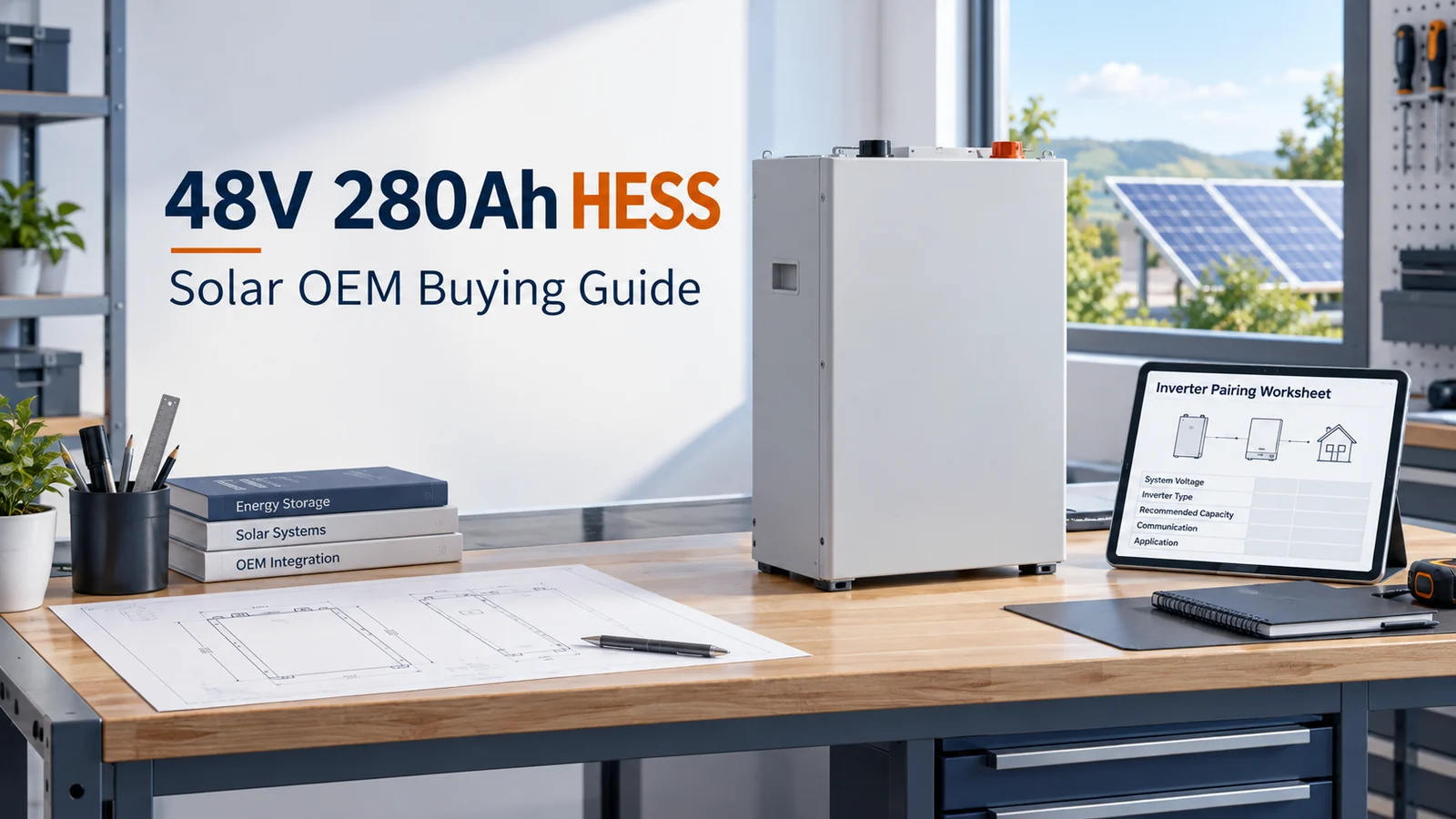
AI concept illustration for procurement planning. The enclosure shown is not a photograph or a dimensional representation of a verified Mottcell model.
The Mottcell Energy Storage System product table lists SMJ 15KWh T01 with 280/314Ah capacity options, a 16S software BMS, SPCC sheet metal and dimensions of 850 × 450 × 250mm. The table shows charging and discharging current as 0–100A. These are published reference values, rather than a substitute for an approved model datasheet and installation drawing.
The 280Ah and 314Ah options should be treated as separate configurations. Confirm which option appears in the quotation, sample label and purchase agreement. A family name containing “15KWh” does not mean both capacities have identical calculated nominal energy. Likewise, enclosure dimensions alone do not establish installation clearance, packed shipping dimensions or the weight that a mounting arrangement must support.
For procurement, request the exact orderable model, nominal voltage, capacity test conditions, cell chemistry, current limits and firmware revision. Ask the supplier to reconcile any difference between the public table and the quotation before approving a sample. A confirmed configuration is easier to compare than a proposal that alternates between capacity labels without explaining the relationship.
This guide focuses on a low-voltage home storage battery supplied to businesses. A brand, factory or distributor can buy a residential product, but that does not make the product suitable for powering an entire industrial plant. Define the intended application as residential solar storage, selected backup loads or another specified use before discussing system capacity.
“48V-class” is often a platform description. The quoted nominal voltage should come from the actual battery configuration. If a confirmed LiFePO4 design uses sixteen cells rated at 3.2V nominal in series, the calculated nominal pack voltage is 51.2V. A fifteen-cell configuration at the same cell voltage would calculate to 48.0V. The public 16S BMS entry provides a reason to clarify the configuration; it does not independently confirm every voltage limit.
The basic calculation is: nominal energy in kWh = nominal voltage × rated capacity in Ah ÷ 1,000. Both inputs must refer to the same battery specification. Do not calculate one option using a 48V platform label and another using its confirmed nominal voltage, then present the difference as a product advantage. Use a consistent basis in the comparison worksheet.
| Configuration for comparison | Capacity | Calculated nominal energy | Procurement meaning |
|---|---|---|---|
| Confirmed 48.0V configuration | 280Ah | 13.44kWh | Requires confirmation that 48.0V is the actual nominal rating |
| Confirmed 51.2V configuration | 280Ah | 14.336kWh | Calculation for a confirmed 51.2V specification |
| Confirmed 51.2V configuration | 314Ah | 16.0768kWh | A separate capacity option requiring its own specification |
| Confirmed 51.2V configuration | 200Ah | 10.24kWh | Smaller-capacity comparison, not a substitute model approval |
The 51.2V calculation is about 6.7% higher than the 48.0V calculation for the same 280Ah value. That is a difference in calculation inputs, not evidence that changing a label increases the battery's physical energy. Similarly, 314Ah has about 12.1% more nominal charge capacity than 280Ah at the same nominal voltage. Whether that extra capacity is useful depends on the load profile, reserve setting, installation space and total installed cost.
Nominal voltage also differs from the voltage observed during charging or discharge. Ask for the full permitted operating range and inverter cutoffs. An inverter that accepts a nominal platform may still require particular charge settings and communication behavior. For comparisons across several capacities, use the separate 51.2V HESS capacity guide alongside the actual model documents.
Backup planning needs an energy budget and a power budget. Energy determines how long a permitted load might run. Power determines whether the battery and inverter can support that load at a particular moment. A battery with substantial stored energy can still be unsuitable for a short, high-current load if the approved discharge limit is exceeded.
Consider an illustrative 51.2V 280Ah battery with 14.336kWh nominal energy. Assume an 80% planning window and 90% combined conversion efficiency. Estimated delivered energy would be 14.336 × 0.80 × 0.90 = 10.32192kWh, or about 10.32kWh. Both percentages are hypothetical planning assumptions. They are not measured Mottcell efficiency, warranted usable capacity or a recommended setting for every installation.
Under that example, a constant 1kW load would calculate to about 10.32 hours. A constant 2kW load would calculate to about 5.16 hours. These estimates exclude extra standby consumption, changing loads, temperature effects, aging and protective shutdown behavior. If a household needs refrigeration, lighting and internet backup, measure their combined duty cycle rather than adding all appliance nameplate powers as though they operate continuously.
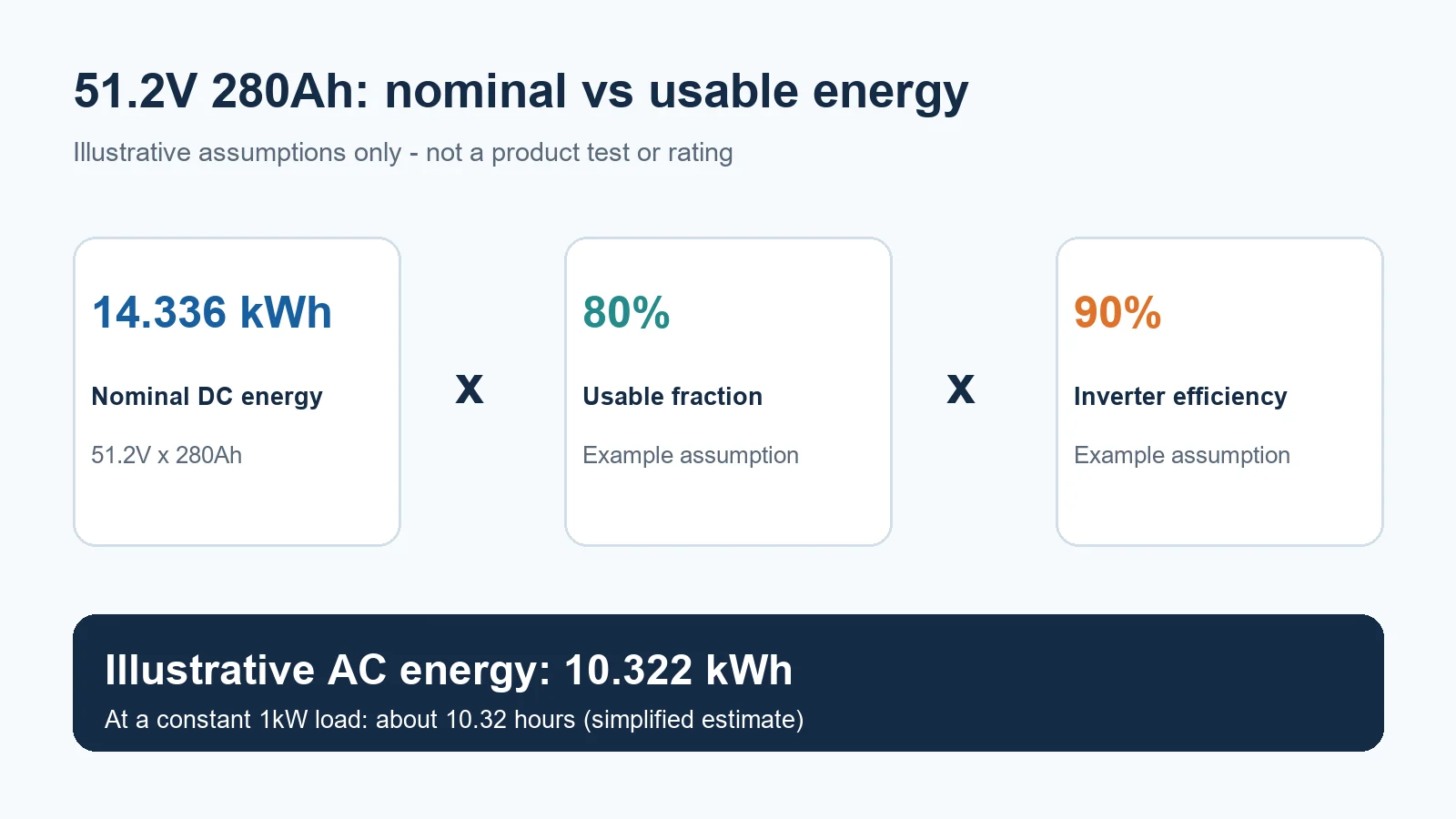
Planning example: 51.2V × 280Ah = 14.336kWh nominal; assumed 80% energy window and 90% efficiency give approximately 10.32kWh delivered. These assumptions are not product test results.
Reserve decisions should reflect the actual purpose. A project that prioritizes outage resilience may preserve more energy than a project focused on daily solar self-consumption. Record the reserve setting and how it changes during different operating modes. Otherwise, two suppliers may appear to provide different backup durations simply because they calculated with different available energy windows.
For a broader discussion of battery modules, capacity labels and backup scenarios, consult the 15kWh home storage buying guide. Keep this 280Ah procurement evaluation tied to the actual model: a general system guide cannot replace the sample's measured capacity or the approved reserve policy.
An inverter power rating is not a battery discharge rating. The inverter may be capable of supplying a load that a single battery cannot sustain. Compare the inverter's maximum battery current with the battery's approved continuous and short-duration limits. Both limits require specified conditions, including temperature, voltage, duration and the behavior expected after a protection event.
For an illustrative 5kW AC load, assume 90% inverter efficiency and a battery voltage of 51.2V. Estimated DC current would be 5,000 ÷ 0.90 ÷ 51.2, or approximately 108.5A. At an illustrative 46V operating point with the same assumed efficiency, the calculation rises to about 120.8A. Neither voltage is a suggested cutoff; the example shows why current demand can increase as voltage falls.
The public SMJ 15KWh T01 table lists a 0–100A discharge range. Consequently, the example does not support promising that one module will continuously deliver 5kW AC across all conditions. The final design needs a documented limit or another approved configuration. A brief surge rating should never be used to justify a continuous load, and nominal voltage multiplied by current is not a guaranteed AC output specification.
Ask the inverter supplier to provide its battery-side current requirements and supported operating modes. Check whether an essential-load circuit, a larger approved bank or a different system architecture is appropriate. The decision belongs in a project design review, because adding batteries changes protection, cabling, communications and installation requirements as well as energy capacity.
For buyers comparing a different capacity in the same broad platform, the 48V 300Ah HESS sourcing guide explains why capacity and current must be evaluated separately. Increasing Ah alone does not confirm a higher permitted current or universal inverter compatibility.
A useful compatibility statement identifies the exact inverter model, battery revision, firmware versions, connection arrangement and validated settings. “Compatible with leading brands” is too broad for an OEM acceptance record. Even when two devices have the same connector type or a familiar communication port, the actual pin assignment, messages and control sequence still need confirmation.
Start with electrical compatibility. The inverter's accepted battery voltage range must agree with the battery's permitted operation. Charge current, discharge current and shutdown thresholds must be coordinated. Confirm whether the installation uses closed-loop communication or a supplier-approved configuration without that communication, and document the limitations of the chosen mode.
Then examine operating behavior. A sample evaluation should include startup, normal charging, controlled discharge, a communication interruption and recovery under an approved test procedure. Record what the inverter displays when the battery reduces available current or reaches a reserve limit. The objective is to understand the real system response, including whether a load transfer or manual intervention is required.
Communication should also support service. Ask which alarms, state-of-charge values and event records can be accessed and how installers should interpret them. A communication cable is not sufficient evidence that all functions are implemented. Keep a validated settings sheet with each approved equipment pair, so a distributor's installation team can reproduce the configuration without relying on a verbal explanation.
Software changes require control after the first order. Agree whether a firmware update needs renewed pairing checks and who authorizes it. A later shipment with different behavior can create support work even if the enclosure and capacity label remain unchanged. For buyers selling under their own brand, this configuration history is part of maintaining a consistent product offer.
The enclosure should fit the intended location and the installation method. Use the published dimensions as an initial space check, then request a dimensioned drawing showing connectors, access panels and service clearances. Confirm the permitted mounting orientation, handling method and cable approach. The space needed to install and service a battery can be larger than its closed enclosure footprint.
Location requirements should be explicit. Describe whether the battery will be indoors, in an equipment room or in another environment. Specify expected ambient conditions and possible exposure to moisture, dust, sunlight or corrosion. Do not infer an outdoor rating from a metal case or from an unrelated product photograph. Obtain the exact enclosure classification and installation instructions for the quoted option.
Clarify the supply boundary before comparing prices. A battery module, a battery cabinet and a complete all-in-one solar system contain different components. State whether an inverter, isolation equipment, communication leads, mounting accessories, monitoring hardware and installation materials are included. The separate all-in-one energy storage range is the relevant starting point when the requirement includes an integrated system.
Delivery planning also needs the actual packed dimensions and gross weight. Ask who provides the packaging specification, labels and shipment documents, and which party checks the requirements for the destination. A general company certification statement cannot establish that a particular configuration has the evidence needed for a specific project or shipment. Review the documents against the exact model rather than copying a certification list into the purchase order.
An RFQ should describe the work the battery must do and the evidence needed to approve it. Start with the buyer's role and application: an OEM brand supplying household solar projects has different documentation and service needs from an installer purchasing for one site. Include the target quantity, sample stage and intended market without assuming a standard minimum order or lead time.
Provide the load profile and equipment details early. A request containing only “48V 280Ah, best price” leaves the supplier to guess the usable energy window, inverter, installation and accessories. Ask for a proposal that separates confirmed specifications, available options and items requiring engineering review. That makes unresolved points visible before commercial terms are finalized.
| RFQ area | Information the buyer should provide | Evidence requested from the supplier |
|---|---|---|
| Battery configuration | 280Ah target, nominal voltage requirement and intended application | Exact model, chemistry, capacity conditions and approved voltage limits |
| Load and operating modes | Continuous load, startup events, backup duration and reserve objective | Current limits, permitted operating modes and design review of the stated load |
| Inverter pairing | Model, firmware and required monitoring functions | Validated pairing record, settings sheet and communication details |
| Mechanical installation | Available space, mounting plan, cable approach and environmental conditions | Dimensioned drawing, handling instructions and enclosure evidence |
| Sample acceptance | Test conditions, reporting needs and measurable acceptance limits | Approved test plan, sample identification and recorded results |
| Commercial supply | Quantities, branding, accessories, destination and support expectations | Itemized quotation, delivery scope, warranty terms and change-control process |
Compare quotations against the same scope. A lower battery-only price is not directly comparable with a package that includes more equipment or technical support. Keep missing documentation and optional components visible in the worksheet. If a proposal changes capacity or nominal voltage, calculate its energy on the confirmed basis and identify the change before comparing cost per nominal kWh.
Buyers requiring a different mechanical layout or branding can use Mottcell's customized energy storage page to frame the discussion. Any custom request still needs written feasibility, specifications and acceptance criteria. A custom label does not itself establish a new enclosure rating, higher current limit or different communication capability.
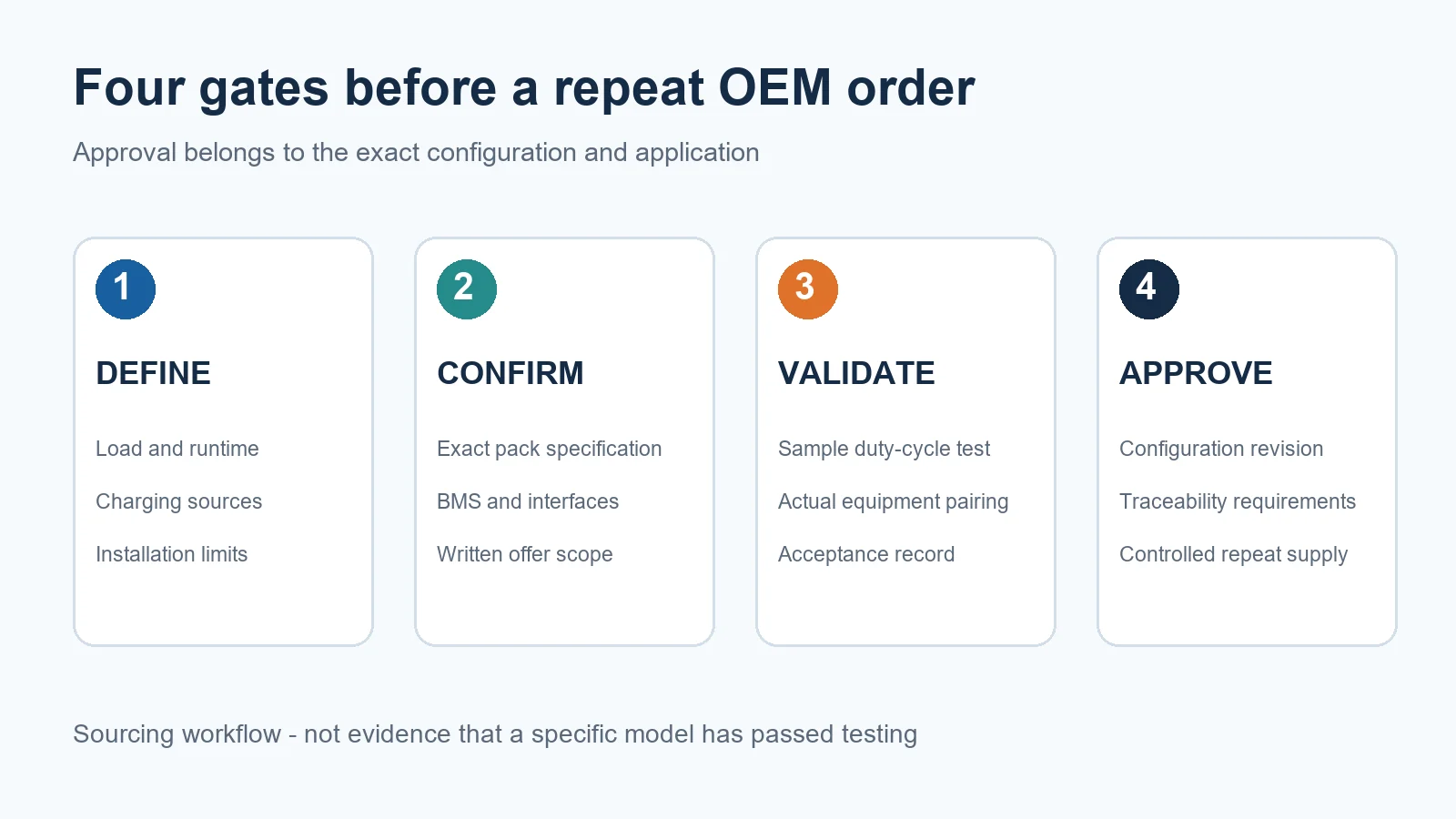
Procurement workflow: define the application, confirm the configuration, evaluate the sample, then approve controlled repeat supply. The diagram describes an evaluation process, not a test certificate.
Begin by checking sample identity. Record the model, serial number, label, firmware revision and supplied accessories. Compare them with the approved quotation and datasheet. If the sample uses a different capacity option or an undocumented component revision, resolve the discrepancy before treating its results as evidence for the production order.
Capacity evaluation needs a defined method. Agree the charge and discharge procedure, temperatures, current levels, termination conditions and measurements. Record both Ah and delivered energy where appropriate, and keep the test conditions with the results. A number shown on a display or calculated from the label is not the same as a completed capacity measurement.
Evaluate the actual inverter pair using an approved test plan. Include the expected normal operating sequence and the relevant recovery behavior. If the application has startup loads, provide measured requirements and agree how they will be assessed. Protection and abnormal-operation tests should be performed by qualified personnel using suitable equipment and the supplier's procedures; they are not informal field experiments.
Mechanical review should include connector access, installation clearances and practical service tasks. Ask an installer to follow the supplied instructions and record questions that remain unclear. Improving an instruction or settings sheet at the sample stage is usually simpler than resolving the same ambiguity across a larger shipment.
For repeat orders, define which changes require notice and which require a new approval. This can include cell selection, BMS, firmware, enclosure, connectors or packaging. Keep an approved configuration record and a reference sample where appropriate. Acceptance of one sample does not automatically approve every later variant marketed under the same capacity name.
Supplier evaluation should connect company capabilities with the specific product being ordered. Mottcell's company and quality-control overview describes cell sorting, pack assembly and inspection activities. Use that overview to request relevant records for the quoted battery, such as sample identification, inspection results and the applicable production control plan. A company overview is contextual evidence, not a model-specific test report.
Ask how the supplier handles technical questions after delivery. Establish the information an installer should provide with a support request, the troubleshooting process and responsibility for replacement decisions. Review written warranty conditions, including the approved use, exclusions and procedure for evaluation. Do not turn an estimated service life into a promised warranty term.
Commercial continuity matters as well. Confirm how repeat configurations are identified, how spare parts are specified and how documents are updated. A supplier relationship should make it possible to trace what was purchased and what changed. Those records help a brand or distributor maintain consistent installation instructions and distinguish a configuration issue from an application mismatch.
The most useful supplier proposal answers a defined requirement with a documented configuration. It should allow the buyer to understand the energy basis, current limits, equipment pairing and delivery scope before placing a larger order. Procurement confidence comes from resolving those points, rather than from an unverified claim about the lowest price, longest lifetime or universal compatibility.
No. A confirmed 48.0V × 280Ah configuration calculates to 13.44kWh nominal, while 51.2V × 280Ah calculates to 14.336kWh. A rounded family name does not replace the actual nominal voltage, rated capacity or usable energy specification.
That requires a model-specific design check. At an assumed 90% efficiency and 51.2V, a 5kW AC load needs about 108.5A DC. This exceeds the published 100A reference for SMJ 15KWh T01; inverter size alone does not approve that load.
Send the application, capacity target, inverter model and firmware, load profile, backup objective, installation constraints, quantity and destination. Request a confirmed configuration, documented pairing, sample acceptance plan and itemized delivery scope before ordering.
For a 48V 280Ah HESS sourcing discussion, begin with your application and the inverter you plan to use. Include the loads, backup duration, reserve objective, installation location and quantity. Mottcell can review the request against its published House ESS range and discuss the exact configuration and supporting documents required for an OEM quotation.
Send your 280Ah HESS project brief to Mottcell to start that review. This guide uses published product information checked on October 5, 2026; its energy and current calculations are transparent planning examples. Final selection depends on the approved model documents, validated equipment pairing and project installation requirements.
36V Battery Pack for E-Bikes and AGVs: OEM Buying Guide
12V 100Ah Battery Pack: Compare 3 Models for OEM Buyers
12V 280Ah Battery Pack: Solar Runtime & OEM Buying Guide
18650 Battery Manufacturer: Cell Specs & OEM Checklist
12V 300Ah Battery Pack: Runtime, BMS and OEM Buying Guide
48V HESS Supplier: Inverter Matching & OEM Checklist
4860 Battery Supplier Guide: Cell Specs & OEM Checks
36V 314Ah Battery Pack Manufacturer: OEM Buying Guide
Established in 2005
In 2009, it was awarded the title of "National High tech Enterprise"
 zoe@mottcell.net
WhatsApp: 8617388790296
Fax: 86-0755-84042963
Skype: live:b0ebaecbb8782516
WeChat: +8613428749632

 VR show
 CN
CN Home >


