

 Sep 03, 2026


In modern smart factories, automated distribution centers, and lights-out manufacturing facilities, intralogistics efficiency depends entirely on continuous mobile automation. Automated Guided Vehicles (AGVs) and Autonomous Mobile Robots (AMRs)—spanning pallet jacks, tugger trains, heavy unit-load carriers, and automated forklift trucks—serve as the mechanical backbone of internal material flow. However, the operational availability, dispatch predictability, and overall productivity of any robotic material handling fleet are governed by a single electrochemical component: the agv lithium battery.
For plant operations directors, robotics system integrators, and OEM automated vehicle manufacturers, legacy battery platforms present severe operational bottlenecks. Traditional lead-acid, gel, and standard AGM chemistries suffer from rapid voltage drop under heavy dynamic loads, require extended 8-hour charge cycles paired with lengthy cool-down windows, demand dedicated hazardous battery-swapping rooms, and degrade after merely 500 charge-discharge cycles.
Transitioning to advanced lithium iron phosphate (LiFePO4) chemistry engineered into a custom agv battery pack configuration solves these structural challenges. Providing ultra-flat voltage discharge plateaus, high continuous charge acceptance for automated opportunity charging, intelligent CANbus and CANopen fieldbus communications, and multi-thousand cycle lifespans, LiFePO4 technology maximizes fleet uptime while substantially lowering total operational expenditure.
This comprehensive technical guide explores the electrochemistry, dynamic peak power delivery, opportunity charging architecture, voltage platform sizing, digital BMS integration protocols, and ruggedized mechanical engineering required to integrate a mission-critical agv lithium battery into industrial robotic fleets.
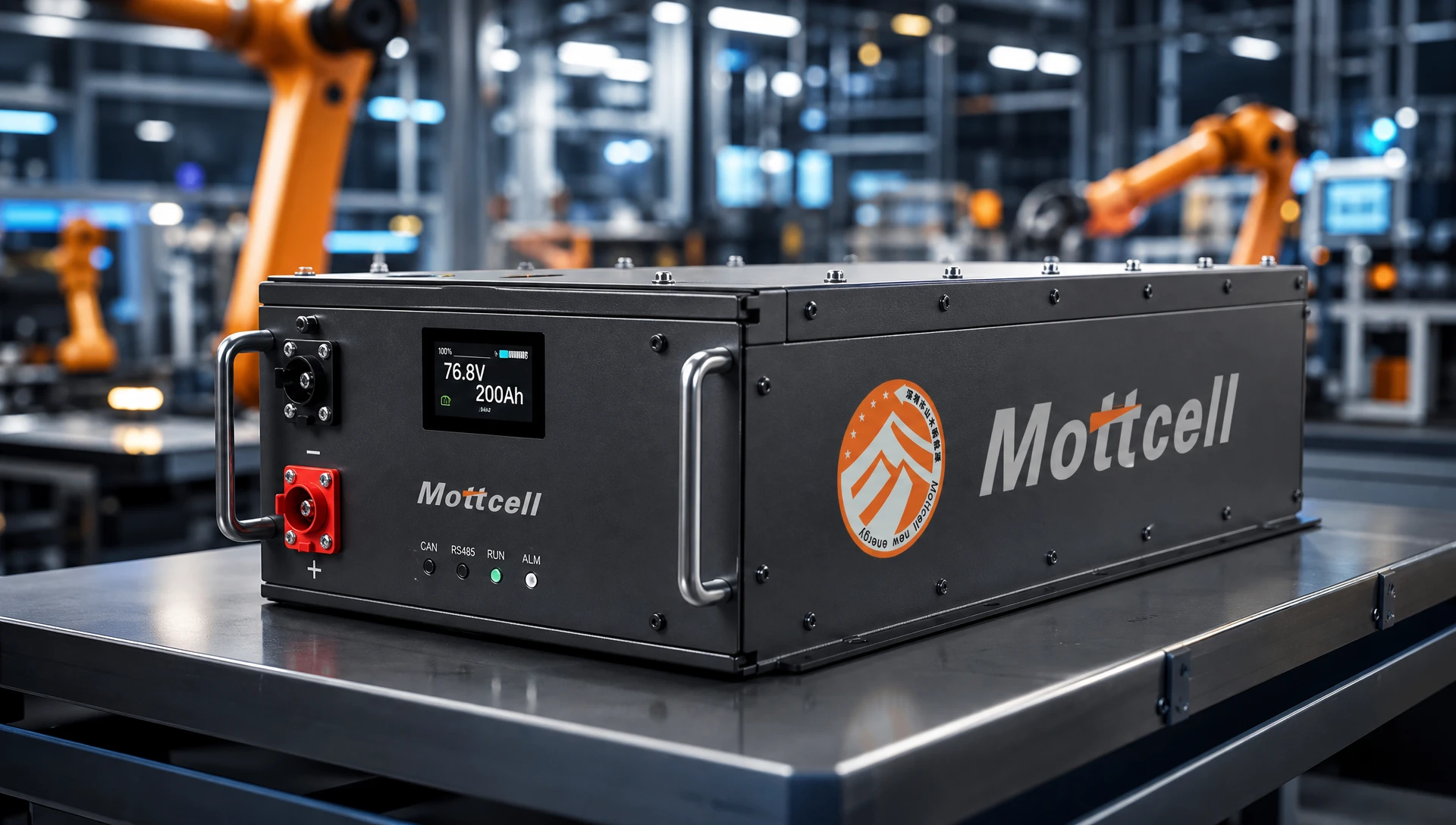
Automated vehicle operations in high-throughput manufacturing plants differ fundamentally from manual material handling. Where human-operated forklifts allow flexible pauses, manual battery swapping, and adaptive operator driving habits, an AGV operates under rigid algorithmic control, executing continuous point-to-point cycles over 16-hour to 24-hour daily schedules. Under these rigorous duty cycles, traditional lead-acid batteries fail on multiple operational fronts.
| Engineering Parameter | Traditional Industrial Lead-Acid / AGM | Industrial Mottcell LiFePO4 Battery | Operational Impact on AGV Fleets |
| Usable Depth of Discharge (DoD) | 50% (Discharging below 50% causes severe sulfation) | 90% to 100% (Linear, usable energy capacity) | 2x usable operating runtime within the same footprint |
| Cycle Life (@ 80% DoD) | 400 to 600 cycles (Requires replacement every 12–18 mos) | 4,000 to 6,000+ cycles (>80% retained capacity) | Eliminates recurring battery pack capital replacements |
| Recharging Window | 8 hours charging + 8 hours thermal resting | 20 to 45 minutes fast opportunity charging | Enables true 24/7 continuous autonomous vehicle runtime |
| Charge Acceptance Rate | 0.1C to 0.2C maximum | 1.0C continuous, 2.0C pulse | Compatible with automated contact-shoe charging pads |
| Voltage Discharge Curve | Steep, continuous drop (12.7V down to 11.2V) | Ultra-flat plateau (12.8V to 13.2V nominal) | Prevents motor stalling and low-voltage PLC resets |
| Maintenance Requirements | Bi-weekly watering, terminal desulfation, cleaning | 100% maintenance-free sealed enclosure | Eliminates dedicated battery maintenance technician labor |
| Fleet Battery Ratio | 2 to 3 battery packs per operating AGV | 1 battery pack per operating AGV | Eliminates battery swapping bays and crane hoists |
| Round-Trip Energy Efficiency | 70% to 75% (Excess energy lost as heat) | 96% to 98% (Minimal internal impedance) | Substantial reduction in facility electrical utility costs |
The operational failure of lead-acid systems in AGV applications stems from Peukert's Law, which dictates that available battery capacity decreases non-linearly as the discharge rate increases.
In lead-acid systems, the Peukert exponent typically ranges from 1.25 to 1.40. When an AGV accelerates with a 1,500-kilogram payload or actuates hydraulic lifting forks, the instantaneous current draw spikes from an idle 10A to over 150A. This high discharge rate induces rapid internal polarization and causes effective capacity to collapse by 30% to 45%, triggering low-voltage cut-offs long before the battery's theoretical energy has been depleted.
In contrast, an agv lifepo4 battery features an exceptionally low Peukert exponent of 1.01 to 1.03. Whether discharging at a nominal 0.2C cruising rate or supplying a 3C surge during incline climbing, the internal impedance remains exceptionally low (cell-level AC internal resistance Ri <= 0.3 mΩ), ensuring virtually 100% of the rated energy is delivered without premature voltage sag.
Legacy fleet deployments frequently require dedicated battery swap rooms equipped with overhead hoists, eyewash stations, acid-resistant floor coatings, and high-capacity HVAC systems to dilute toxic, explosive hydrogen gas vented during equalization charging.
Maintaining this setup requires purchasing two to three battery packs for every active AGV (one in the vehicle, one charging, one cooling), tying up massive capital and warehouse floor space.
Switching to an industrial agv lithium battery completely eliminates dedicated battery-swap infrastructure. LiFePO4 cells are hermetically sealed, produce zero off-gassing, require no electrolyte replenishing, and remain permanently installed within the vehicle chassis for automated in-chassis opportunity charging.
Industrial AGVs and AMRs rely on permanent magnet synchronous motors (PMSM) or brushless DC (BLDC) motors paired with precision planetary gearboxes and hydraulic lift systems. This electro-mechanical configuration creates dynamic, step-function load profiles that place heavy electrical stress on the vehicle's DC power source.
An automated vehicle transitions through several operational current states throughout every mission cycle:
Standby and Navigation Baseline (1.5A to 3.5A): Continuous baseline power consumption driven by onboard safety LiDARs, industrial PCs (IPCs), optical cameras, and wireless fieldbus transceivers. High coulombic efficiency ensures minimal parasitic drain during scheduled production idle states.
Constant-Velocity Cruising (15A to 30A / 0.15C to 0.3C): Steady rolling draw across smooth epoxy factory floors at constant speeds of 1.0 to 1.5 meters per second. The ultra-flat voltage plateau of LiFePO4 ensures predictable motor torque and constant travel speeds regardless of remaining state-of-charge.
Breakaway Acceleration (80A to 160A / 1.0C to 2.0C): High-torque initial impulse lasting 2 to 5 seconds to overcome static friction and wheel inertia under maximum rated payload. Low internal pack impedance (Ri <= 0.05 mΩ) prevents instantaneous voltage dips from resetting onboard safety controllers.
Hydraulic Fork Elevation (180A to 280A / 2.5C to 3.5C): High-pressure hydraulic pump actuation for pallet lifting, generating sharp 5 to 12-second current spikes. High-rate cell interconnects sustain these bursts without localized thermal accumulation.
Regenerative Braking Absorption (-30A to -60A): Reverse current generated during deceleration and downhill descent fed back into the battery terminals. Fast charge acceptance absorbs this energy cleanly, protecting the motor driver from bus overvoltage conditions.
If an inferior battery pack is deployed, severe current spikes cause internal terminal voltage to collapse below the motor controller's undervoltage lockout (UVLO) threshold, triggering error codes, stopping the vehicle mid-aisle, and interrupting factory workflows. A heavy-duty agv lithium battery utilizes high-drain, automotive-grade prismatic cells paired with solid laser-welded busbars, sustaining peak pulse discharge rates of 3C to 5C for up to 10 seconds without dropping below 95% of nominal operating voltage.
The foundational operational advantage of implementing an opportunity charging agv battery strategy is the ability to operate automated fleets continuously across 24-hour cycles without human intervention or physical battery exchanges.
Lead-acid batteries cannot accept high charge currents due to internal resistance and the slow chemical kinetics of lead-sulfate conversion; forcing charge currents beyond 0.2C leads to rapid boiling of the electrolyte and grid plate corrosion.
Conversely, lithium iron phosphate allows rapid, reversible intercalation of lithium ions into the phospho-olivine cathode matrix. A purpose-built agv lifepo4 battery accepts continuous charge rates of 1.0C and pulse charging rates up to 2.0C without plating lithium onto the graphite anode, provided internal cell temperatures remain within the controlled 15°C to 45°C window.
To execute seamless opportunity charging, AGVs interface with automated floor-mounted or wall-mounted charging stations strategically positioned along line-side delivery points, pallet drop-off stations, or buffer zones:
Spring-Loaded Conductive Plates: When the AGV docks at a picking station to load or discharge cargo (a process taking 60 to 180 seconds), underbody or side-mounted pneumatic contact shoes deploy to make physical contact with floor-mounted charging pads.
Rapid Top-Up Profiling: During this short 2-minute dwell period, an onboard 1C charge profile injects 3% to 5% capacity back into the pack. Over a 24-hour production cycle, these micro-charging events balance out total energy consumption, keeping the fleet's State of Charge (SoC) hovering continuously between 40% and 85%.
Elimination of Deep Cycling Stress: Operating within a 40% to 85% SoC operating band avoids the high-stress states of deep over-discharge (<10% SoC) and full saturation charge (>95% SoC), extending the physical lifespan of the cells beyond 6,000 equivalent full cycles.
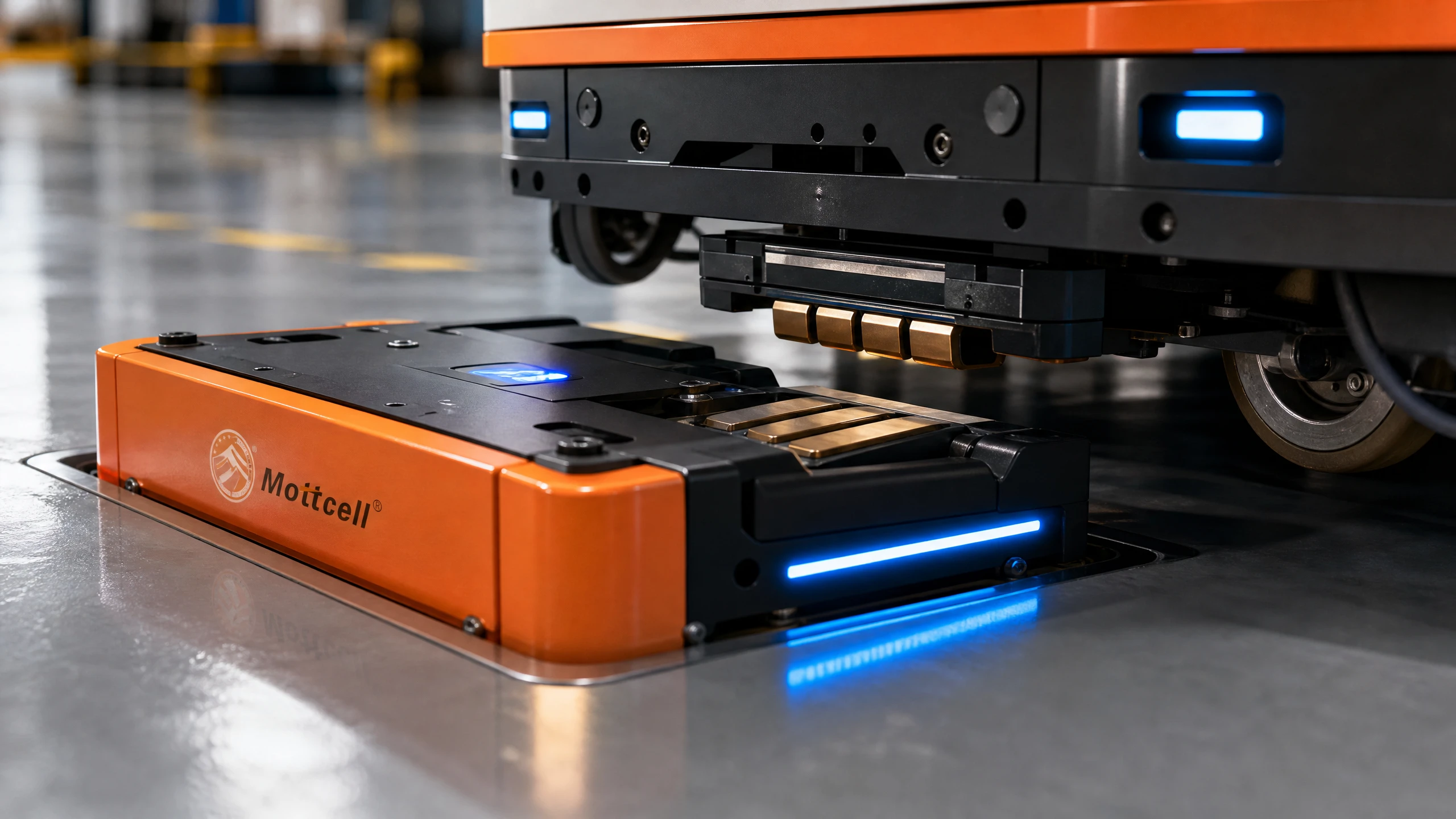
Mobile robotic architectures vary widely based on vehicle kinematics, lifting payload capacities, and drivetrain motor types. Choosing the appropriate voltage platform is critical for optimizing cable bundle diameters, minimizing continuous copper resistive losses (I squared R losses), and matching standard factory control voltages.
| Voltage Architecture | Cell String Configuration | Usable Capacity Range | Nominal Energy (Wh) | Continuous Current Rating | Peak Pulse Current (<10s) | Target Mobile Robotic Platform |
| 12V Platform (12.8V Nom.) | 4S1P to 4S2P Prismatic | 50Ah to 100Ah | 640 Wh to 1,280 Wh | 50A to 100A (1.0C) | 150A to 250A | Light AMRs, AOI mobile inspection carts, conveyor transfer tables |
| 24V Platform (25.6V Nom.) | 8S1P to 8S2P Prismatic | 100Ah to 200Ah | 2,560 Wh to 5,120 Wh | 100A to 200A (1.0C) | 300A to 500A | Under-ride "mouse" AGVs, collaborative sorting robots, mid-load lifters |
| 36V Platform (38.4V Nom.) | 12S1P to 12S2P Prismatic | 100Ah to 200Ah | 3,840 Wh to 7,680 Wh | 100A to 200A (1.0C) | 350A to 600A | Long-distance tow tractors, high-speed warehouse tugger trains |
| 48V Platform (51.2V Nom.) | 16S1P to 16S2P Prismatic | 150Ah to 300Ah | 7,680 Wh to 15,360 Wh | 150A to 300A (1.0C) | 500A to 800A | Counterbalanced automated forklifts, reach trucks, heavy 5-ton movers |
In compact automated optical inspection (AOI) mobile platforms, small surveillance robots, and lightweight sorting trolleys, lower-voltage architectures simplify power regulation for onboard 12V computer boards, LiDAR sensors, and barcode scanners.
Integrating a standardized
For installations requiring standardized modular architecture or multi-pack series expansion into higher voltage systems, engineering teams can reference our comprehensive
The 24v agv battery pack (8S LiFePO4 configuration, 25.6V nominal) is the globally recognized standard for industrial automated logistics. It balances high electrical efficiency with human-safe touch voltages (<60V DC), eliminating the need for high-voltage orange safety conduit or specialized high-voltage electrician handling on the factory floor:
Drive System: Directly compatible with standardized 24V DC brushless traction wheel drives (e.g., direct-drive steering motors from 400W to 1,500W).
Payload Capacities: Optimally designed for under-ride "mouse" AGVs, collaborative sorting AMRs, and automated assembly line carriers handling payloads up to 1,000 kilograms.
Typical Capacity Band: 100Ah to 200Ah, supplying sufficient energy for 8 to 12 hours of continuous running on a single charge if opportunity charging is unavailable.
For heavy-duty tugger AGVs pulling multiple cart trailers through distribution centers, standard 24V systems experience elevated continuous currents, requiring heavy-gauge, inflexible copper cabling that adds deadweight and raises motor operating temperatures.
Implementing an industrial-grade
For counterbalanced automated forklifts, reach trucks, and heavy-payload movers hauling 1,500 to 5,000 kilograms, a 48v agv battery pack (16S LiFePO4 configuration, 51.2V nominal) is essential.
Higher voltage reduces I squared R thermal losses across the primary distribution cables, allowing high-power hydraulic lift pumps (3kW to 10kW) to operate at manageable continuous currents (60A to 200A).
Furthermore, where large fleets of 48V automated forklifts are charged simultaneously from automated high-power charging stations, plant energy managers frequently install a centralized
An industrial agv lithium battery is not merely an energy storage reservoir; it is an intelligent, communicating edge node within the automated factory's network. A basic analogue protection board is inadequate for autonomous fleets; a dedicated digital battery management system (BMS) running real-time industrial fieldbus protocols is mandatory.
Modern automated vehicle master controllers—typically industrial PCs or rugged PLCs from manufacturers such as Siemens, Beckhoff, Omron, or Rockwell Automation—require deterministic, real-time feedback to schedule charging dispatch and prevent mid-mission power failure. Mottcell industrial packs incorporate fully isolated CANopen (CiA DS301 and DS402 device profiles) and RS485 Modbus-RTU interfaces that continuously broadcast vital battery operational metrics:
Dynamic State of Charge (SoC %): Derived from continuous Coulomb counting recalibrated dynamically using extended Kalman filtering (EKF) against open-circuit voltage curves, achieving an accuracy of +/-1.5%. This enables the fleet management algorithm to dispatch the vehicle for charging at exactly the optimal scheduling window.
Individual Cell Voltages (Cell 1 to Cell 16): Continuously sampled down to +/-1.0 mV resolution, detecting high-resistance cell interconnects or micro-shorts long before they impact vehicle performance.
Dynamic Current Limits (CCL / DCL): Dynamic feedback instructing the vehicle motor driver and off-board charging station on maximum permissible current based on instantaneous cell temperature, preventing thermal acceleration.
Core Temperature Sensing: Multi-point NTC thermistor array monitoring cell broad faces, busbars, and power MOSFETs with 0.1°C resolution to trigger pre-alarm safety states.
In an operational regime characterized by repeated 1C to 2C opportunity charging, standard passive balancing (which slowly bleeds off 50mA to 100mA of excess charge through resistors only at full charge) is completely ineffective:
Mottcell AGV packs integrate active bidirectional inductive cell balancing circuitry operating at 1.0A to 2.0A. This balancing system functions continuously across both charging and discharging states, actively moving energy from higher-capacity cells to lower-capacity cells. This prevents string voltage divergences during rapid opportunity charges and guarantees that 100% of the pack's usable capacity is always accessible.
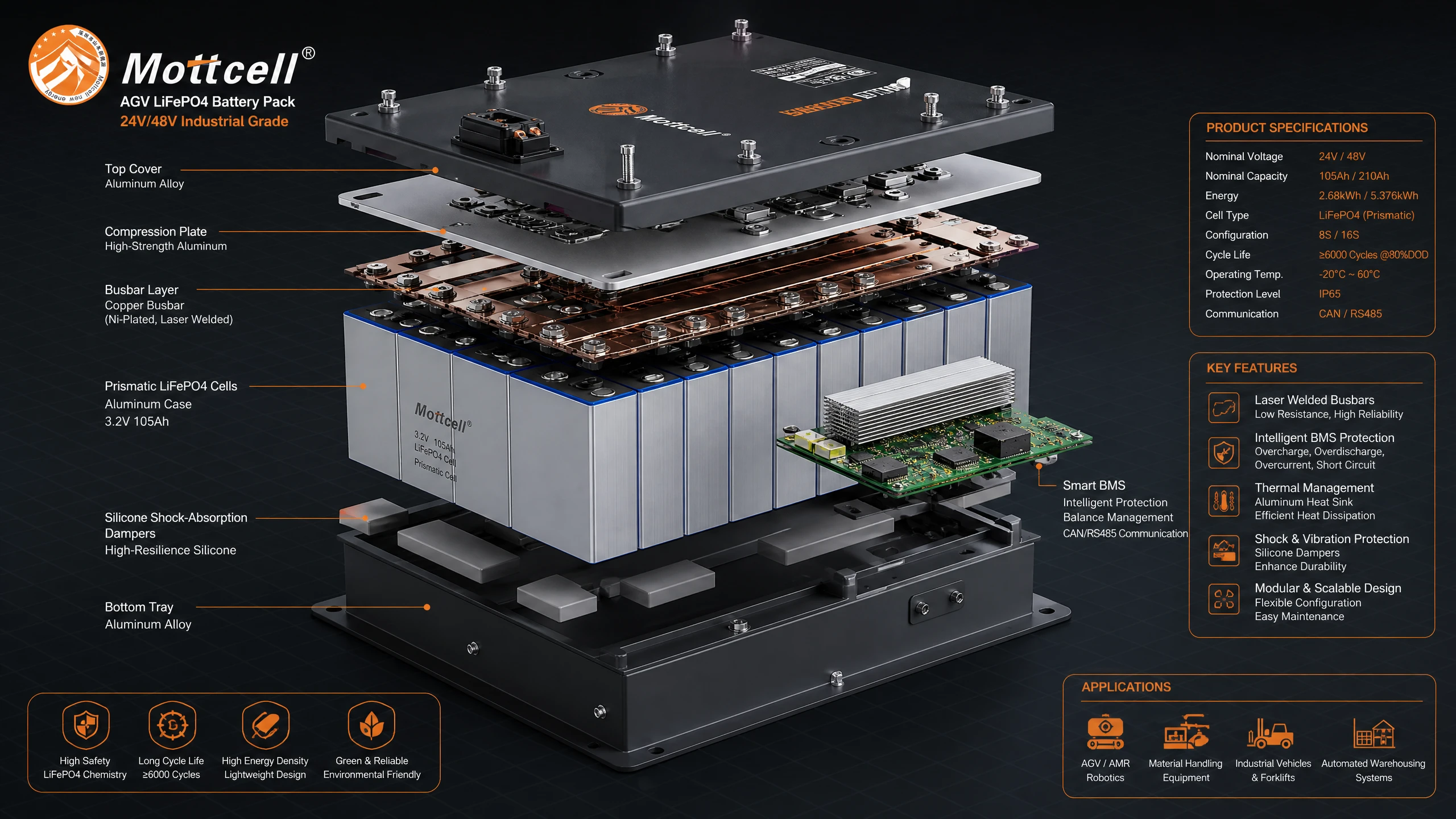
Factory floors are mechanically demanding environments. Even smooth-looking concrete contains expansion joints, steel floor plates, embedded induction wire tracks, and dock leveler transitions that impart continuous vibration and high-g shock loads to an AGV's internal structure.
Conventional consumer or lightweight battery packs built with loose cylindrical holders or mechanically bolted screw terminals quickly degrade in AGV environments. Continuous micro-vibrations loosen bolted terminal connections, resulting in elevated electrical resistance, localized overheating, and catastrophic terminal melting under high current.
Automated Fiber Laser Beam Welding (LBW): Mottcell industrial battery assemblies feature automated fiber laser welding that fuses heavy-gauge nickel-plated copper busbars directly onto prismatic cell terminal posts. This achieves an unbreakable, monolithic electrical connection with an ultra-low joint resistance of less than 0.05 mΩ, withstanding shear pull forces exceeding 1,200N.
Structural Mechanical Compression: Prismatic cells are housed within 2.0-millimeter heavy-gauge powder-coated steel enclosures. Cells are separated by shock-absorbing, high-elasticity EVA foam pads and bound under calibrated spring-loaded mechanical compression plates. This setup absorbs floor vibration (tested to IEC 60068-2-6 standards up to 25g acceleration) and prevents cell swelling during continuous high-rate cycling.
Ingress Protection (IP65 / IP67): Sealed with continuous closed-cell silicone perimeter gaskets and integrated Gore pressure-equalization vents, preventing the ingress of conductive metal dust, oil vapors, and high-pressure cleaning water jets.
Automated cold-storage warehouses and frozen food logistics facilities operate at temperatures ranging from -18°C to -30°C. Attempting to fast-charge standard lithium batteries below 0°C causes permanent damage, as lithium ions cannot rapidly intercalate into the frozen graphite structure, leading to metallic lithium plating, dendritic growth, internal short-circuits, and fire risks.
To overcome this, Mottcell cold-chain custom agv battery pack units integrate internal silicone-encapsulated PTC heating films and intelligent thermal management logic:
When the AGV docks at a cold-storage charging station, the BMS assesses internal cell core temperatures via multi-point NTC sensors.
If the temperature is below 5°C, incoming charging power is routed exclusively to the internal heating elements while isolating the cells.
The PTC system heats the cell core to +10°C at a rate of 1.5°C to 2.0°C per minute.
Once safe operational core temperature is confirmed, the BMS switches power to the main cell array, initiating fast opportunity charging without compromising cycle life or operating safety.
When evaluating battery procurement, purchasing departments often focus on upfront purchase price (CapEx). However, experienced factory engineering and operations managers recognize that battery-related expenses are predominantly operational (OpEx): maintenance technician labor, replacement pack frequency, energy conversion losses, and downtime costs.
Below is an empirical 10-year Total Cost of Ownership (TCO) model comparing industrial-grade LiFePO4 against traditional Lead-Acid / AGM for an automated logistics fleet of 20 AGVs operating on a two-shift daily manufacturing schedule (approx. 5,000 operational hours per year):
| Cost Category (10-Year Timeline) | Lead-Acid / AGM Fleet (20 AGVs) | Mottcell LiFePO4 Battery Fleet (20 AGVs) | Net 10-Year Financial Variance |
| Initial Battery Pack CapEx | $100,000 (Requires 50 packs: 2.5 per AGV) | $140,000 (Requires 20 packs: 1.0 per AGV) | +$40,000 (Higher initial pack investment) |
| Charging & Swap Infrastructure | $40,000 (Swap cranes, acid floors, exhaust) | $20,000 (4 automated floor contact stations) | -$20,000 (Eliminates battery swap room) |
| 10-Year Battery Replacement Cost | $420,000 (4 complete fleet replacements) | $0 (LiFePO4 delivers 5,000+ cycles, 10+ yrs) | -$420,000 (Zero replacement packs needed) |
| Battery Maintenance Technician Labor | $180,000 ($18k/year watering and swapping) | $10,000 ($1k/year routine physical checks) | -$170,000 (94% reduction in maintenance labor) |
| Electrical Energy Conversion Losses | $96,000 (72% round-trip efficiency) | $32,000 (97% round-trip efficiency) | -$64,000 (Saves 530,000+ kWh of electricity) |
| Unscheduled Downtime & Stalled AGVs | $60,000 (Voltage drops, dead cells) | $5,000 (BMS predictive diagnostic warnings) | -$55,000 (Maximizes continuous plant uptime) |
| TOTAL 10-YEAR LIFECYCLE TCO | $896,000 | $207,000 | NET SAVINGS: $689,000 (77% Reduction) |
Elimination of Secondary Battery Purchases: Because lead-acid batteries require 8 hours to charge and 8 hours to cool, 20 operating AGVs require at least 50 total battery packs to maintain two-shift operations. With LiFePO4 opportunity charging, exactly 20 battery packs are required—one per vehicle—permanently reducing fleet capital requirements.
Replacement Cycle Economics: Lead-acid packs operating under heavy dynamic discharge last 18 to 24 months (approx. 800 cycles at practical factory discharge levels). Over 10 years, the plant must repurchase the entire battery pool four times. A quality LiFePO4 pack delivering 5,000 cycles easily spans the full 10-year design life of the vehicle chassis.
Electricity Consumption: LiFePO4 provides 96% to 98% round-trip coulombic and energetic efficiency, compared to 70% to 75% for lead-acid. For an active 20-robot fleet, this difference saves hundreds of megawatt-hours of utility power over the life of the installation.
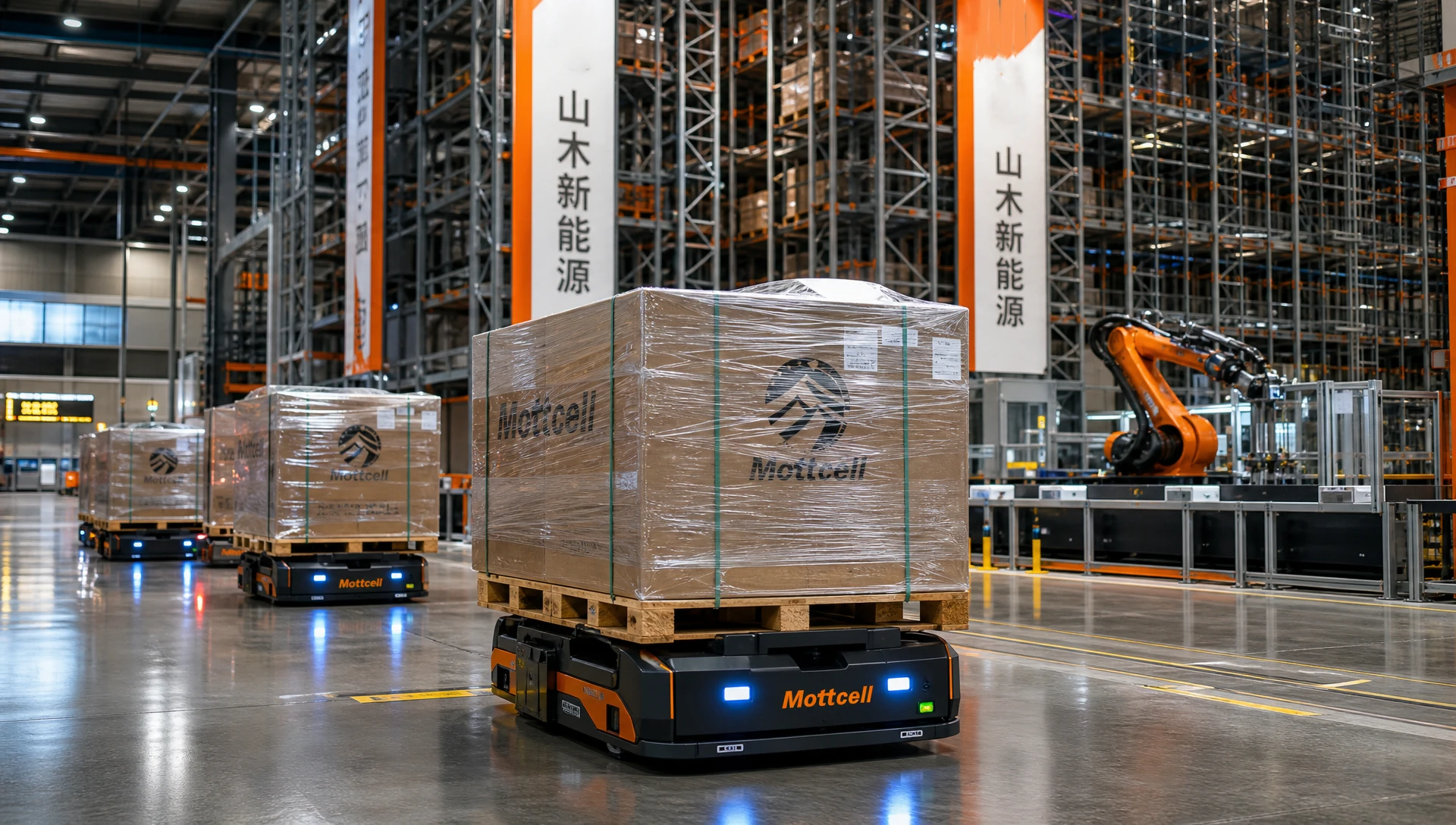
As an established amr battery manufacturer and industrial energy specialist, Mottcell subjects every production lot to rigorous quality control procedures to guarantee zero defect rates in high-speed automated environments.
Incoming Cell Electrochemical Sorting: Automated optical inspection, open-circuit voltage sorting (Delta OCV < 2 mV), and AC internal resistance binning (Delta AC-IR < 0.2 mΩ) ensure every series-parallel branch shares identical chemical impedance.
Laser Weld Joint Verification: Continuous monitoring of weld penetration depth and seam pull-force testing (>1,200N) ensures busbar connections will not crack under continuous dynamic factory vibrations.
Hi-Pot Dielectric Insulation Verification: Testing at 2,500V DC confirms complete electrical isolation between live high-current DC busbars and the outer grounded metal chassis (leakage current < 1.0 mA).
Multi-Axis Vibration & Environmental Stress Testing: Swept-sine and random vibration testing according to IEC 60068-2-6 standards, paired with thermal chamber dwell testing from -30°C to +60°C.
End-of-Line Automated Calibration: Complete 100% charge and discharge capacity verification cycles at full 1.0C rate to guarantee rated ampere-hour output before packaging.
Mottcell AGV and AMR battery assemblies comply with critical global industrial benchmarks:
IEC 62619: Evaluates the safety of secondary lithium cells and batteries in industrial stationary and motive applications, certifying structural safety under thermal runaway, severe mechanical drop, and forced internal short-circuit conditions.
UL 2580 / UL 1973: Certifies that the power pack withstands high mechanical shock, electrical over-stress, and continuous operational vibration without thermal propagation or fire hazards.
UN 38.3 Compliance: Rigorous multi-parameter shipping certification verifying safe transport across altitude simulation, thermal cycling, vibration, impact, external short-circuit, and forced overcharge conditions.
ISO 9001:2015 Manufacturing Traceability: Every completed battery pack features digital serialization. Detailed laser welding parameters, cell batch capacity numbers, and internal resistance figures are recorded and archived for 10 years to provide end-to-end supply chain traceability.
Yes. Mottcell industrial LiFePO4 packs are engineered with low-impedance Grade-A prismatic cells and dynamic active balancing to accept standard 1C and pulse 2C opportunity charging rates safely, maintaining a lifespan of over 5,000 cycles within a 20% to 85% operational State of Charge window.
Mottcell packs feature fully isolated CANbus 2.0B and CANopen interfaces running standardized protocols (such as CiA DS301 and DS402) that transmit real-time SoC, SoH, voltage, current, and fault diagnostics directly to vehicle master PLCs (including Siemens, Beckhoff, and Omron) for predictive charging dispatch.
Yes. Mottcell provides full OEM/ODM engineering services, tailoring sheet metal enclosures, counterweight balances, mounting brackets, thermal heating elements, and connector configurations (such as Anderson, REMA, or automated spring-loaded charging pads) to match your specific chassis envelope.
Deploying an optimized agv lithium battery platform is one of the most effective mechanical and electrical upgrades a factory or logistics facility can make to increase automated throughput, eliminate manual battery maintenance, and drive down operating costs. By moving from legacy lead-acid systems to custom-engineered LiFePO4 battery solutions, plant operators unlock true 24/7 continuous robotic fleet operations.
Mottcell combines decades of battery manufacturing experience, precision cell matching, automated laser welding, and advanced digital BMS integration to engineer durable power systems tailored for the world's most demanding automated mobile robotics platforms.
Ready to engineer custom power packs for your AGV/AMR fleet or retrofit your existing facility to automated opportunity charging? Contact our AGV battery engineering specialists today for detailed CAD integration drawings, communication profile specifications, and direct factory quotation.
12V 300Ah Battery Pack: Runtime, BMS and OEM Buying Guide
48V HESS Supplier: Inverter Matching & OEM Checklist
4860 Battery Supplier Guide: Cell Specs & OEM Checks
36V 314Ah Battery Pack Manufacturer: OEM Buying Guide
26700 LiFePO4 Battery Manufacturer: 4000-5000mAh Cells
Commercial HESS Supplier: Factory Microgrid Sizing Guide
5kWh HESS Supplier: Home Solar Battery & OEM Options
48V 280Ah HESS Supplier: Solar Battery OEM Buying Guide
Established in 2005
In 2009, it was awarded the title of "National High tech Enterprise"
 zoe@mottcell.net
WhatsApp: 8617388790296
Fax: 86-0755-84042963
Skype: live:b0ebaecbb8782516
WeChat: +8613428749632

 VR show
 CN
CN Home >


