

 Sep 01, 2026


Modern manufacturing plants, automated logistics hubs, and industrial microgrids are undergoing a rapid transition toward decentralized direct-current (DC) power architectures. At the core of this transformation is the industrial-grade 12v battery pack. While legacy lead-acid and AGM systems previously dominated low-voltage industrial backup and motive power, their operational limitations—frequent maintenance cycles, severe Peukert capacity loss under dynamic loads, and vulnerability to thermal stress—have made them obsolete in high-throughput automation environments.
For factory plant directors, OEM machinery builders, and electrical system integrators, selecting the optimal energy storage platform directly impacts operational uptime, round-trip energy efficiency, and total cost of ownership (TCO). Transitioning to advanced lithium iron phosphate (LiFePO4) chemistry in standardized 12V formats provides the thermal stability, cycle longevity, and digital communication capabilities required by modern Industry 4.0 infrastructure.
This comprehensive guide examines the electrochemistry, internal architecture, capacity sizing metrics, battery management system (BMS) integration protocols, and multi-pack scaling rules essential for deploying a heavy-duty 12v battery pack in factory-floor operations.

An industrial 12v battery pack built on Lithium Iron Phosphate (LiFePO4) technology utilizes a four-cell series configuration (4S). With each individual cell exhibiting a nominal voltage of 3.2V, the assembled pack delivers a stable nominal output of 12.8V, matching and exceeding the operational voltage windows of traditional 12V lead-acid systems while providing vastly superior discharge profiles.
The fundamental performance differentiator of LiFePO4 lies in its phospho-olivine crystal structure. The strong covalent bonding between tetrahedral phosphate (PO4) units and octahedral iron (FeO6) arrays provides exceptional structural and chemical stability.
Thermal Runaway Threshold: Unlike nickel-manganese-cobalt (NMC) or lithium cobalt oxide (LCO) chemistries that experience self-sustaining exothermic decomposition between 150°C and 210°C, LiFePO4 exhibits chemical stability up to 270°C to 300°C. Oxygen release during severe overcharge or mechanical abuse is negligible, preventing catastrophic fire escalation in dense factory installations.
Voltage Flatness Under Load: A 4S LiFePO4 pack maintains a virtually flat discharge curve between 20% and 90% State of Charge (SoC). While lead-acid voltage steadily degrades from 12.7V down to 11.4V under continuous discharge—forcing industrial DC motors and inverters to draw higher current to compensate—LiFePO4 sustains steady output between 12.8V and 13.2V, optimizing motor efficiency and eliminating low-voltage equipment cut-offs.
Industrial pack assembly strategies diverge between deep-drawn cylindrical cells (such as 26650 or 32650 formats) and heavy-gauge aluminum prismatic cells:
Prismatic Form Factor (Optimal for 50Ah and higher): High volumetric efficiency, rigid casing, laser-welded terminal posts, and integrated internal explosion-proof safety vents. These cells allow direct busbar bolting, minimizing internal resistance (Ri <= 0.3 mΩ) across high-ampere industrial pathways.
Cylindrical Form Factor (Optimal for compact/high-vibration tools): Excellent radial heat dissipation and high structural rigidity, but requires extensive parallel spot-welding interconnects, increasing assembly complexity when scaling past 100Ah.
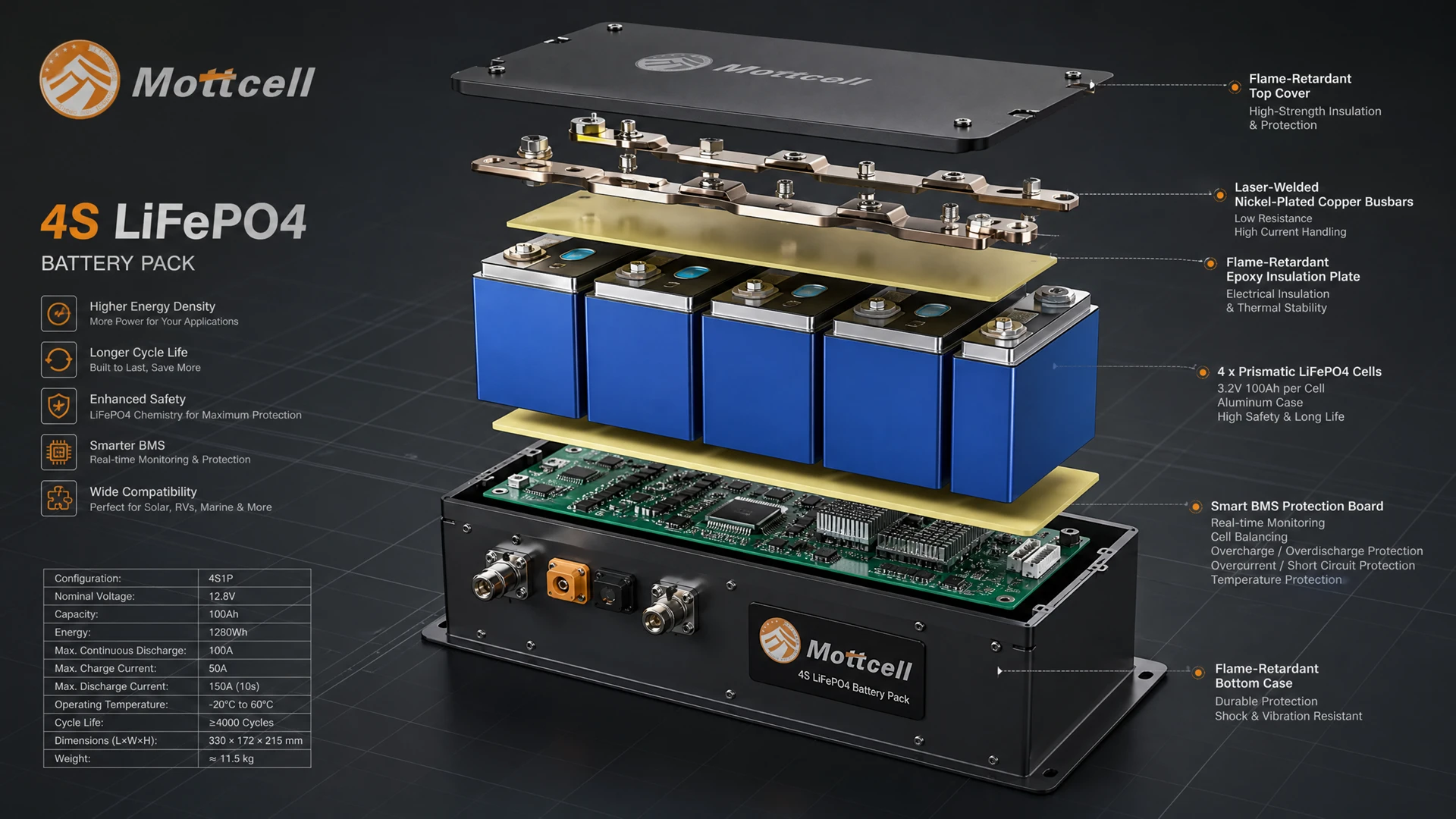
Factory environments encompass diverse electrical requirements, ranging from low-power monitoring stations to massive megawatt-level buffer banks within an
| Capacity Class | Nominal Energy (Wh) | Optimal Continuous Current | Peak Pulse Current (<10s) | Typical Industrial Applications | Key Engineering Metric |
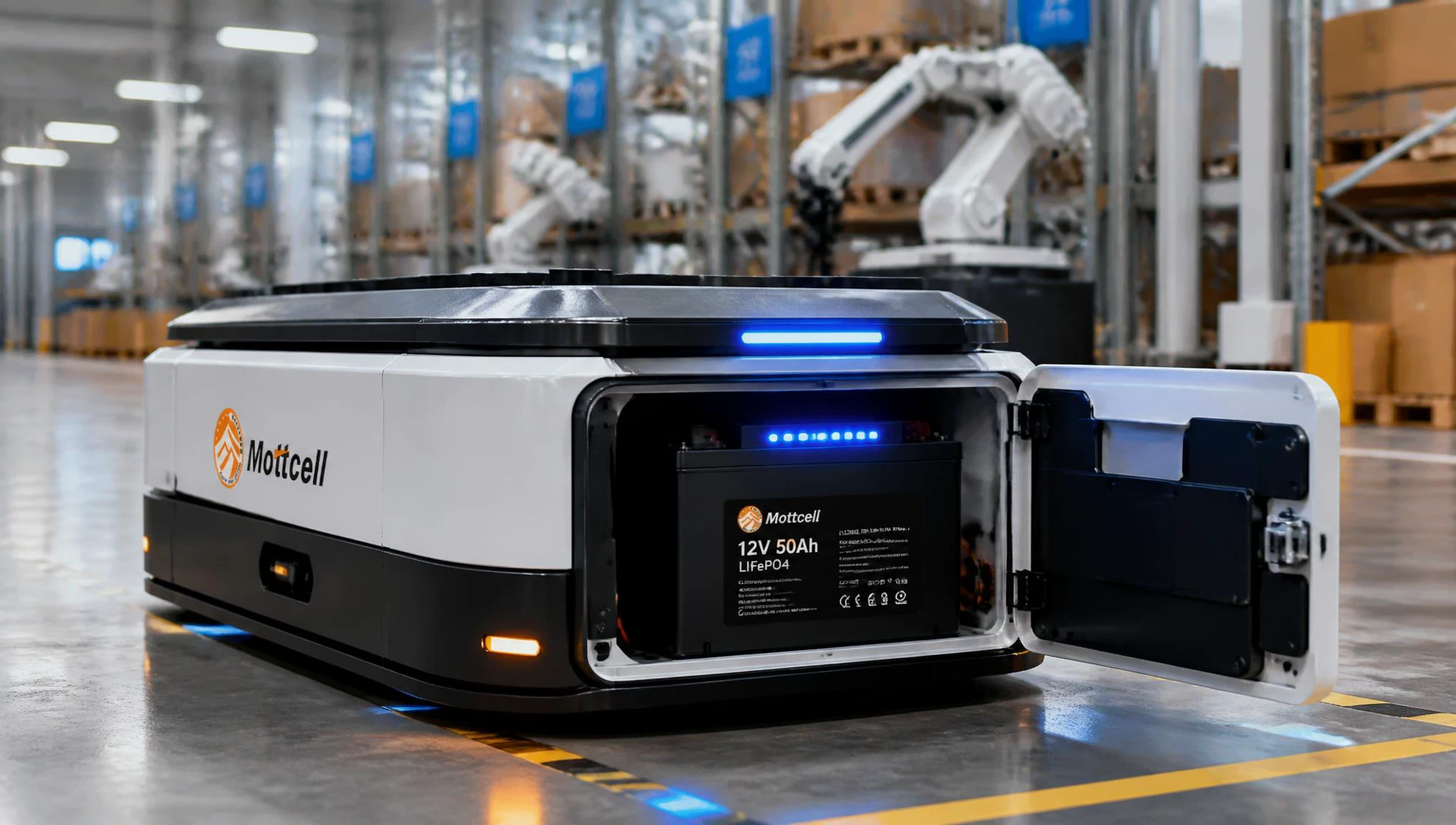
| 50Ah | 640 Wh | 50A (1C) | 100A to 150A | AGVs, AMRs, portable testing instrumentation, valve actuators | Compact footprint, lightweight mobility |
| 100Ah | 1,280 Wh | 100A (1C) | 200A to 250A | Telecom base stations, SCADA cabinets, small solar lighting | Direct 1:1 drop-in replacement for Group 27/31 lead-acid |
| 200Ah | 2,560 Wh | 150A to 200A | 350A to 400A | Marine DC switchboards, heavy robotics, off-grid field shelters | High energy density per footprint area |
| 280Ah | 3,584 Wh | 140A to 280A | 500A | Commercial solar buffering, microgrid UPS, material handling | Heavy-cycle utility-grade cell architecture |
| 300Ah | 3,840 Wh | 150A to 300A | 600A | Factory peak shaving, auxiliary substation power, EV chargers | Extended autonomy under heavy continuous draw |
| 314Ah | 4,019.2 Wh | 157A to 314A | 600A to 650A | Next-generation BESS containers, centralized factory backup | High energy density using 314Ah utility cells |
Automated Guided Vehicles (AGVs) and Autonomous Mobile Robots (AMRs) operating on factory warehouse floors demand rapid charging capabilities, low deadweight, and high thermal endurance under continuous start-stop acceleration cycles.
Deploying an industrial-grade
Factory supervisory control and data acquisition (SCADA) enclosures, remote telemetry units (RTUs), and emergency egress lighting arrays operate predominantly on 12V or 24V bus architectures.
For distributed control systems requiring continuous power during grid dropouts, a rugged
Modern manufacturing operations with onsite photovoltaic (PV) arrays or heavy regenerative loads (such as overhead gantry cranes and electric hoists) require high-capacity energy reservoirs to smooth power spikes and provide peak shaving.
Solar & Grid Buffering: Integrating a
Heavy Industrial Power Reserves: For centralized plant UPS and high-drain DC motive equipment, a
Next-Generation Storage Density: Facilities transitioning to cutting-edge utility-scale cells can implement a
A commercial or hobby-grade battery management system (BMS) relies on basic analogue protection switches. In contrast, an industrial-grade 12v battery pack requires an enterprise digital BMS capable of microsecond fault clearance, active thermal regulation, dynamic State of Health (SoH) modeling, and industrial fieldbus integration.
The digital BMS continuously monitors each of the four series-connected cell strings, enforcing strict deterministic safety bounds:
Over-Voltage Protection (OVP): Cell-level cut-off triggers at 3.65V (+/-0.025V); pack-level protection activates at 14.6V. Release threshold resets at 3.45V.
Under-Voltage Protection (UVP): Cell-level cut-off triggers at 2.50V (or an emergency threshold of 2.20V under extreme load); pack-level shutoff occurs at 10.0V.
Over-Current Protection (OCP): Two-stage current monitoring comprising standard hardware overcurrent trip (such as 1.5 times nominal current with a 5-second delay) and short-circuit interrupt (greater than 5 times nominal current triggering in less than 200 microseconds).
Thermal Window Regulation: Multi-point NTC thermistors monitor individual cell interconnections and power MOSFET heat sinks. Charging is disabled below 0°C and above 55°C; discharging is isolated if internal temperatures exceed 65°C.
Cell mismatch is the primary cause of premature capacity loss in multi-cell assemblies.
Passive Balancing: Diverts excess charge from top-performing cells through bleed resistors during top-balancing (greater than 3.40V per cell). However, balancing currents are typically limited to 50mA to 150mA to prevent localized thermal accumulation within sealed enclosures.
Active Balancing: Utilizes inductive or switched-capacitor bidirectional energy transfer, redistributing charge from high-potential cells to low-potential cells at currents ranging from 1.0A to 2.0A. This dynamic redistribution occurs across both charge and discharge cycles, preserving usable pack capacity even as individual cells age at slightly divergent rates.
In automated industrial facilities, the energy storage subsystem must not operate as an isolated unit. An industrial 12v battery pack features isolated CANbus 2.0B and RS485 interfaces running Modbus-RTU protocols, transmitting real-time operational telemetry to plant programmable logic controllers (PLCs) or central energy management systems:
Individual cell voltages (Cell 1 to Cell 4 precision down to +/-1mV)
Real-time pack current directionality (mA-level resolution via precision Hall effect or shunt sensors)
State of Charge (SoC %) derived from hybrid Coulomb counting calibrated against open-circuit voltage tables
Internal resistance degradation tracking for predictive maintenance scheduling
Diagnostic alarm flags (cell imbalance warnings, MOS over-temperature, pre-alarm thermal warnings)
Industrial installations expose power equipment to severe mechanical shocks, continuous high-frequency vibration, and harsh ambient environments containing airborne particulates or moisture. Ensuring structural and electrical integrity requires robust mechanical packaging:
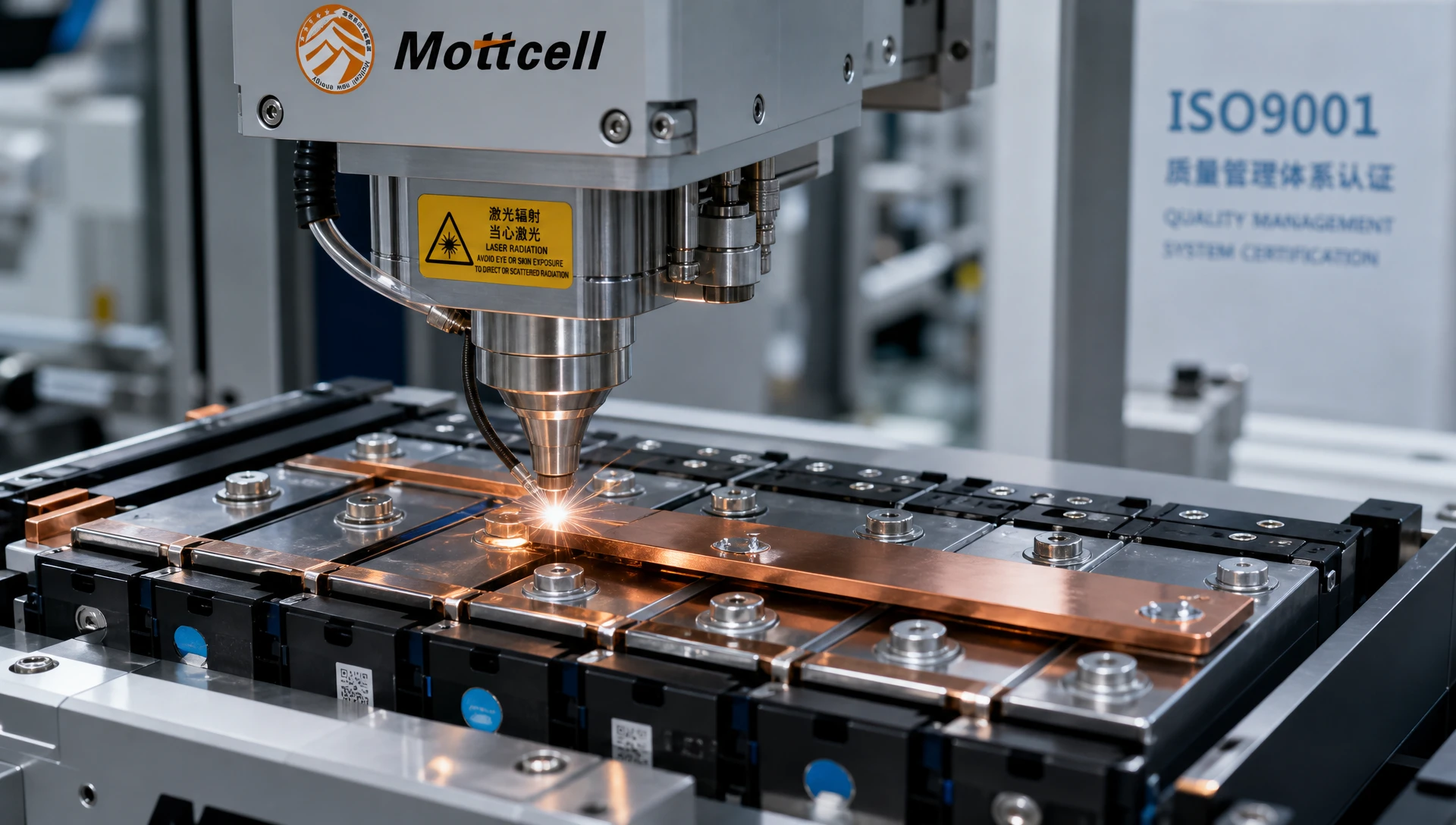
Bolted mechanical connections with spring washers can loosen over time under harmonic vibrations from heavy factory machinery (such as stamping presses, injection molders, and vibrating conveyors). Mottcell industrial packs utilize automated fiber Laser Beam Welding to fuse nickel-plated copper busbars directly onto cell terminal studs. This achieves a joint resistance of less than 0.05 mΩ, eliminating localized resistive hot spots during continuous high-ampere discharge.
IP65 Enclosures: Gasket-sealed heavy-gauge steel or flame-retardant ABS/PC enclosures engineered to resist low-pressure industrial washdown jets and airborne conductive dust.
IP67 Submersible Specs: Engineered with pressure-relief Gore valves for marine platforms, wastewater pumping stations, and outdoor mining field stations where complete ingress protection is mandatory.
Charging a LiFePO4 battery below freezing (below 0°C) without current attenuation leads to lithium metal plating on the graphite anode, permanently degrading capacity and creating internal micro-short circuits. Industrial packs deployed in cold-storage logistics facilities or unheated outdoor enclosures incorporate integrated silicone PTC heating mats. When charging power is detected, the BMS directs current to the heating element first, bringing the cell core temperature to +10°C before initiating cell charging.
Industrial requirements frequently exceed the single-pack electrical threshold of 12.8V and 100Ah to 300Ah. System integrators combine modular 12V packs into multi-unit banks configured in Series (to scale system voltage up to 24V, 36V, or 48V) or Parallel (to scale energy capacity and runtime).
Before connecting multiple packs in series or parallel, all units must be equalized.
Measure each pack's open-circuit voltage using a calibrated digital multimeter.
The voltage delta between any two packs must not exceed ΔV <= 50mV (0.05V).
Failure to equalize: Connecting parallel packs with a large voltage mismatch results in uncontrolled circulating cross-currents limited only by internal resistance (I_cross = ΔV / (R1 + R2)), which can trip BMS overcurrent switches or damage terminal wiring.
When configuring packs in series (such as a 4S configuration for a 51.2V industrial bus), ensure the internal BMS MOSFETs and optocouplers are rated to withstand total bank breakdown voltages (100V DC or higher). Additionally, install a dedicated external series battery balancer or select packs equipped with inter-BMS communication links to prevent long-term string voltage drift.
For high-capacity parallel banks, asymmetric wiring creates uneven current distribution, causing the pack closest to the master inverter to degrade prematurely.
Always utilize a diagonal (reverse-return) cabling layout or install a centralized copper busbar with precisely matched cable lengths and cross-sections (such as 4/0 AWG or 70 mm2 copper cables).
Procurement evaluations based solely on initial upfront capital expenditure (CapEx) overlook the substantial operating expenses (OpEx) associated with legacy lead-acid systems. A financial and technical comparison over a 10-year factory operational lifecycle illustrates the economic return of high-performance LiFePO4 technology:
| Performance Parameter | Standard Industrial Lead-Acid / AGM | Mottcell Industrial LiFePO4 Pack | Operational Advantage |
| Usable Depth of Discharge (DoD) | 50% (Discharging past 50% severely cuts lifespan) | 90% to 100% (Linear capacity delivery) | 2x usable energy per rated Ah |
| Cycle Life (@ 80% DoD) | 400 to 600 cycles | 4,000 to 6,000 cycles (>80% retained capacity) | 8x to 10x longer service life |
| Round-Trip Energy Efficiency | 70% to 78% (Energy lost as heat during charge) | 96% to 98% (Minimal internal resistance) | Reduced power utility consumption |
| Weight per Usable kWh | Approximately 35 kg / kWh | Approximately 9.5 kg / kWh | Substantial load reduction on mobile AGVs |
| Maintenance Requirements | Routine watering, terminal corrosion cleaning | 100% Maintenance-free sealed design | Zero technician maintenance labor hours |
| Self-Discharge Rate | 5% to 15% per month | Less than 2% per month | Long shelf-life during facility shutdowns |
Deploying battery systems in commercial and industrial settings requires compliance with stringent international safety standards to ensure facility safety and regulatory compliance.
UN 38.3 Transport Certification: Mandates that the completed pack withstands altitude simulation (11.6 kPa), extreme thermal shock (-40°C to +72°C), dynamic vibration, mechanical impact, external short circuits (55°C with external resistance <0.1 Ω), and overcharge testing.
IEC 62619: The benchmark safety standard for industrial energy storage systems, certifying resistance against propagation during thermal runaway, cell drop impact, and internal electrical short-circuiting.
UL 1973: Evaluates the ability of the battery system to safely withstand simulated electrical, mechanical, and environmental abuse conditions in stationary power and auxiliary industrial applications.
ISO 9001 Manufacturing Traceability: Full serialization and digital tracking of individual cell batches, providing complete provenance data for cell capacity, impedance, and welding parameters across the entire production lifecycle.
Yes. Mottcell industrial 12V packs support up to 4S4P arrays (creating 48V nominal systems and four parallel strings). Always ensure all packs are voltage-balanced within ΔV <= 50mV before interconnecting.
Under standard industrial conditions (0.5C rate at 25°C and 80% DoD), a Mottcell LiFePO4 pack delivers over 5,000 full cycles before reaching its 80% End-of-Life capacity threshold, providing over 10 years of reliable daily service.
Yes. Mottcell provides complete OEM/ODM engineering services, customizing metal or ABS casing dimensions, IP65/IP67 ingress ratings, thermal heating elements, and communication profiles (CANbus, RS485, Modbus-RTU) for seamless machine integration.
Selecting the appropriate 12v battery pack is critical to optimizing operational reliability, safety, and profitability across modern manufacturing and automated industrial facilities. By leveraging Grade-A LiFePO4 electrochemistry, intelligent digital BMS protection, rugged mechanical design, and broad multi-pack scalability, Mottcell provides high-performance energy storage solutions tailored to demanding industrial requirements.
Whether designing automated guided vehicles (AGVs), upgrading legacy lead-acid plant UPS systems, or engineering containerized microgrids, our engineering team provides end-to-end technical support, precision cell matching, and full custom manufacturing services.
Ready to optimize your facility’s low-voltage power infrastructure or request custom OEM specifications? Contact our industrial battery engineering specialists today for technical consultations, customized dimensional drawings, and direct factory-level pricing.
12V 300Ah Battery Pack: Runtime, BMS and OEM Buying Guide
48V HESS Supplier: Inverter Matching & OEM Checklist
4860 Battery Supplier Guide: Cell Specs & OEM Checks
36V 314Ah Battery Pack Manufacturer: OEM Buying Guide
26700 LiFePO4 Battery Manufacturer: 4000-5000mAh Cells
Commercial HESS Supplier: Factory Microgrid Sizing Guide
5kWh HESS Supplier: Home Solar Battery & OEM Options
48V 280Ah HESS Supplier: Solar Battery OEM Buying Guide
Established in 2005
In 2009, it was awarded the title of "National High tech Enterprise"
 zoe@mottcell.net
WhatsApp: 8617388790296
Fax: 86-0755-84042963
Skype: live:b0ebaecbb8782516
WeChat: +8613428749632

 VR show
 CN
CN Home >


