

 Nov 27, 2026


A 5kWh solar battery is a good candidate for evening self-use when a home regularly exports electricity during the day and buys it back after the sun goes down. The quickest way to test the fit is to take one day of meter readings and ask how many of those evening imports the battery could actually displace. A full battery at sunset can still leave the house buying power during dinner. On another day the limiting factor can be a cloudy afternoon that leaves little energy to store.
For an installer or distributor preparing a quote, the useful answer is a number at the customer’s meter, in kWh per evening, with the conditions attached. The worked example below starts with a 5 kWh nominal battery and 4 kWh of daytime exports. Under its specified assumptions, the battery can cover 3 kWh of evening purchases. When the same solar energy arrives in a shorter burst, delivery falls to about 1.81 kWh. The two homes could have identical daily totals on their electricity bills and need different equipment. For enclosure choices and product sourcing, see Mottcell’s 5kWh HESS buying guide.

Ask for a meter export covering both directions of flow at the grid connection. In a home with solar and no existing storage, the export register records the energy left after appliances have taken their share. This makes a much better starting point for a retrofit quote than the generation figure on the inverter. If the array produces 12 kWh on a given day and household equipment uses 8 kWh of that solar output as it is generated, only the remaining 4 kWh can be considered for storage on that basis.
Keep imports and exports in separate columns. A daily bill showing 2 kWh of net imports could represent 2 kWh bought with no exports at all. It could also represent 6 kWh bought and 4 kWh exported. In the second case a battery may have energy available to shift. Even those two separate totals leave one question open. Did the imports occur before or after the exports? Label the first and last timestamp of every interval and sort them in the order the home experienced them.
Define “evening” with the customer before calculating a result. A household may want to cover the period from sunset to bedtime, or its main concern may be imports during a specific priced period. An overnight water heater may fall outside either window. Record the local times, days of the week and any seasonal schedule. A battery controller that starts serving loads at four in the afternoon can spend its stored energy before an expensive evening period begins. Include that afternoon use in the simulation if the proposed control mode permits it.
For a prospective house without a working PV system, use time-aligned estimates of solar generation and household demand and label the result a design estimate. Apply any known generation or export restrictions when defining the baseline. A grid meter cannot show electricity that an export limiter has already prevented the inverter from producing. Recovering such energy may be possible with the right controls and topology. Quantify it separately from measured exports and ask the equipment supplier to confirm how it would become available to the battery.
The kWh printed on a battery can refer to nominal DC energy or to a manufacturer-defined usable energy figure. Ask which definition the supplier uses. A pack labeled 51.2 V nominal and 100 Ah provides a nominal arithmetic example of 5.12 kWh. A quote described as “5 kWh class” could use this size or a different configuration. For the model described in a quotation, check the datasheet and the approved inverter pairing. Mottcell’s 48V-class 100Ah home battery guide explains the distinction between a system voltage class and the stated nominal pack voltage.
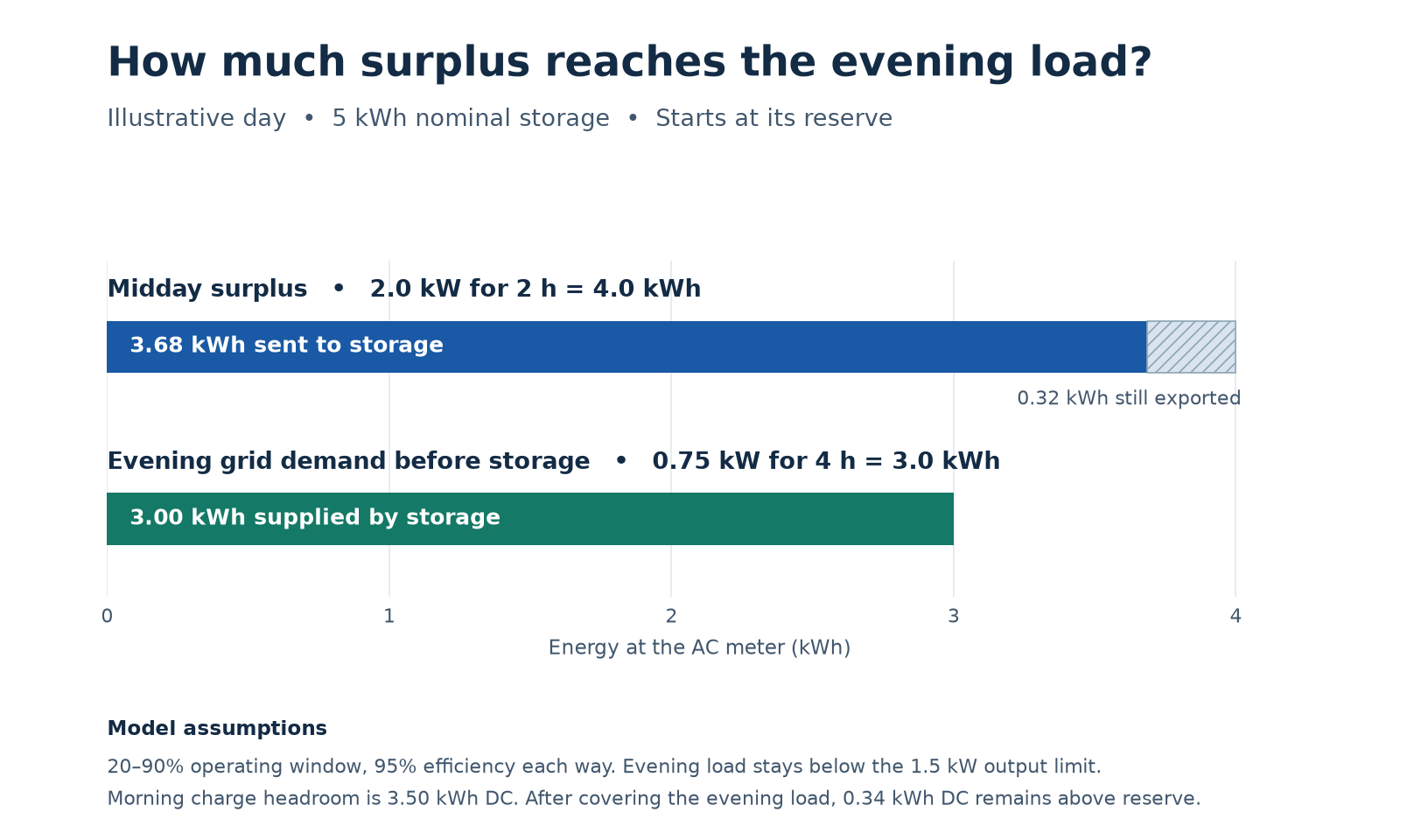
Consider a hypothetical 5.00 kWh nominal pack. Suppose the project allocates the range from 20% to 90% state of charge to daily solar shifting. The discretionary storage budget is 5.00 × (0.90 − 0.20), or 3.50 kWh DC. Energy below the selected floor is excluded from the evening budget. This example assumes a linear planning relationship between the indicated state of charge and stored energy. Use the supplier’s usable energy definition and operating data for a quotation, especially when the reported percentage already incorporates a protected range.
Now identify where each number is measured. Our grid meter reports AC energy. For illustration assume 95% efficiency from AC charging input to stored DC energy, and separately 95% from stored DC energy to AC delivery. Filling the 3.50 kWh DC window from its floor takes about 3.684 kWh at the AC input. Emptying that window delivers up to 3.325 kWh AC before other site consumption. The two assumed efficiencies multiply to 90.25% on a full round trip. Applying that round-trip number again at discharge would charge the example twice for the same losses.
A supplier may instead specify usable AC energy for the whole packaged system under named conditions. Ask which conversion stages and auxiliary loads that test covers. Standby consumption matters in a home that exchanges only a small amount of energy overnight. For example, an additional 20 W measured for ten hours amounts to 0.20 kWh. Include it once at its measured boundary. Keep assumptions about temperature, reserve and power limit beside the result so a buyer comparing quotations can see how each estimate was obtained.
Take a home that exports 2.0 kW continuously for two hours around midday. Later it imports 0.75 kW continuously for four hours. Assume no other flows for this example. The battery starts at the chosen reserve floor, the controller charges only from available solar, the permitted AC charging power is 2.0 kW and the permitted AC discharge power is 1.5 kW. Power limits and efficiencies are illustrative system assumptions throughout this guide. They need written confirmation for any proposed equipment.
At noon there is room for 3.50 kWh DC. Of the 4.00 kWh AC that would have been exported, the system can absorb about 3.684 kWh AC before it reaches its upper operating limit. The remaining 0.316 kWh still goes to the grid. At night the 0.75 kW load is within the 1.5 kW discharge limit. Covering all 3.00 kWh of evening imports uses about 3.158 kWh from the battery, leaving about 0.342 kWh DC available above the reserve floor.
| Case, same 5 kWh nominal pack | Baseline solar export | Baseline evening import | AC solar captured | AC import displaced |
|---|---|---|---|---|
| A. Steady export, steady evening load | 2 kW × 2 h = 4 kWh | 0.75 kW × 4 h = 3 kWh | 3.684 kWh | 3.000 kWh |
| B. Short solar burst, steady evening load | 4 kW × 1 h = 4 kWh | 0.75 kW × 4 h = 3 kWh | 2.000 kWh | 1.805 kWh |
| C. Steady export, short evening peak | 2 kW × 2 h = 4 kWh | 3 kW × 1 h = 3 kWh | 3.684 kWh | 1.500 kWh |
Case B puts the same 4 kWh of exports into a single hour. The 2 kW charging path can take only 2 kWh AC in that hour, adding 1.90 kWh DC to storage. At 95% discharge efficiency it can deliver 1.805 kWh AC in the evening. The customer would still buy 1.195 kWh during the four-hour window. A higher energy capacity with the same charging limit and initial state would capture no additional energy in this particular example. An installer evaluating a larger pack should ask whether the proposed change also alters permitted charging power.
Case C changes the demand side. The battery fills as in case A, but a 3 kW load runs for one hour. The 1.5 kW discharge path can cover only half of that hour’s demand. The grid supplies the other 1.5 kWh even though about 1.92 kWh DC remains above reserve at the end of the event. Stored energy could help with a later load. If the owner cares specifically about imports during this one hour, the quotation should address the output limit. If the owner can shift part of that appliance duty into the earlier solar window, model the revised schedule before comparing equipment sizes.
Create one row per meter interval. For a 15-minute file, the time step is 0.25 hour. A column reporting average kW becomes kWh after multiplication by that interval. A column already reporting interval kWh goes directly into the energy balance. For cumulative readings, subtract consecutive readings for the same register and flag meter resets. Keep the original export from the meter alongside the working file so another engineer can reproduce a quoted result months later.
Add a column for the energy available in storage above the reserve at the start of the interval. When solar export is available, the maximum AC charge is the smallest of three amounts. These are the baseline export for that interval, permitted AC charging kW multiplied by interval hours, and remaining DC headroom divided by charge efficiency. Add the accepted AC energy multiplied by charge efficiency to the DC balance. The charging row should never push the balance over the agreed operating ceiling.
On a row with household imports, limit AC discharge to the smallest of eligible imports, permitted AC discharge kW multiplied by interval hours, and available DC energy multiplied by discharge efficiency. Subtract delivered AC energy divided by discharge efficiency from the DC balance. Carry that closing balance into the next row, including at midnight. Sum the AC delivery only for the evening intervals the customer specified when reporting the evening result. For a reproducible reference on behind-the-meter dispatch models, see the System Advisor Model battery dispatch documentation.
If one interval records both import and export, avoid assuming the battery can use all of both in a conveniently chosen order. The home may have alternated between buying and selling within that interval. A multiphase meter may also use a particular aggregation rule. Ask for shorter intervals or the meter’s measurement convention. Where only aggregated data is available, flag that portion of the estimate and compare a conservative case with the upper bound. A meter total alone cannot reveal the sequence of a passing cloud and a short appliance start.
When an existing battery or an EV charger already follows an automatic schedule, the present grid trace includes its decisions. Replaying that trace as if it came from an unmodified house can give the new battery credit for energy already used elsewhere. Request the relevant device histories, their control modes and any recent schedule changes. Reconstruct the unmodified demand and generation if the evidence allows it. Otherwise limit the proposal to the incremental change that can actually be assessed from the available data.
Start with a sunny working day and a cloudy day for which the owner can account for the main loads. Add a weekend or an occupied weekday if routines differ materially. Expand to the available seasons before annualizing a result. A quiet summer week can leave the battery full in the afternoon and partly full the next morning. A winter week can leave ample headroom with very little energy to charge it. Record how often each constraint appears, preferably weighted by the kWh it prevents the system from shifting.
Keep the opening balance connected across consecutive days. Case A ends with about 0.342 kWh DC above reserve. If next morning’s charging window starts from that level, new headroom is about 3.158 kWh DC. The system will need less new solar energy to reach the ceiling. Resetting every simulated morning to an empty battery loses that carryover and can overstate incremental export capture. For a short dataset with an unknown opening state, run the same calculation with two plausible initial states and state the effect on the reported total.
Compare an alternative appliance schedule against the original profile before pricing more storage. Suppose a household can move a 1 kWh appliance cycle from the evening to a midday hour with at least 1 kWh of available solar surplus and sufficient instantaneous power. The grid baseline for those hours changes on both sides. One kWh fewer imports are available for the battery to displace in the evening and one kWh less export is available to charge it in the day. Recording the full benefit of direct solar use and the original battery result together would double-count part of the opportunity.
A homeowner may also want emergency backup. Agree how much storage the controller is allowed to use while the grid is available and whether that operating floor changes on a schedule. Keep outage performance on a separate acceptance sheet. If a control system raises its reserve or enters a backup-priority mode, the evening grid-import result changes even when the same hardware remains in place. Ask for the documented behavior of the selected controller and the approved battery combination. For an example of how one supplier defines an ESS operating mode and minimum state of charge, see Victron’s ESS configuration manual.
Report two quantities side by side. The first is AC solar export captured at the chosen boundary. The second is AC grid import displaced during the agreed evening period. In case A these are 3.684 and 3.000 kWh respectively. They answer different customer questions. Some of the captured energy remains in the battery after the evening, and conversion losses occur as energy moves through the system. A proposal that calls both numbers “savings” makes it difficult for the homeowner to compare the forecast with a later bill.
For a tariff comparison, apply the relevant import rate to displaced purchases and the applicable export credit to the exports forgone, at the time each event occurs. If the customer receives an export credit, absorbing that energy can reduce export income. Use the actual tariff period, netting arrangement and billing rules supplied by the customer. Apply fixed or demand-related charges only when the tariff and modeled behavior justify a change. Bill impacts require more information than the kWh balance alone. Britain’s Energy Saving Trust guide to battery storage explains the connection between storing surplus generation and buying electricity later.
| Evidence for the quote | What to record | Decision it supports |
|---|---|---|
| Interval meter file | Local time zone, interval length, direction of flow, missing intervals | How often available solar and later imports can be matched |
| Proposed equipment | Nominal and usable energy definitions, approved charge and discharge limits, conversion boundary | Whether energy capacity or power limits the application |
| Planned operating mode | Reserve range, eligible loads, grid charging policy, schedules | Which portion of the physical battery the owner can use each evening |
| Acceptance record | PV generation, grid imports and exports, AC charge and discharge, opening and closing state of charge | Whether signed-off operation follows the quoted model |
Before handover, ask the installer to document the meter location and relevant circuits, the operating mode shown by the commissioned controller and the approved limits used by the inverter. Have a qualified installer compare an ordinary load event with the reported power flow to confirm that the monitoring view represents the intended circuits and directions. A meter placed on only one branch may generate a credible-looking chart that misses a second consumer or a separate PV connection. Resolving that discrepancy will improve a forecast more than adding decimal places to the efficiency inputs.
Choose a real day after commissioning and reconcile it in order. Identify the interval when exports started, the first measurable battery charge, the point charging slowed and the evening discharge window. Compare measured PV and household demand with the baseline assumptions for those hours. Classify the largest difference as a change in site conditions, a control decision, a metering mismatch or an equipment constraint supported by the logged evidence. If the inverter reached its charge limit for only a few minutes and the evening load was small, that brief event provides little justification for a higher-power design.
An installer quoting multiple homes can give each client a short result sheet with the home’s measured export and evening demand, the number of usable days in the dataset, displaced imports under the stated controls and the principal limit. Keep any assumed days visibly separate from days backed by meter readings. For a system with an existing PV inverter, record the coupling arrangement and the metering boundary used in the calculation. Mottcell’s AC and DC coupling guide can help frame the questions for the inverter supplier when comparing retrofit proposals.
It can cover an evening whose eligible demand fits the energy available after charging and whose loads fit the discharge limit at each interval. In case A the example system supplies all 3 kWh. With the same total demand concentrated into one hour, it supplies only 1.5 kWh.
Request timestamped, separate import and export readings at the grid connection, the interval duration and the customer’s target hours. Add PV generation data and the operating schedules of existing storage or flexible loads where relevant. Inspect the file for missing intervals and verify which direction its signs represent.
Extra capacity helps on days when the existing operating window fills, additional solar remains available and later eligible demand can use it. A short charging window, a low discharge limit or insufficient evening demand can leave the additional capacity unused. Compare candidates against the same sequence of intervals and controls.
For a model review, share a representative interval file with customer identifiers removed, the existing PV and inverter models, target evening hours and the proposed reserve policy. Include the supply scope and any metering limitations so the supplier can respond to the exact configuration. Compare the Mottcell home energy storage range and request a project review with the expected charging power, discharge power and usable energy required at your site.
5kWh Solar Battery: How to Size for Evening Self-Use
12V 50Ah Battery for Solar: Remote Monitoring Guide
16340 LiFePO4 Battery Factory Guide for OEM Cell Buyers
48V 300Ah HESS: Solar Backup Reserve and Recharge Guide
Industrial 12V LiFePO4 Battery Pack: OEM Buying Guide
12V 314Ah Battery Pack: Solar Inverter Shutdown Guide
36V 314Ah Battery Pack Manufacturer: OEM Buying Guide
48V 200Ah HESS: Solar Battery Expansion Planning Guide
Established in 2005
In 2009, it was awarded the title of "National High tech Enterprise"
 zoe@mottcell.net
WhatsApp: 8617388790296
Fax: 86-0755-84042963
Skype: live:b0ebaecbb8782516
WeChat: +8613428749632

 VR show

 CN
 Home >


