

 Aug 21, 2026


If you're specifying batteries for a megawatt-scale energy storage system, here's the question that keeps procurement leaders awake at night:
"Which cell format gives me the best combination of safety, cycle life, and total cost of ownership — without burning down my facility?"
The answer isn't obvious.
· Cylindrical cells offer the best physical safety but fall short on cycle life.
· Prismatic LFP cells dominate the storage market for good reason — but they're not perfect.
· Pouch cells? They're the lightest, but also the most fragile.
Let's cut through the marketing noise and look at the data.
This article is written for:
· Energy storage system integrators — choosing the right cell for 20-year infrastructure
· Automotive procurement teams — balancing cost, safety, and performance
· Battery buyers — who need a simple answer to a complex question
Here's what we'll cover:
1. What each cell format actually is — and what it's good for
2. Side-by-side comparison of safety, cycle life, and cost
3. Which format wins in energy storage, electric vehicles, and consumer electronics
4. Actionable recommendations for your next project
What they are:
Cylindrical cells are the oldest and most standardized lithium-ion format. They evolved from the 18650 (18mm diameter, 65mm height) to the 21700, and now the 4680 large-format cell (46mm diameter, 80mm height) — a leap in capacity from 1.5Ah to roughly 30Ah.
What makes them unique:
· Steel casing: Far stronger than aluminum or laminated film, providing exceptional structural protection
· Directional pressure relief: The built-in vent releases high-temperature gas in a controlled direction during thermal runaway — preventing cascading failures
· Precision winding: The jelly-roll design achieves the highest volumetric energy density (650-700 Wh/L)
Why this matters to you:
If you need the highest level of physical safety and can tolerate lower cycle life, cylindrical cells are your answer. They're the most automated and cost-effective at the cell level — though pack integration adds complexity.
Key advantages:
· Highest volumetric energy density (650-700 Wh/L)
· Excellent mechanical protection (steel casing)
· Best thermal runaway containment (directional venting)
· Lowest cell cost
Key disadvantages:
· Shortest cycle life (1,000-2,000 cycles for ternary chemistry)
· Complex pack assembly (thousands of cells, many weld points)
· Hollow core in large-format cells creates manufacturing challenges
What they are:
Prismatic cells use an aluminum casing in a rectangular shape. They come in two process variants:
· Wound: Smaller capacities, lower cost
· Stacked: Larger capacities — the dominant method for blade-type cells and energy storage
What makes them unique:
· Aluminum casing: Lighter than steel, but more susceptible to deformation under crush
· Large format: Individual cells can reach 314Ah, 320Ah, 560Ah, and beyond
· Stacking process: Enables thick electrodes — perfect for LFP chemistry
Why this matters to you:
If you need maximum cycle life and lowest total cost of ownership over 20+ years, prismatic LFP is the undisputed champion. This is why >90% of grid-scale storage projects use prismatic LFP.
Key advantages:
· Longest cycle life by far (6,000-10,000 cycles for LFP)
· Most efficient pack integration (fewer cells, fewer welds)
· Best full-lifecycle economics (lowest LCOS)
· Superior thermal stability (LFP chemistry can withstand >500°C)
Key disadvantages:
· Lower cell-level energy density (500-600 Wh/L)
· Aluminum casing can tear under crush — creating sharp edges that may penetrate electrodes
· Rapid thermal propagation between adjacent cells (flat surfaces transfer heat directly)
What they are:
Pouch cells have no rigid casing. Instead, they use aluminum laminated film — a three-layer composite (nylon/aluminum/PP) that is thin, light, and flexible.
What makes them unique:
· Extremely thin: Can be manufactured below 3mm thickness
· Highest gravimetric energy density: 200-260 Wh/kg — the best by weight
· Stacked design: Multiple tabs reduce internal resistance
Why this matters to you:
If you're building a smartphone, tablet, or drone — pouch is the only real choice. In EVs and storage, however, the safety trade-offs are severe.
Key advantages:
· Best weight-to-energy ratio
· Can be formed into almost any shape
· Low pack height — ideal for sports cars and slim devices
Key disadvantages:
· Almost no physical protection (no rigid casing)
· Rapid thermal runaway propagation (30-60 seconds to adjacent cells)
· Non-directional pressure relief — flames can eject in any direction
· Swelling during cycling is a persistent challenge
· Higher manufacturing cost and lower yield

Metric | Cylindrical | Prismatic | Pouch |
Casing material | Steel (nickel-plated) | Aluminum alloy | Aluminum laminated film |
Mechanical protection | Highest | Medium | Lowest |
Nail penetration behavior | Needle slides off; directional venting | Casing deforms; sharp edges risk internal short | Direct penetration; rapid swelling |
Thermal runaway propagation time | 5-15 minutes | 2-5 minutes | 30-60 seconds |
Pressure relief | Directional (top) | Through explosion vent | Non-directional — any direction |
Overall safety rating | ⭐⭐⭐⭐⭐ | ⭐⭐⭐⭐ | ⭐⭐ |
What this means for you:
· If you need the best containment of a single-cell failure → Cylindrical
· If you need the best combination of safety and longevity → Prismatic LFP
· If you need thinness above all else → Pouch — but accept the safety trade-offs
Chemistry + Format | Typical Cycle Life | What This Means |
Prismatic LFP | 6,000-10,000 cycles | 20+ years of daily cycling — designed for grid infrastructure |
Cylindrical LFP | 2,000-4,000 cycles | Suitable for smaller stationary storage |
Cylindrical Ternary | 1,000-2,000 cycles | Limited lifespan — best for high-performance EVs |
Pouch Ternary | 1,500-2,500 cycles | Consumer electronics and some premium EVs |
Key takeaway:
For energy storage, prismatic LFP is not a preference — it's a requirement. The difference between 6,000 and 2,000 cycles translates to 3x fewer battery replacements over a system's life.
Metric | Cylindrical | Prismatic | Pouch |
Single cell cost | Lowest | Medium | Highest |
Pack integration cost | High (many cells, many welds) | Low (fewer cells) | Medium |
Manufacturing maturity | Highest | High | Medium |
Typical yield | >99% | 95-98% | 90-95% |
20-year LCOS (storage) | Highest | Lowest | Highest |
If you're evaluating a 10MWh storage project (20-year design life):
Cell Format | Upfront Cost Premium vs. Prismatic | Expected Replacements (20 yrs) | Total Cost Ranking |
Prismatic LFP | Benchmark | 0 | Lowest |
Cylindrical Ternary | -15% | 4-5 | Highest |
Pouch Ternary | +10% | 4-5 | Highest |
The math is brutal: A -15% upfront saving with cylindrical ternary costs you 4-5x more over the system lifetime. Cheaper upfront is more expensive over time.
Application | Recommended Format | Why |
Utility-scale storage (>1MWh) | Prismatic LFP | Longest cycle life, best LCOS, proven safety at scale |
Commercial & industrial storage | Prismatic LFP | 20-year design life, minimal maintenance |
Residential storage (home battery) | Prismatic LFP or Cylindrical LFP | LFP preferred; cylindrical can work for smaller systems |
Data center UPS | Cylindrical or Prismatic | Cylindrical offers best physical safety; prismatic offers longer life |
For energy storage developers:
"If your project needs a 20-year design life with minimal maintenance, prismatic LFP is not the recommended choice — it's the only choice that meets the economic and safety requirements. Cylindrical and pouch cells may work in niche applications, but for grid-scale storage, the data is unequivocal."
Vehicle Type | Recommended Format | Why |
Mass-market BEVs | Prismatic LFP | Lowest TCO, longest life, sufficient energy density |
Premium BEVs | Cylindrical (4680) or Prismatic NCM | Higher performance, faster charging |
Performance/sports cars | Pouch (if space is extreme) or Cylindrical | Pouch offers low pack height; 4680 offers high power |
Commercial trucks/buses | Prismatic LFP | Longevity and safety under heavy use |
For automotive procurement teams:
"Prismatic LFP gives you the lowest TCO for high-volume, cost-sensitive models. Large cylindrical cells like 4680 offer premium performance at a higher cost — suitable for high-performance vehicles where customers are willing to pay a premium. Pouch cells? Unless you're building an ultra-flat sports car chassis, the safety and cost trade-offs are hard to justify."
Device Type | Recommended Format | Why |
Smartphones, tablets, laptops | Pouch | Extreme thinness required; small cell capacity limits hazard |
Drones, wearable devices | Pouch | Lightweight is critical |
Power tools | Cylindrical | High discharge rates, rugged handling, proven durability |
Before you specify any cell format, ask yourself these three questions:
If your answer is... | Then... |
20+ years (grid storage) | → Prismatic LFP only — nothing else comes close on cycle life |
5-10 years (residential storage, some commercial) | → Prismatic LFP or Cylindrical LFP — both viable |
3-5 years (EVs, consumer devices) | → Any format — choose based on other priorities |
If your answer is... | Then... |
Zero tolerance (data centers, hospitals, schools) | → Cylindrical — best physical safety and containment |
Acceptable with mitigation (grid storage, commercial buildings) | → Prismatic LFP — with proper pack-level insulation |
Low risk tolerance (consumer devices) | → Pouch — acceptable due to small cell size |
If your answer is... | Then... |
Lowest 20-year cost (LCOS) | → Prismatic LFP — undisputed leader |
Highest power density | → Cylindrical — best rate capability and fast charging |
Lightest weight | → Pouch — best gravimetric energy density |
Highest volumetric efficiency | → Cylindrical — best Wh/L ratio |
Penetration is expected to rise from ~15% to 25% by 2030. The key drivers:
· Full-tab (tabless) design — shorter electron path, lower internal resistance
· Compatibility with CTP/CTC architectures — fewer cells, simpler integration
· Premium EV adoption — Tesla, BMW, GM are all investing
The manufacturing bottleneck? Full-tab welding. Once this is solved, expect accelerated adoption.
For energy storage, prismatic cells are racing toward 314Ah, 320Ah, 560Ah, and 587Ah. By 2026, 314Ah has become the mainstream tender requirement.
Why bigger cells?
· Fewer welded connections
· Higher assembly efficiency
· Lower cost per Wh
The challenge: Internal temperature uniformity. Larger cells are harder to cool in the center — expect innovations in internal cooling channels.
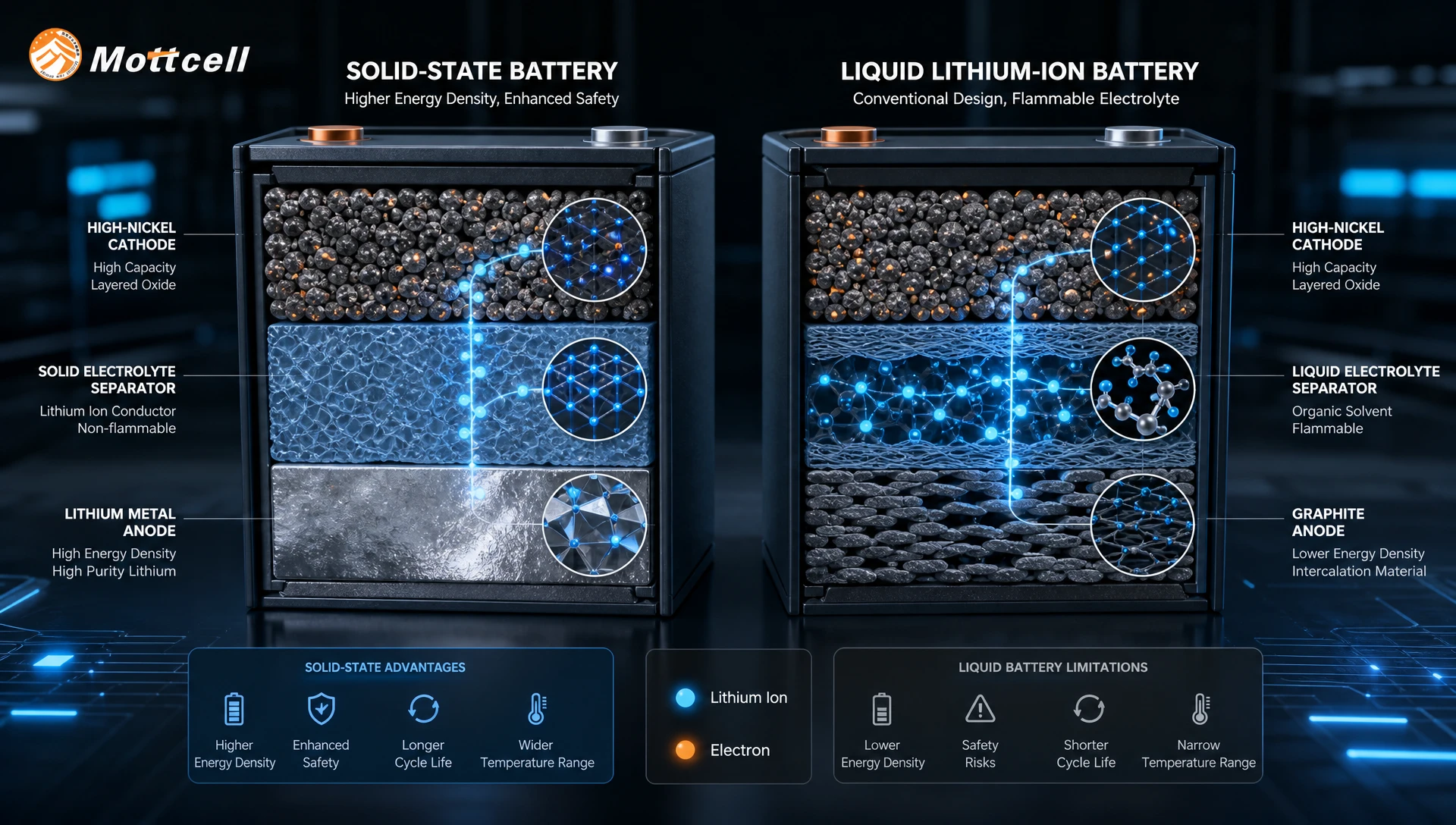
If all-solid-state batteries achieve commercial scale, the safety advantages of cylindrical cells and cycle-life advantages of prismatic LFP may shift. Pouch cells — currently limited by safety concerns — could gain ground due to their high gravimetric energy density.
However, this is a post-2030 scenario. For today's procurement decisions, the answer remains clear.
Cylindrical | Prismatic | Pouch | |
Best for | High performance, high safety EV | Storage, mass-market EV | Consumer electronics, light EVs |
Safety rating | ⭐⭐⭐⭐⭐ | ⭐⭐⭐⭐ | ⭐⭐ |
Cycle life | 1,000-2,000 (ternary) | 6,000-10,000 (LFP) | 1,500-2,500 (ternary) |
Volumetric energy density | 650-700 Wh/L | 500-600 Wh/L | 550-650 Wh/L |
Gravimetric energy density | 240-280 Wh/kg | 180-220 Wh/kg | 200-260 Wh/kg |
Cell cost | Lowest | Medium | Highest |
Pack integration cost | High (many cells) | Low (fewer cells) | Medium |
20-year LCOS (storage) | Highest | Lowest | Highest |
Recommendation: Prismatic LFP (314Ah+)
· Longest cycle life (6,000-10,000 cycles)
· Lowest 20-year total cost of ownership
· Proven safety at scale
· Modular design for easy container integration
Plain English: "No other format gives you the safety and longevity you need for a 20-year infrastructure investment. Don't compromise."
Recommendation: Cylindrical 4680
· Highest volumetric energy density
· Best physical safety containment
· Excellent fast-charging capability
Plain English: "If performance and safety are your priorities — and you're willing to accept higher pack complexity — large cylindrical is the answer."
Recommendation: Pouch
· Extremely thin (<3mm possible)
· Lightest weight
· Flexible form factor
Plain English: "For smartphones, tablets, and drones, pouch is the only practical choice. Just accept the safety trade-offs — they're manageable at small scale."
For energy storage: Prismatic LFP is the undisputed winner.
For premium EVs: Large cylindrical cells are the rising star.
For consumer electronics: Pouch remains the only practical choice.
What about the "cheaper upfront" option? Cylindrical ternary may cost 15% less today — but over a 20-year storage system life, it costs you 4-5x more in replacements. Cheaper upfront is more expensive over time.
Data sources: Shanghai Metals Market (SMM), Gaogong Industry Research Institute (GGII), CATL, BYD, Tesla, and publicly available industry data.
If you're still unsure which format fits your project, I'm happy to discuss your specific requirements. A 15-minute conversation can save you months of costly mistakes. Reach out anytime.
Rechargeable Battery Manufacturer: Custom AAA OEM Cells
The Lead-to-Lithium Transition: A Strategic Deep Dive
Cylindrical, Prismatic, or Pouch: Which Battery Format Keeps Your Project Safe — and Profitable?
Comparing Rechargeable Battery Types | Industrial Guide
Alkaline vs Rechargeable Battery | Industrial Choice Guide
Lithium Polymer vs Lithium Ion: The Professional Industrial Guide | Mottcell
LiFePO4 vs Lead Acid: The Ultimate Guide for Industrial Applications
Lithium Ion Battery Manufacturer: Custom High-Capacity Cells for OEM Projects | Mottcell
Established in 2005
In 2009, it was awarded the title of "National High tech Enterprise"
 zoe@mottcell.net
WhatsApp: 8617388790296
Fax: 86-0755-84042963
Skype: live:b0ebaecbb8782516
WeChat: +8613428749632

 VR show
 CN
CN Home >


