

 Aug 17, 2026


In March 2026, Nandu Power—a publicly listed company with nearly three decades of lead-acid battery manufacturing heritage—made a move that stunned its peers: it divested its lead recycling subsidiary for RMB 1.415 billion, used RMB 1.15 billion to repay outstanding loans, and recorded a total cash recovery of RMB 2.565 billion. The official announcement was unambiguous: "To fully complete the strategic transition from lead-acid to lithium-ion batteries."
In plain terms: We are exiting lead-acid and going all-in on lithium-ion.
This is far from an isolated case. An even more aggressive player is Xiongtao Co., Ltd. Founded in 1994 as a lead-acid battery manufacturer, the company had already quietly initiated lithium-ion R&D as early as 2003. By 2025, its data center UPS power supply business accounted for 75% of total profits. In April 2026, Xiongtao went a step further—it terminated its hydrogen fuel cell industrial park and communication base station energy storage investment projects, reorienting its entire strategic focus toward the AIDC (AI Data Center) sector.
One company sold its legacy crown jewel; another amputated its emerging businesses. Both actions telegraph the same unmistakable signal: the lead-to-lithium transition—or "lead-to-lithium conversion" in industry parlance—is no longer a question of "whether," but rather "how soon, before it's too late."
Let's cut straight to the data.
Energy density:
· Lead-acid: 30–50 Wh/kg
· LFP (lithium iron phosphate): 150–200 Wh/kg
What does this mean in practice? To cover 100 kilometers, a lead-acid battery requires a 30-kilogram "heavy backpack," whereas lithium-ion needs only 10 kilograms.
Cycle life:
· Lead-acid: 300–500 cycles
· LFP: 2,000–8,000 cycles
In other words, lead-acid batteries need replacement every two years, while lithium-ion can last five to eight years.
The disparity becomes even more pronounced during high-rate discharge. A 100Ah lead-acid battery has a maximum continuous discharge current of just 1C (100 amperes), whereas an LFP battery of the same capacity can deliver up to 10C (1,000 amperes). To put it in perspective: one is a garden hose; the other is a fire hose. Under normal loads, both perform adequately—but when a sudden surge current is required, lead-acid simply runs out of steam.
At the system level, there is another fundamental architectural difference: the BMS (Battery Management System). Lead-acid batteries are inherently robust and do not require a sophisticated BMS—their electrochemical properties incorporate a built-in negative feedback mechanism that automatically suppresses current as voltage rises during the final charging stages, thereby preventing overcharge. Lithium-ion, on the other hand, is unrideable without a BMS. The BMS must monitor the voltage, temperature, and current of every single cell in real time, precisely control charge/discharge processes, perform cell balancing, and prevent any individual cell anomaly that could lead to thermal runaway. The charging cutoff voltage for LFP cells must be controlled to 3.65 V ± 0.05 V—any deviation risks capacity degradation in the best case, and fire or explosion in the worst. This is why lead-acid can be treated as "charge-as-you-like," whereas lithium-ion demands "constant care."
From a total cost of ownership (TCO) perspective, lead-acid has a lower upfront cost but a shorter lifespan and lower efficiency. In data center UPS applications, the TCO of lithium-ion is 30%–40% lower than that of lead-acid—and the savings generated over its lifetime are sufficient to purchase multiple rounds of GPUs.
Not exactly. Lead-acid still holds two key moats: affordability and safety. At the same capacity, lead-acid is roughly 40% cheaper than lithium-ion. Moreover, lead-acid batteries rarely catch fire—under overcharge or short-circuit conditions, they may leak electrolyte or swell, but they will not experience thermal runaway.
However, these moats are steadily being eroded.
While lithium iron phosphate prices did experience a surge from H2 2025 to H1 2026—rising from RMB 35,771/ton to RMB 58,178/ton for power applications (+63%), and from RMB 29,000/ton to RMB 57,016/ton for energy storage applications (+97%)—the long-term trend remains firmly downward. On the safety front, the tipping point is already behind us: by 2025, lithium-ion's penetration in data center UPS systems is expected to surpass lead-acid for the first time, reaching 58.3%. If lithium-ion were truly "too dangerous," data center operators—who are notoriously risk-averse—would not be adopting it at this scale.
Let's examine lead-acid first.
For the full year 2025, China's cumulative exports of lead-acid batteries reached 219 million units, representing a year-on-year decline of 12.79%. In December 2025 alone, monthly exports plunged 33.86% year-on-year. The sharpest declines were recorded in India, Singapore, and the United States—down 11.04 million, 7.21 million, and 4.03 million units respectively, with the U.S. drop amounting to a staggering 48.59%.
Now, let's turn to lithium-ion.
In 2025, China's lithium battery exports reached RMB 570.86 billion, a year-on-year increase of 24.4%. From January to May 2025, lithium-ion exports accounted for 92.9% of the total battery export value. From January to September 2025, cumulative battery product exports reached approximately USD 59.677 billion, up 24.1% year-on-year.
When placed side by side, the contrast is stark:
Metric | Lead-Acid | Lithium-Ion |
2025 Export Growth | ↓12.79% | ↑24.4% |
Share of Total Battery Exports | ≈3.3% | ≈92.9% |
Industry Sentiment | Anxious | Expanding aggressively |
This is not a zero-sum game—it is a *dominant takeover. *
North American backup battery market: In 2023, lead-acid held 78%–82% market share, with lithium-ion at just 18%–22%. By 2024, lithium-ion penetration surged to 38%. By 2025, it is expected to exceed 50%. That's more than doubling in just two years.
Global data center UPS systems: By 2025, lithium-ion penetration is projected to reach 58.3%—surpassing lead-acid for the first time—and is forecast to climb to 79.2% by 2028.
Global AIDC backup power supply market: Projected to reach RMB 51.27 billion by 2028, with lithium-based backup power accounting for nearly RMB 40 billion, or 78% of the total.
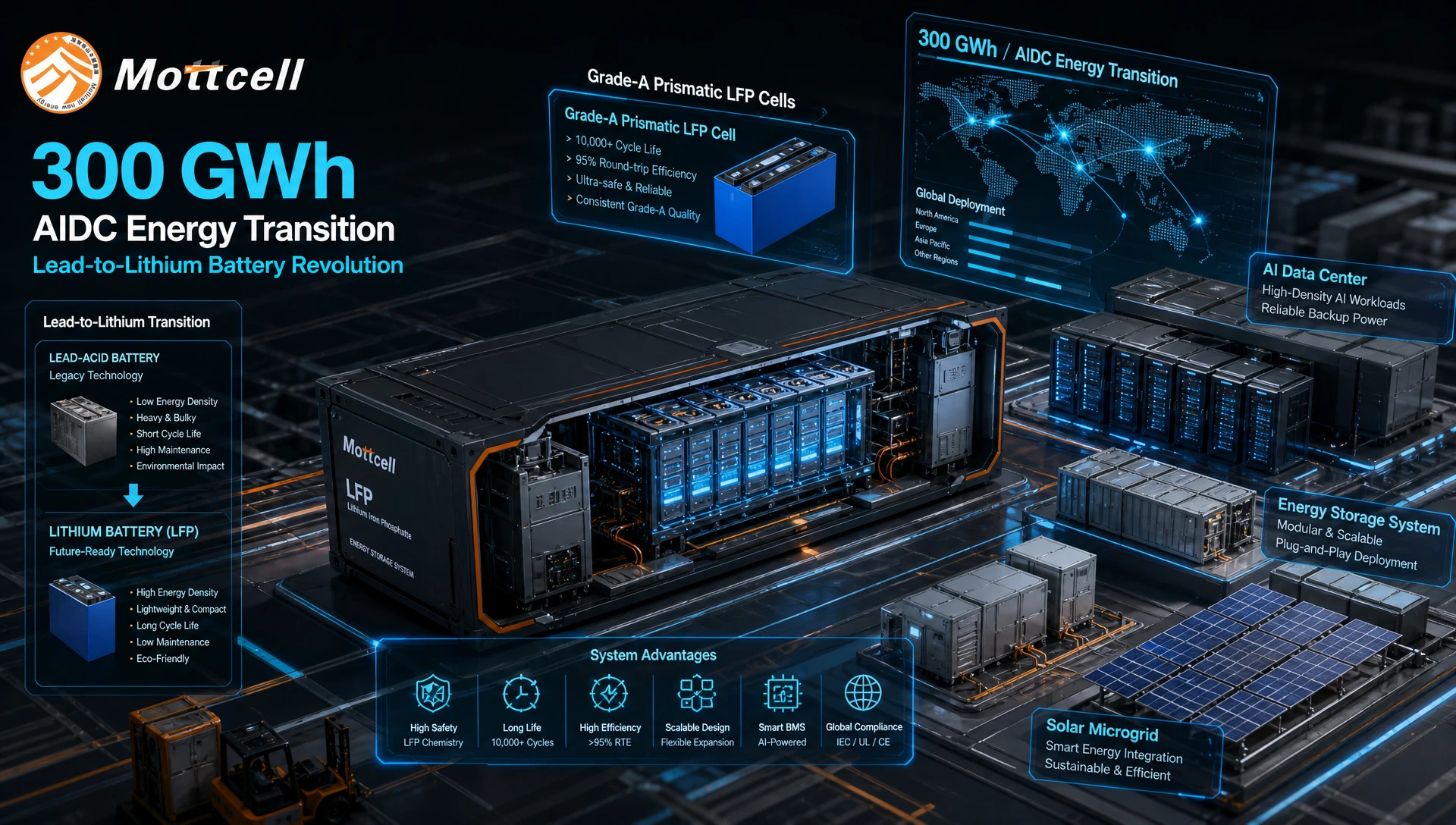
AIDC lithium-ion energy storage shipments: 15 GWh in 2025, projected to hit 69 GWh by 2027, and exceed 300 GWh by 2030—a 20-fold increase over five years.
Crossing the 50% penetration threshold is a landmark moment. It signals that the lead-to-lithium transition has evolved from a niche experiment into *mainstream industry consensus. *
Category 1: Traditional Lead-Acid Manufacturers—The Most Anxious Incumbents
Xiongtao Co., Ltd.: Founded in 1994 as a lead-acid manufacturer; began lithium-ion production in 2003. In 2025, its data center UPS power business contributed 75% of total profits. April 2026: all-in on AIDC. The CEO's remark was poignant: "Better to self-disrupt than to be disrupted."
Nandu Power: March 2026: divested its lead recycling business for RMB 1.415 billion, recovering RMB 2.565 billion, and completed its full transition to lithium operations.
Category 2: Lithium-Ion Giants—The Most Composed Cross-Sector Entrants
CATL, BYD, Sungrow Power Supply, and Huawei are all expanding their presence in AIDC energy storage. However, their core battlegrounds remain power batteries and utility-scale storage; AIDC is just one of many niche segments. Unlike Xiongtao and Nandu, these giants are not "betting the farm" on this single vertical.
Category 3: Energy Storage System Integrators—The Most Aggressive Market Grabbers
Established international players such as Victron, Schneider Electric, and Eaton collectively hold 60% of the global UPS market. Chinese companies, including Haichen Energy Storage, are also entering the arena with innovative approaches such as "sodium-lithium synergy."
Data Center UPS: Global market size expected to reach approximately US$38.24 billion in 2025, growing 14.7% year-on-year, and projected to exceed US$67.21 billion by 2030.
AIDC backup power supply: Expected to reach RMB 51.27 billion by 2028, with a CAGR of 42.3% during 2025–2028.
Global data center energy storage: Approximately US$1.4 billion in 2025, projected to reach US$2.4 billion by 2032.
Automotive low-voltage lithium batteries: EVTank forecasts the global market will reach RMB 38.07 billion by 2030.
Global data center battery market: US$3.6 billion in 2025, projected to grow to US$6.1 billion by 2033.
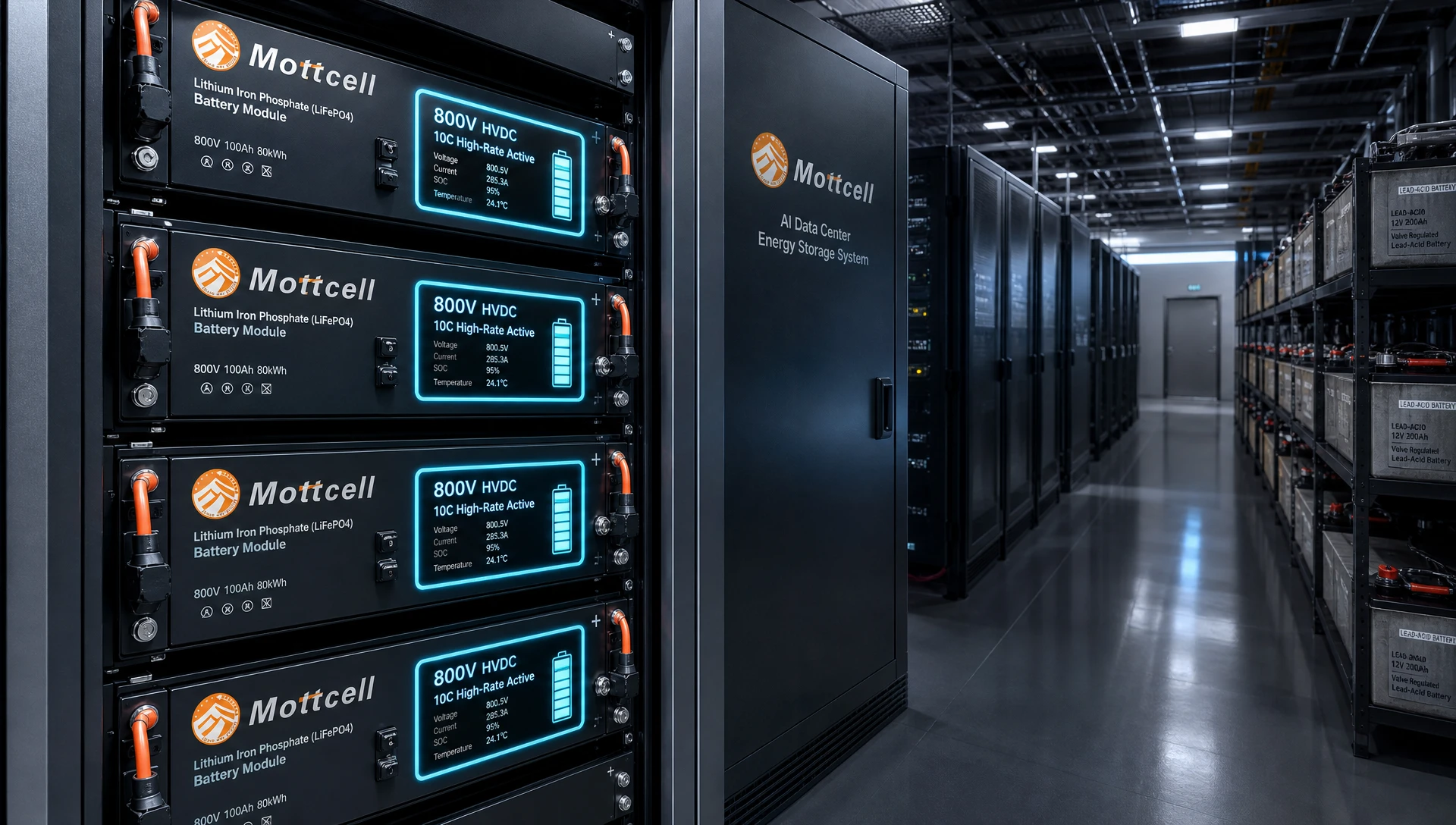
First, the explosive growth of AI computing power. AI data center cabinet power consumption has surged from tens of kilowatts to 150 kW or even higher. The physical limits of lead-acid batteries—capped at sub-1C discharge—make them physically incapable of meeting AI-driven power demands. This is not a cost issue; it is a matter of physics.
Second, the evolution of power supply architecture. Data center power is transitioning from 400V to 800V HVDC, further amplifying lithium-ion's advantages in high-voltage architectures.
Third, intensifying policy tailwinds. The EU has issued a directive requiring that all new vehicles after 2030 shall no longer use lead-acid batteries. The EU Battery Regulation mandates that lithium-ion battery recycling efficiency reach 65% by 2025 and 70% by 2030.
As noted earlier, lithium-ion penetration in North America's backup power market jumped from 20% to over 50% in just two years. The single variable driving this change is the concentrated build-out of hyperscale data centers.
GGII forecasts that the AIDC lithium-ion storage market will grow from 15 GWh in 2025 to 300 GWh by 2030, with a CAGR exceeding 60%. In plain terms: this market is expected to expand 20-fold over the next five years.
Examples include sub-10 kWh residential energy storage systems, off-grid RV backup storage systems prevalent in Europe and North America, and batteries for electric forklifts, golf carts, and similar applications.
Currently, only a handful of companies—such as LG and Samsung—are truly active in this lithium backup battery segment. The combination of high market concentration and a significant supply gap represents a golden window of opportunity for Chinese enterprises.
By 2025, the mass-production cost of sodium-ion batteries has already dropped to RMB 0.48/Wh. Technical specifications indicate that 6C high-rate sodium-ion batteries can replace 12V/200Ah lead-acid systems, reducing battery capacity by 70%, decreasing volume and weight by over 50%, and lowering cooling energy consumption by more than 50%.
Haichen Energy Storage has launched a synergistic solution combining lithium backup power with high-rate sodium-ion batteries. The introduction of sodium-ion technology may accelerate the retirement timeline of lead-acid batteries even further.
Europe's Battery Passport and Carbon Border Adjustment Mechanism (CBAM) have not only raised compliance thresholds but have also effectively barred non-compliant competitors from the market.
This is the most unavoidable hurdle in the lead-to-lithium transition.
Lead-acid batteries rarely catch fire, whereas a thermal runaway event in lithium-ion batteries could potentially escalate into a catastrophic failure. What data center customers fear most is not cost, but fire or system downtime. In environments demanding 99.9999% availability, any fire risk is simply unacceptable.
Lithium-ion UPS systems must obtain certifications such as UL and CE, with certification cycles ranging from 6 to 12 months. This is not about "selling batteries"—it's about "selling trust."
As noted earlier, LFP prices surged from RMB 35,000/ton in Q3 2025 to RMB 58,000/ton in Q2 2026 for power applications (+63%), and from RMB 29,000/ton to RMB 57,000/ton for energy storage applications (+97%).
While costs are expected to decline in the long term, short-term price volatility has indeed impacted the economic calculus of the lead-to-lithium transition.
The recycling rate for lead-acid batteries exceeds 95%, and the reuse rate of lead from spent lead-acid batteries in the United States surpasses 98.5%. Spent lead-acid batteries command a positive resale value, creating strong recycling incentives.
What about lithium battery recycling? While the upfront selling price is high, the recycling value is so low that it is often negligible—sometimes requiring the owner to pay for disposal themselves. Moreover, the recovery of metals such as lithium and cobalt involves significant technical challenges. While recovery rates have improved dramatically, with nickel-cobalt-manganese exceeding 99% and lithium recovery now exceeding 90% in advanced facilities, the economics still lag behind lead-acid. The EU's target of 65% recycling efficiency by 2025 and 70% by 2030—while ambitious—will be challenging to achieve at scale.
The Gulf Cooperation Council (GCC) issued its final anti-dumping ruling on Chinese-made lead-acid batteries in December 2025.
U.S. tariffs continue to rise.
The EU's CBAM imposes new requirements on the embedded carbon emissions of imported equipment.
The average price of data center energy storage systems exported from China to North America decreased by 8.2% year-on-year.
The good news: lithium batteries are China's home turf—80% of global production capacity is located in China.
The bad news: competitors will do everything in their power to keep you out.
Understanding the strategic necessity of transitioning from lead-acid to lithium is the first step; executing the correct electrical sizing for your facility is the next. Whether replacing legacy 48V DC telecom backup banks, deploying decentralized edge-node microgrids, or installing centralized high-voltage storage to eliminate utility demand charges, selecting the appropriate voltage topology (SELV low voltage vs. 800V high voltage) and capacity rating (5kWh to 100kWh) is critical for system reliability.
To evaluate real-world load calculations, inverter efficiency derating, and step-by-step capacity sizing for your factory floor, review our comprehensive engineering guide:
👉 Commercial HESS Sizing Guide for Factory Microgrids
As I write this, I am reminded of the analogy drawn by He Tianlong, CEO of Xiongtao Co., Ltd.—the "Kodak Dilemma."
Kodak invented the digital camera but, reluctant to abandon its film business, was ultimately swept away by the digital age. Today's lead-acid battery manufacturers face the exact same choice:
Do you self-disrupt—or wait to be disrupted?
Looking at the data, the answer is already crystal clear:
Lead-acid exports declined (↓12.79%), while lithium battery exports rose (↑24.4%).
Lead-acid's share of North America's backup power market plummeted from 80% to under 50%—all in just two years.
Lithium-ion has for the first time surpassed lead-acid in data center UPS systems (58.3% vs. 41.7%).
AIDC energy storage capacity is projected to expand 20-fold over five years (15 GWh → 300 GWh).
Lead-acid battery manufacturers are already selling their legacy assets, curtailing non-core businesses, and committing fully to lithium.
This is not a trend; this is a fact.
The lead-to-lithium transition is no longer a question of "whether to convert"—it has become a survival imperative: adapt or be eliminated. For professionals in the battery industry, these are the best of times—characterized by triple dividends: technological breakthroughs, market expansion, and policy support. Yet they are also the most challenging times—marked by four concurrent headwinds: safety concerns, cost pressures, trade barriers, and technological uncertainty.
But one thing is certain: the era of reliably making money on lead-acid batteries is over.
As for what comes after lithium? Sodium-ion, solid-state, hydrogen fuel cells... those are the next frontiers. For now, let's focus on winning the lead-to-lithium battle first.
Data sources: General Administration of Customs of China, Shanghai Metals Market (SMM), Gaogong Industry Research Institute (GGII), IIM Information, CICC Research Reports, etc.
Rechargeable Battery Manufacturer: Custom AAA OEM Cells
The Lead-to-Lithium Transition: A Strategic Deep Dive
Cylindrical, Prismatic, or Pouch: Which Battery Format Keeps Your Project Safe — and Profitable?
Comparing Rechargeable Battery Types | Industrial Guide
Alkaline vs Rechargeable Battery | Industrial Choice Guide
Lithium Polymer vs Lithium Ion: The Professional Industrial Guide | Mottcell
LiFePO4 vs Lead Acid: The Ultimate Guide for Industrial Applications
Lithium Ion Battery Manufacturer: Custom High-Capacity Cells for OEM Projects | Mottcell
Established in 2005
In 2009, it was awarded the title of "National High tech Enterprise"
 zoe@mottcell.net
WhatsApp: 8617388790296
Fax: 86-0755-84042963
Skype: live:b0ebaecbb8782516
WeChat: +8613428749632

 VR show
 CN
CN Home >


