

 Dec 18, 2025


Choosing an 18500 lithium-ion battery manufacturer starts with the device, not the largest capacity printed on a wrapper. An OEM buyer needs a cell that fits the enclosure, supports the real operating load and matches the charging system. The supplier must also identify the exact model being sampled and the documents that apply to it. A shared size name does not establish those points.
This guide is for device manufacturers, purchasing teams and distributors comparing compact cylindrical cells. It uses Mottcell's published INR18500 catalogue entries as a starting point, then explains what to confirm before a sample or production order. Catalogue figures are not a substitute for the current model datasheet, approved mechanical drawing or application test results. The purchasing examples below are planning examples, not completed customer projects.
Ask for an exact cell specification tied to your application. The initial response should connect a model designation, chemistry, electrical limits, mechanical drawing and sample configuration. A quotation that says only “18500 rechargeable battery” leaves too much undefined. Different suppliers, capacity variants and finished assemblies can use similar size descriptions without being interchangeable.
Start your request with the device's operating voltage, average and peak demand, available battery space, charging arrangement and expected use environment. State whether you need a bare cell, a tabbed cell, an individually protected assembly or a multi-cell pack. That distinction changes the dimensions and responsibilities the supplier must review. It also prevents a cell-only price from being compared with a finished battery assembly.
Identify the commercial contact and the party responsible for technical approval. For company background, Mottcell's company profile provides the brand context. For a purchase, request confirmation of the contracting entity, production location and model-specific documentation. A company introduction is useful background; it does not establish the suitability of an individual cell for your device.
Treat the size designation as a format reference, then use the approved drawing to check fit. The installed envelope must account for manufacturing tolerances, the terminal style, insulation, tabs and any protection components. A nominal size written in a product name is not a complete enclosure specification.
For example, Mottcell's published INR18500 entries list a diameter of 18.2 ± 0.3mm and a height of 49.9 ± 0.3mm. Those are catalogue dimensions for the listed cell format. They should not be transferred automatically to a protected version, a cell with attached leads or a packaged battery. Obtain the drawing for the exact supplied item and let the device designer establish the required clearance.
Review the terminal contact area and how the cell is retained in the device. A sample that fits loosely on a workbench may behave differently in the finished housing with contacts, insulation and assembly tolerances present. Record the proposed orientation and assembly method. Have the responsible engineering team approve the complete mechanical arrangement before freezing the purchasing specification.
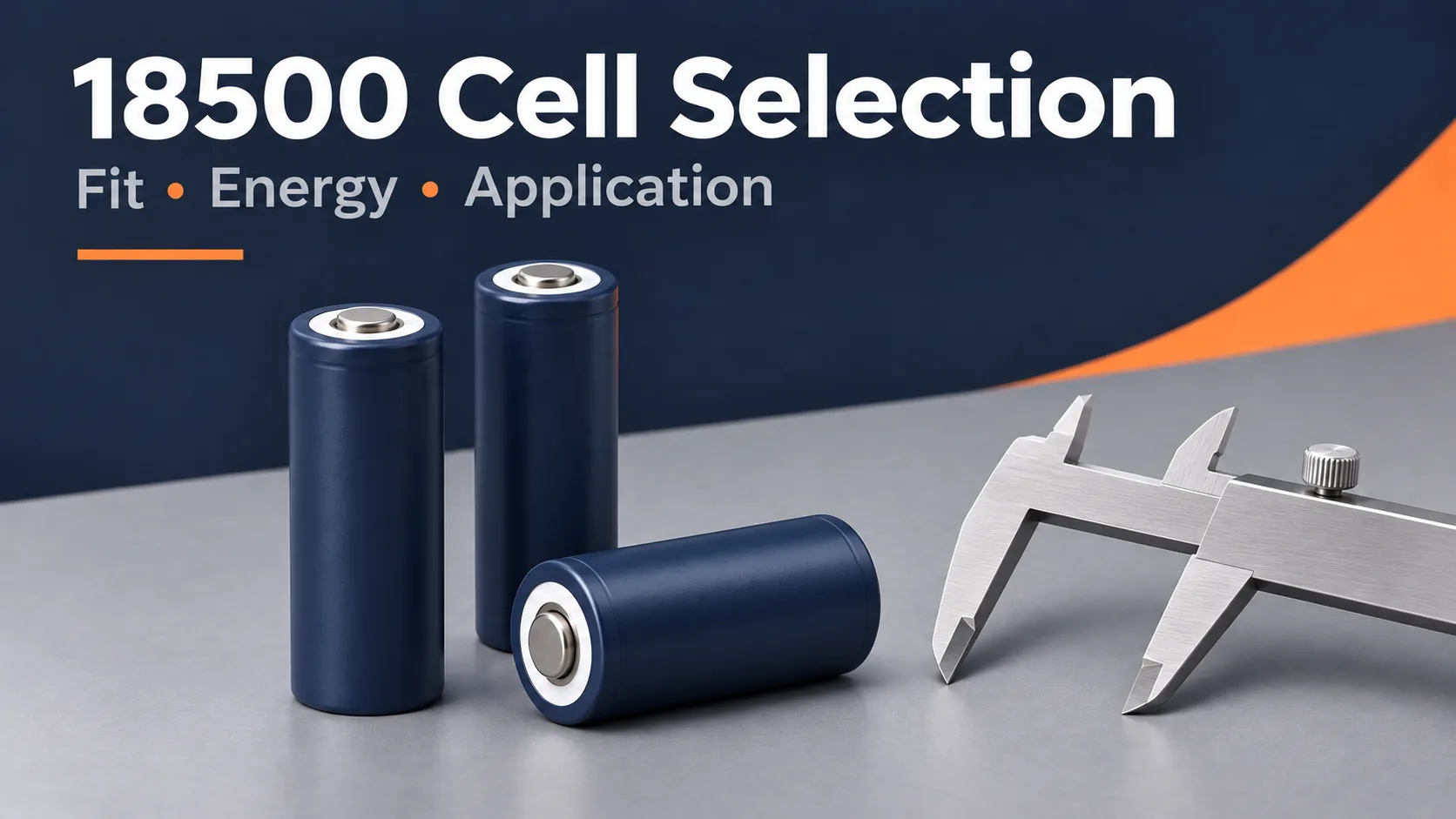
Mottcell's official product tables list three INR18500 capacity options. The table below reproduces their nominal voltage and capacity, with nominal energy calculated separately. The shared model family name makes it especially important to identify the capacity variant and document revision in the quotation.
| Published family | Nominal voltage | Capacity | Calculated nominal energy |
|---|---|---|---|
| INR18500 | 3.7V | 1,600mAh | 5.92Wh |
| INR18500 | 3.7V | 2,000mAh | 7.40Wh |
| INR18500 | 3.7V | 2,400mAh | 8.88Wh |
Source: Mottcell's official product tables checked on November 5, 2026. Energy calculation: nominal voltage × capacity in Ah. These are catalogue options, not a statement of present stock, sample availability or measured device runtime. Confirm the current offered variant before purchasing. Do not infer discharge current, cycle life, approvals or delivery commitments from this comparison.
The largest listed capacity is not automatically the best choice for every application. Compare the complete discharge and charging specifications, the usable voltage window and the performance required by your load. If a proposed substitution changes the capacity variant, repeat the relevant engineering review. A similar wrapper or family name is insufficient evidence that the previously approved configuration remains unchanged.
A cylindrical format does not determine its chemistry or charging requirements. Confirm the nominal voltage, charge termination requirements and permitted discharge limits for the offered model. Do not replace one chemistry with another solely because the cells appear to fit the same compartment. The charger and device operating range must be reviewed together.
This distinction matters when a sourcing list mixes conventional lithium-ion entries with LiFePO4 entries. The published Mottcell tables contain different 18500 families. A buyer should specify which family the device is designed to use, rather than treating every 18500-labelled item as an equivalent replacement. If the project is changing chemistry, make that an explicit redesign decision with its own approval process.
Ask the device designer to check the charging circuit, any protection functions and the device's shutdown behavior against the selected cell documentation. Obtain the supplier's proposed charging conditions in writing. Do not use a generic description such as “lithium charger” as evidence of compatibility. Where an existing charger must remain, provide its actual specifications before accepting a cell recommendation.
Capacity is only one part of a cell-selection decision. Describe how the device draws energy over time, including startup, sustained operation, intermittent high demand and standby. The supplier can then review the offered model against the relevant operating conditions. A single average-current number can conceal short events that determine whether a design works reliably.
For a handheld electronic device, for example, separate the normal operating mode from a brief activation event and a long standby period. Record the duration and repetition of each mode, along with the device's permitted voltage range. Give those requirements to the responsible engineering team. The point is to obtain a recommendation for the actual duty cycle, not to choose a rating in isolation.
Request the applicable discharge curves and test conditions for the proposed capacity variant. Check the temperature, discharge rate, starting charge state and cutoff used in the evidence. If the supplier provides data from a different cell or a different condition, identify the gap before approving the comparison. A larger nominal capacity does not by itself prove better performance under your device's peak load.
Also distinguish a cell's capability from the limits introduced by the rest of the product. Contacts, wiring, protection components and the device enclosure can affect the result of a complete assembly review. If a sample stops operating during a demanding mode, ask the engineering team to identify the cause before requesting a higher-capacity cell. Increasing milliamp-hours may not address the condition that caused the interruption.
Use nominal watt-hours to begin an energy budget, then test the complete device. Capacity in milliamp-hours must first be converted to amp-hours. For the listed 3.7V, 2,000mAh option, the calculation is 3.7 × 2.0 = 7.40Wh. That is nominal cell energy, not a promise that the device will receive all of it.
As an illustrative planning calculation, assume that 80% of nominal energy is available over the chosen operating window and that conversion to the device load is 85% efficient. At an average load of 0.60W, the estimate is 7.40 × 0.80 × 0.85 ÷ 0.60 = about 8.39 hours. The availability and efficiency figures are assumptions for this example, not measured Mottcell performance.
A useful runtime test replaces those assumptions with the behavior of the approved cell, device and operating cycle. Include the intended shutdown threshold, auxiliary consumption, environmental conditions and relevant end-of-service expectations in the test plan. Compare candidates using the same conditions. Keep the calculated estimate, the supplier's cell test and the finished-device result as three separate records.
Compare formats only when the product design permits a change in the mechanical envelope. A format substitution can affect the enclosure, contacts, retention and assembly process. It can also require a new charging or protection review. A purchasing spreadsheet that compares only capacity and price misses those engineering costs.
If the design can accommodate a different cylindrical format, the existing 18650 OEM cell guide provides a separate sourcing discussion. Use it to organize the alternative review, not to infer that an 18650 can replace an 18500 in an unchanged housing. Confirm the final assembly drawing for whichever route is selected.
If the application instead calls for a different chemistry or a larger custom assembly, define that requirement before asking for an alternative. The 22650 LiFePO4 sourcing guide addresses another format and chemistry. Keeping these reviews distinct helps a buyer compare real design choices without turning every catalogue option into an assumed substitute.
A sample programme should answer the unresolved fit, load and documentation questions before a production order. Agree on the exact supplied configuration, the checks to perform and who signs off the result. “Sample received” is a logistics milestone. It does not establish that the device, charger and battery combination has been approved.
Begin with identity and mechanical checks, then assess the electrical and device-level requirements through a competent testing process. Compare the received marking and configuration with the quotation and drawing. Record the sample batch, document revisions and any deviations. Where tabs, leads or protection are included, evaluate the supplied assembly rather than testing an unrelated bare cell and assuming equivalent behavior.
| Review area | Evidence to request | Decision to record |
|---|---|---|
| Cell identity | Exact variant, sample batch and datasheet revision | Which item has actually been assessed? |
| Mechanical fit | Supplied-item drawing and device assembly check | Is the complete configuration accepted? |
| Load and runtime | Agreed duty cycle, conditions and test records | Does the device meet its operating requirement? |
| Charging and protection | Model-specific limits and system review | Is the proposed combination supported? |
| Documents and supply | Applicable reports, traceability and agreed change process | What remains open before production? |
Do not leave a failed check as an informal email conversation. Ask for a revised specification or documented corrective action, then repeat the affected assessment. Retain both the original finding and the accepted resolution. This creates a usable approval record for purchasing and production, rather than relying on a successful demonstration with unknown conditions.
Make the handover between engineering and purchasing explicit. Record the approved item description, the evidence reviewed and any limitations that remain. If the initial sample is hand-built or differs from the intended production assembly, document that difference and decide what must be checked again. Purchasing should be able to identify the approved configuration without reconstructing a long chain of messages.
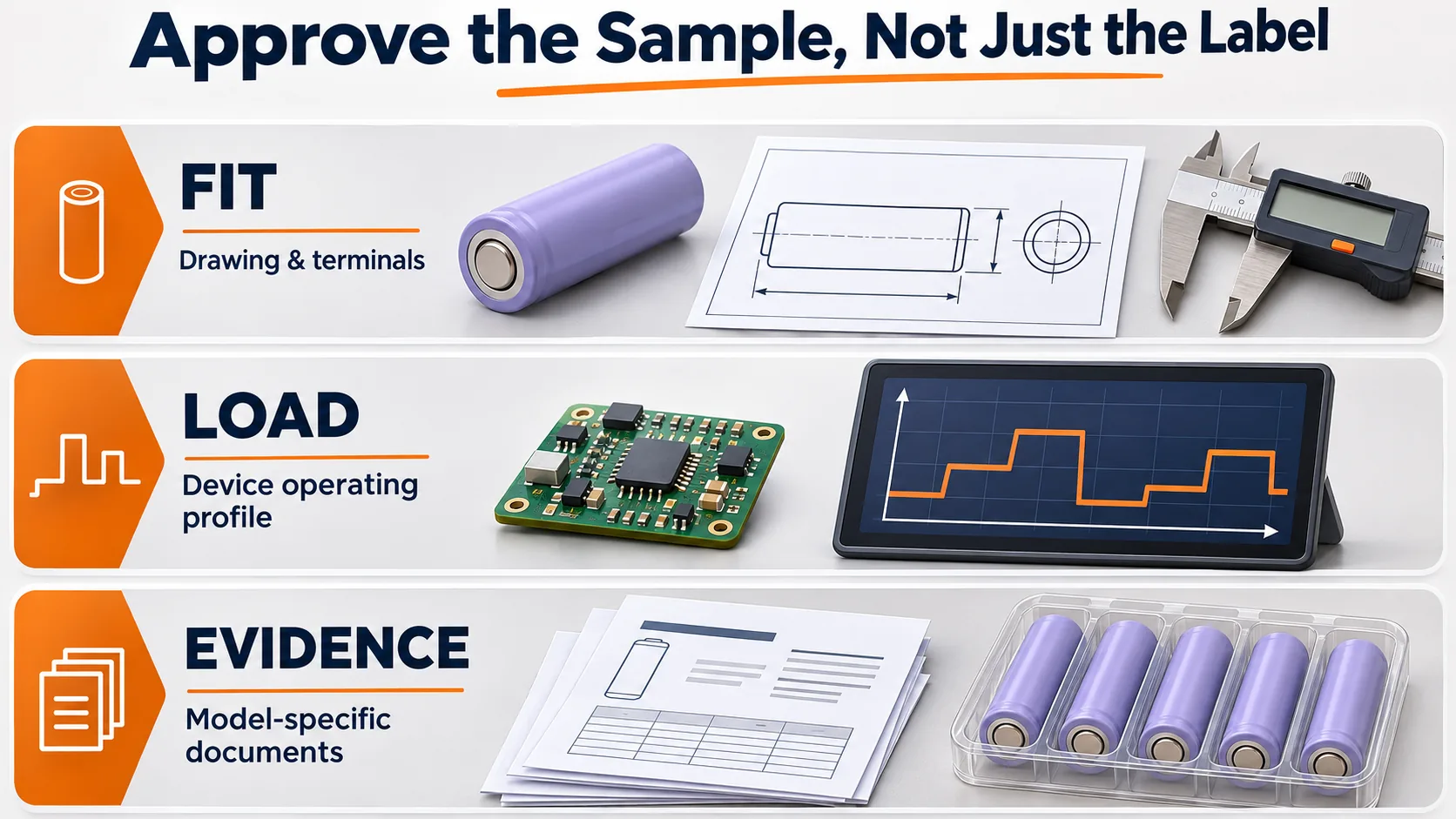
Match each document to the exact offered product and the purpose of the review. A company certificate, a cell datasheet, a transport test summary and an end-device assessment answer different questions. An unrelated report cannot fill a model-specific evidence gap. Ask the supplier to identify the scope and current applicability of each document it provides.
For transport documentation, the PHMSA test-summary guide explains the identifying information used in a lithium battery test summary. Use that as a document-review reference: check the manufacturer and cell identity, report references and relevant result information. The guide is not a Mottcell report and does not prove that a particular offered cell has passed a test.
Ask the supplier and the responsible logistics provider which documents apply to the planned shipment and supplied configuration. A test summary does not replace a review of packaging, route or finished-product requirements. Keep any unresolved scope item visible in the order process. Do not advertise a model as certified, transport-approved or suitable for a regulated end use without the corresponding evidence.
A comparable offer states the same cell configuration, quantity, documentation and delivery scope. Separate the base cell from additional work such as tabs, leads, protection, labelling or packaging. Identify which services are included and which need separate confirmation. This makes price comparisons meaningful without assuming every supplier has quoted the same deliverable.
For repeat orders, agree how the supplier identifies production batches and communicates changes to the approved item. A capacity variant, material, assembly or document change may require the buyer to repeat part of the approval process. State who reviews a proposed change and what evidence is needed before substitution. A matching product name alone should not close that review.
Send a concise enquiry with the device use, operating profile, target envelope, charging arrangement, required supplied form and expected order quantities. Attach the relevant drawings through the agreed business channel. Mottcell can then be asked to identify a suitable offered variant and the evidence available for it. Keep any unconfirmed customization, availability and lead time explicitly open until the quotation resolves it.
Consider a buyer comparing two quotations for the same compact device. One offer identifies a bare cell and a capacity variant. The other includes attached tabs, additional insulation and a proposed protection arrangement. Comparing their unit prices directly would hide a difference in scope. First ask both suppliers to state exactly what will arrive and which assembly requirements they have reviewed.
Next compare the acceptance evidence. An offer with an attractive headline capacity may not yet include a drawing for the supplied assembly or test data under the intended operating conditions. Another offer may provide useful documentation but still leave an important charging question unanswered. Put each unresolved item beside the relevant proposal and ask for a specific response. Do not convert a general assurance into a completed engineering check.
Close the comparison by issuing one agreed specification for the selected configuration. Reference the approved drawing and datasheet revisions, the sample assessment and any production-order conditions. Keep commercial matters such as packaging, quantity, delivery scope and change notification connected to that specification. This makes a repeat order easier to control and gives both parties a clear basis for reviewing a later proposed substitution.
The same approach is useful when a distributor passes the enquiry between a device brand and a cell supplier. Preserve the original application requirements and return technical questions to the responsible designer. Avoid simplifying an unresolved requirement into a generic “18500 equivalent” request. Clear model identity and an agreed acceptance process are more useful than a catalogue comparison that omits the device boundary.
No. Confirm chemistry, electrical limits, terminal construction and the complete supplied dimensions. A shared format label does not establish charger compatibility or device approval. Review the exact model and assembly before making a substitution.
Not necessarily. Nominal capacity must be considered with the load profile, usable voltage window and operating conditions. Compare the offered variants through the same device-level test before treating the largest capacity as the preferred choice.
Provide the device operating profile, available space, charging arrangement, required supplied configuration, destination market and order quantities. Ask for the exact recommended variant, current documents and a sample plan tied to the intended application.
Shortlist the cell using documented fit and operating requirements, then approve the actual sample before ordering production quantities. Mottcell's published options provide a useful starting point for that discussion. Send the project brief to the Mottcell enquiry team and request a model-specific proposal, including the current datasheet, supplied-item drawing and the evidence needed to close the remaining review items.
Top 18500 Lithium-Ion Battery Manufacturer (Guide)
15kWh HESS for Solar Systems: AC vs DC Coupling Guide
12V LiFePO4 Battery Capacity Guide: Ah, Wh and Runtime
12V 300Ah Battery Pack: Series vs Parallel OEM Guide
12V 50Ah LiFePO4 Battery Pack: Size, Runtime & OEM Guide
22650 LiFePO4 Battery Manufacturer: OEM Buying Guide
36V Battery Pack for E-Bikes and AGVs: OEM Buying Guide
12V 100Ah Battery Pack: Compare 3 Models for OEM Buyers
Established in 2005
In 2009, it was awarded the title of "National High tech Enterprise"
 zoe@mottcell.net
WhatsApp: 8617388790296
Fax: 86-0755-84042963
Skype: live:b0ebaecbb8782516
WeChat: +8613428749632

 VR show

 CN
 Home >


