

 Feb 10, 2026


In the rapidly evolving landscape of portable power, the 18650 battery has cemented its position as the industry standard for high-performance applications. From powering the latest medical devices and electric vehicles to high-drain industrial tools and energy storage systems, these cells offer a perfect harmony of energy density, safety, and reliability.
For factory procurement managers, engineers, and product designers, understanding the nuances of 18650 batteries: sizes & uses is essential. Choosing the right cell dictates not only the performance of your product but also its long-term safety and brand reputation. As a premier global manufacturer, Mottcell provides this comprehensive guide to help industrial clients navigate the complexities of 18650 technology.
| Feature | Mottcell Industrial Grade | Consumer / Generic Grade |
| Cell Quality | Grade A (Matched Consistency) | Random / Grade B |
| Cycle Life | 500 - 2000+ Cycles (LFP/NCM) | 150 - 300 Cycles |
| Internal Resistance | Ultra-low & Uniform (< 15mΩ) | High & Variable |
| Safety Features | CID, PTC, & Advanced BMS | Basic or No Protection |
| Compliance | UN38.3, MSDS, IEC62133 | Minimal or None |
The term "18650" is not just a random number; it refers to the standardized physical dimensions of the cell. Understanding the 18650 battery size is the first step in ensuring mechanical compatibility for any OEM project.
The naming convention breaks down as follows:
18: Indicates a diameter of 18mm.
65: Indicates a length of 65mm.
0: Indicates a cylindrical form factor.
However, in professional applications, the 18650 battery size dimensions can vary slightly. For instance, "protected" cells—which include a micro-PCB for safety—may be 1-3mm longer. When designing battery compartments, engineers must account for these tolerances to ensure a secure fit for the specific 18650 li-ion battery chosen.
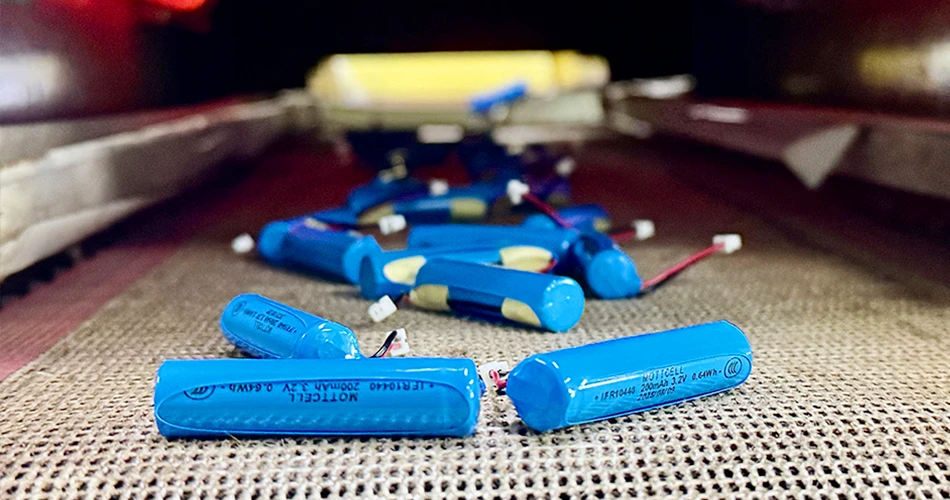
The versatility of lithium ion batteries 18650 comes from the variety of chemical compositions available within the same form factor. Each chemistry offers unique advantages depending on the end-use environment.
One of the most popular choices for high-performance tools is the lithium ion manganese oxide battery. Known as IMR, this chemistry allows the battery to discharge at high currents while maintaining low internal temperatures. This makes it the safer choice for high-drain applications where thermal stability is paramount.
While often used in primary (non-rechargeable) cells, lithium manganese dioxide variants are valued for their long shelf life and stability. For rechargeable systems, the integration of manganese significantly improves the safety profile compared to traditional cobalt-only cells.
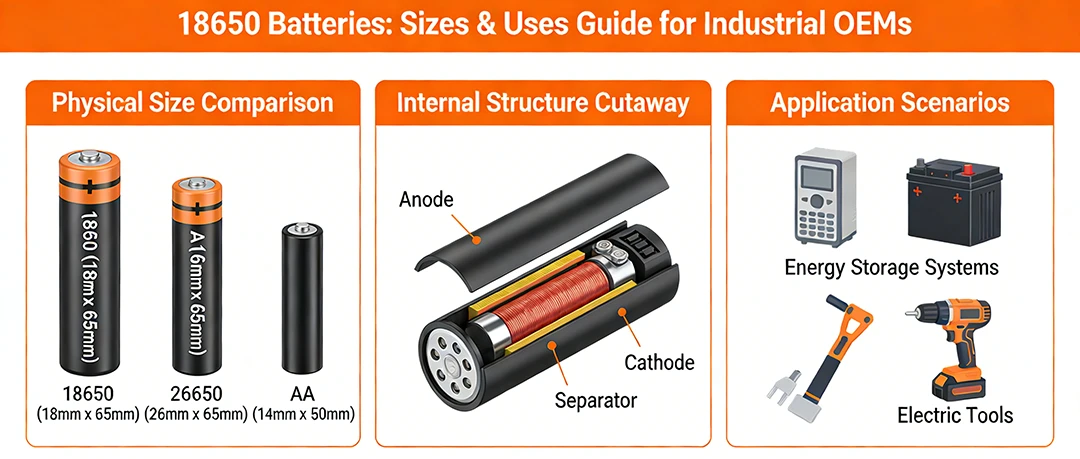
The shift from disposable to sustainable power has made rechargeable lithium ion 18650 batteries the dominant choice in global manufacturing.
A high-quality li ion rechargeable battery 18650 can endure between 300 to 1,000+ full charge-discharge cycles. For industrial equipment, this longevity translates to a significantly lower Total Cost of Ownership (TCO).
At Mottcell, our 18650 li-ion battery production lines utilize Grade-A materials to ensure that every cell maintains its capacity over time. Whether you are building an e-bike pack or a medical ventilator backup, our rechargeable lithium ion 18650 batteries provide the unwavering reliability your customers expect.
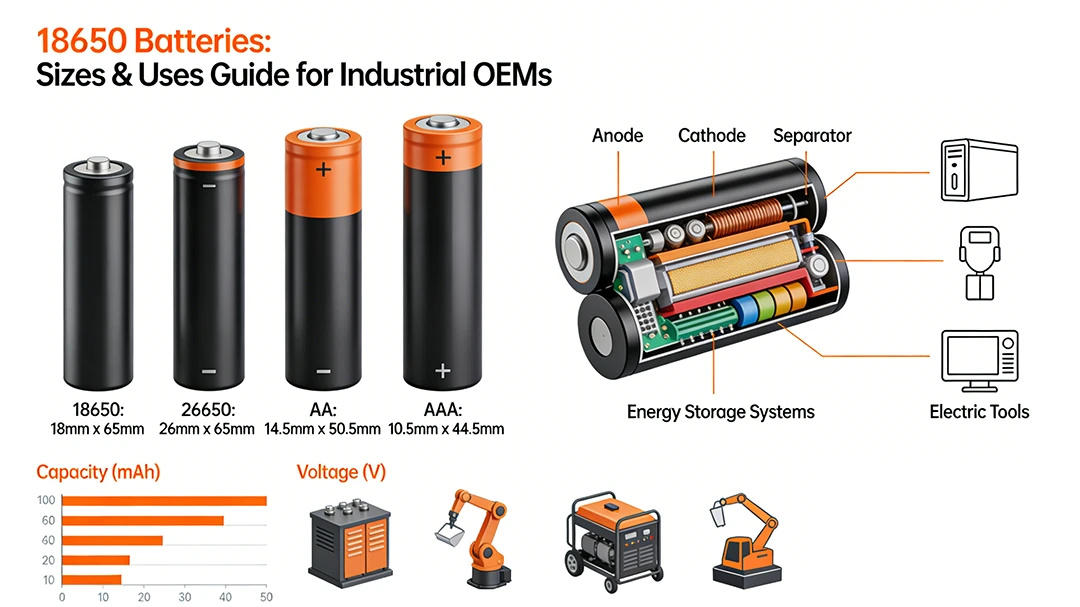
In some legacy industrial designs, procurement teams often ask: what are c batteries? and how do they compare to the 18650?
Traditional types of c batteries are typically alkaline (non-rechargeable) or NiMH (rechargeable). They are significantly wider than an 18650 but shorter.
Dimensions: A "C" battery is approximately 26.2mm in diameter and 50mm long.
Voltage: Standard C batteries provide 1.2V to 1.5V, whereas a lithium ion 18650 provides a much higher nominal 3.6V/3.7V.
Because of this voltage and energy density gap, most modern factories are redesigning their devices to move away from legacy types of c batteries in favor of the more powerful and compact 18650 li-ion battery.
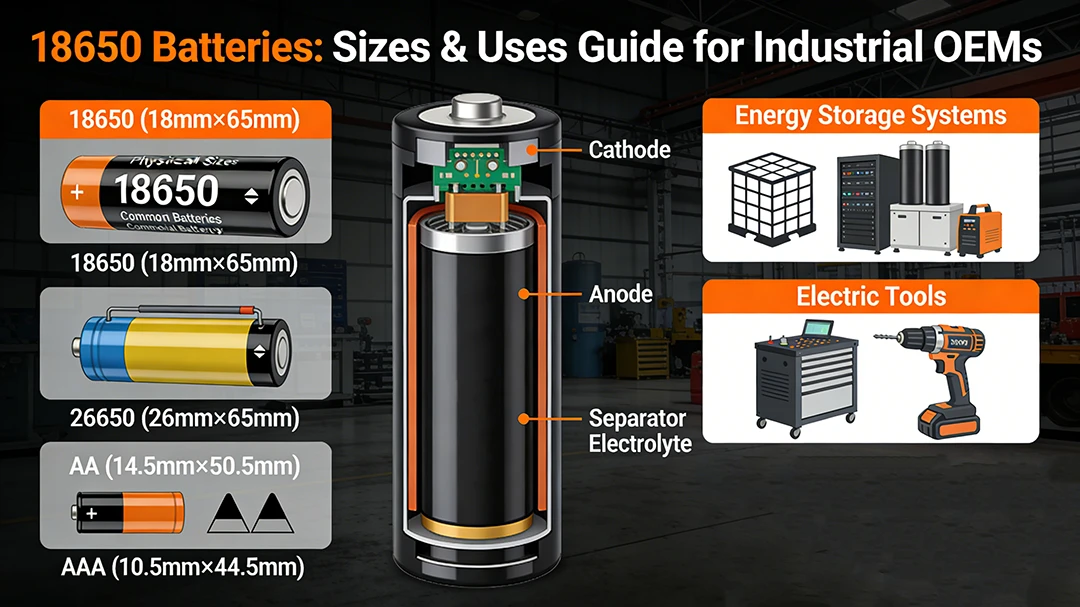
Selecting a cell isn't just about the 18650 battery size; it's about matching the capacity and discharge rate to your machine's requirements.
High-Capacity Cells: Often ranging from 3000mAh to 3500mAh, these are ideal for low-drain, long-duration uses like sensors or laptop packs.
High-Discharge Cells: These may have lower total capacity (e.g., 2500mAh) but can handle continuous current bursts of 20A or 30A without overheating.
As a specialized manufacturer, Mottcell helps OEMs navigate these trade-offs to ensure the li ion rechargeable battery 18650 you select is optimized for your product's specific duty cycle.
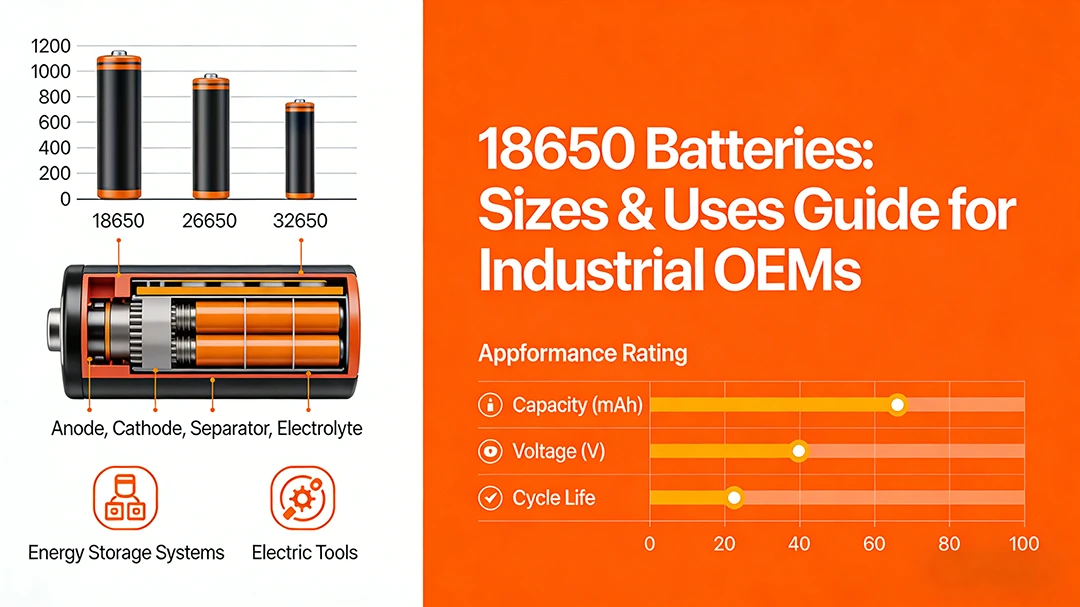
An 18650 li-ion battery is a standardized cylindrical rechargeable cell. It uses lithium-ion technology to provide high energy density. At Mottcell, we specialize in producing these cells with various chemical coatings (NMC, LFP, IMR) to suit industrial, medical, and consumer electronics applications.
The capacity of a rechargeable lithium ion 18650 battery typically ranges from 1200mAh to 3500mAh. Capacity represents the total amount of energy stored. For industrial projects, it is crucial to balance capacity with the "C-rating" (discharge rate) to ensure the battery doesn't fail under heavy load.
Capacity is measured in Milliampere-hours (mAh). In a laboratory setting, we calculate this by discharging the cell at a constant current (usually 0.2C) from a full charge (4.2V) to a cutoff voltage (2.5V). Mottcell provides precise discharge curves for all our lithium ion batteries 18650 to help engineers calculate exact runtimes.
While a phone charger provides 5V, you cannot connect an 18650 directly to it. You must use a dedicated 18650 charging circuit or a battery pack with an integrated BMS (Battery Management System). Mottcell offers custom packs with integrated USB-C charging modules for modern industrial convenience.
Not necessarily. In the world of lithium ion batteries 18650, there is often a trade-off. Cells with the highest capacity (3500mAh) usually have lower discharge rates. If your device requires high power bursts (like a power tool), a 2500mAh high-discharge cell is actually a "better" and safer choice than a 3500mAh low-drain cell.
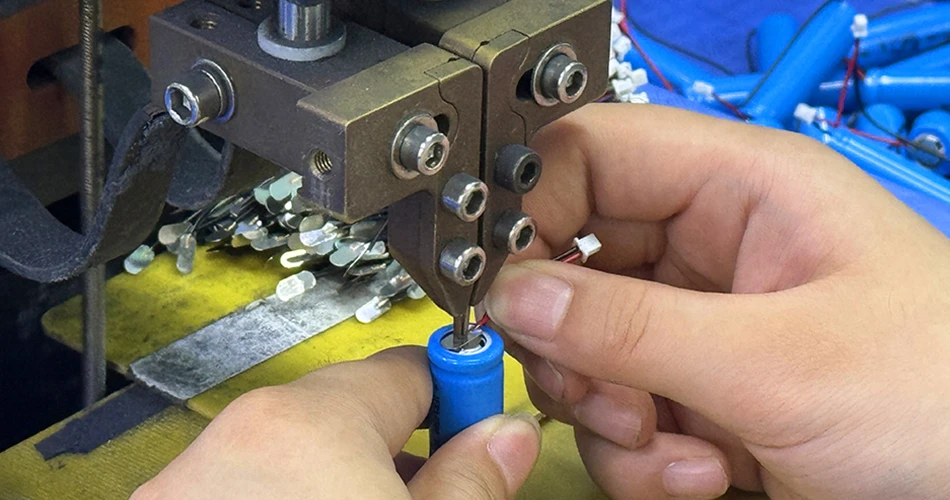
The 18650 battery remains the most strategic power choice for the next decade of industrial innovation. By understanding 18650 batteries: sizes & uses, and choosing the right chemistry—whether it's a lithium ion manganese oxide battery or a standard NMC cell—you ensure your product's success.
Mottcell is more than just a supplier; we are your technical partner in energy. From individual rechargeable lithium ion 18650 batteries to complex custom packs, we deliver the quality and safety certifications your factory requires.
Related News
High-Capacity Lithium Ion Batteries: Reliable Power for Industrial Innovation
Lithium Ion Battery Solutions: High-Capacity Cells for Professional Projects
Leading 18650 LiFePO4 Battery Factory for Global Energy Solutions
Leading 18650 Rechargeable Battery Manufacturer for OEM Projects
Efficient 3.2V 14430 Rechargeable Battery Factory Insights
14650 Rechargeable Battery Factory: Power & Innovation
32650 Rechargeable Battery Supplier for OEM and Industrial Use
Rechargeable Battery Manufacturer: Custom AAA OEM Cells
The Lead-to-Lithium Transition: A Strategic Deep Dive
Cylindrical, Prismatic, or Pouch: Which Battery Format Keeps Your Project Safe — and Profitable?
Comparing Rechargeable Battery Types | Industrial Guide
Alkaline vs Rechargeable Battery | Industrial Choice Guide
Lithium Polymer vs Lithium Ion: The Professional Industrial Guide | Mottcell
LiFePO4 vs Lead Acid: The Ultimate Guide for Industrial Applications
Lithium Ion Battery Manufacturer: Custom High-Capacity Cells for OEM Projects | Mottcell
Established in 2005
In 2009, it was awarded the title of "National High tech Enterprise"
 zoe@mottcell.net
WhatsApp: 8617388790296
Fax: 86-0755-84042963
Skype: live:b0ebaecbb8782516
WeChat: +8613428749632

 VR show
 CN
CN Home >


